What is crypto staking — and how does it compare to earning interest?
Apr 09•8 min read
There are two main ways your crypto can earn while you hold it
Most people know you can buy crypto and wait. Fewer know your crypto can work while you wait.
Two of the most common ways to earn on your holdings are crypto staking and earning interest. They look similar at first — both generate returns on crypto you already own — but they work very differently. Understanding the difference helps you make a more informed choice about what to do with your assets.
This guide focuses on staking: what it is, how it works, what the risks are, and how it compares to earning interest through a platform like Nexo.
What is crypto staking?
Staking is the process of locking up your crypto to help run a blockchain network — and receiving rewards in return.
To understand why this exists, it helps to know a little about how blockchains work.
Older blockchains like Bitcoin rely on proof of work to validate transactions. In this system, miners compete to solve complex computational puzzles. It requires significant hardware and energy.
Newer blockchains — including Ethereum (since its 2022 upgrade), Solana, Cardano, and others — use proof of stake instead. In this system, validators don't mine. Instead, they lock up, or stake, a certain amount of the network's own cryptocurrency as collateral. By doing so, they signal that they have a financial interest in the network working correctly. In return for validating transactions honestly and keeping the network running, they earn staking rewards.
Think of it like a security deposit. You commit your crypto, the network trusts you as a validator because you have something to lose if you misbehave, and you get paid for your participation.
How do staking rewards work?
When you stake, the rewards you earn come from the blockchain itself — typically paid out in the same cryptocurrency you staked.
How much you earn depends on several factors:
- The network's reward rate — each blockchain sets its own annual staking yield, which fluctuates based on how many validators are active and how much crypto is staked in total
- How much you stake — rewards are proportional to your stake
- Lock-up periods — some networks pay higher rates if you commit to longer lock-up windows
Staking returns are usually expressed as an APY (Annual Percentage Yield). Typical ranges vary widely — from under 2% on some networks to over 15% on others — though rates change frequently, and the higher the yield, the more risk is usually involved.
Three types of staking: direct, pooled, and liquid
You don't always need to run your own validator node to stake. There are three main ways to participate.
Direct (solo) staking
You validate transactions yourself. This requires significant technical knowledge and, in Ethereum's case, a minimum of 32 ETH. It's the most decentralized form of staking but the least accessible for most people.
Pooled staking
Multiple holders combine their crypto to meet the minimum staking requirement or increase their share of rewards. The pool's validator does the technical work; you share in the rewards proportionally. Staking pools on centralized exchanges and DeFi protocols both work this way.
Liquid staking
When you stake through a liquid staking protocol (like Lido for Ethereum), you receive a tokenized receipt — for example, stETH — representing your staked position. This token can be used elsewhere in DeFi while your underlying crypto is still earning staking rewards. You keep liquidity, but you take on the added risk of the liquid staking protocol itself.
The risks of staking that most guides skip over
Staking rewards exist because staking involves real commitments and real risks. Here are the ones worth understanding before you start.
Lock-up periods. Many networks require you to lock your crypto for days, weeks, or longer. During this time, if the market drops sharply, you can't sell or move your assets. Unstaking often involves a waiting period — Ethereum's unbonding period, for example, can take several days depending on network conditions.
Slashing. Validators who behave incorrectly — whether due to malicious intent or technical failure — can have a portion of their staked crypto destroyed. This is called slashing. In pooled or liquid staking, you share exposure to this risk even if you're not running the validator yourself.
Smart contract risk. Liquid staking and pooled staking through DeFi protocols rely on smart contracts. If a contract has a bug or is exploited, stakers can lose funds. This is separate from the blockchain itself failing.
Reward rate volatility. Staking APYs are not fixed. They move based on the number of active validators and network demand. A 10% APY today can become 4% six months from now.
Tax treatment. In many jurisdictions, staking rewards are considered taxable income at the time they're received — not just when you sell. The rules vary by country, so consulting a qualified tax adviser before staking significant amounts is a sensible step. For the full picture, see our plain-language guide to crypto taxes.
Staking vs. earning interest: how they compare
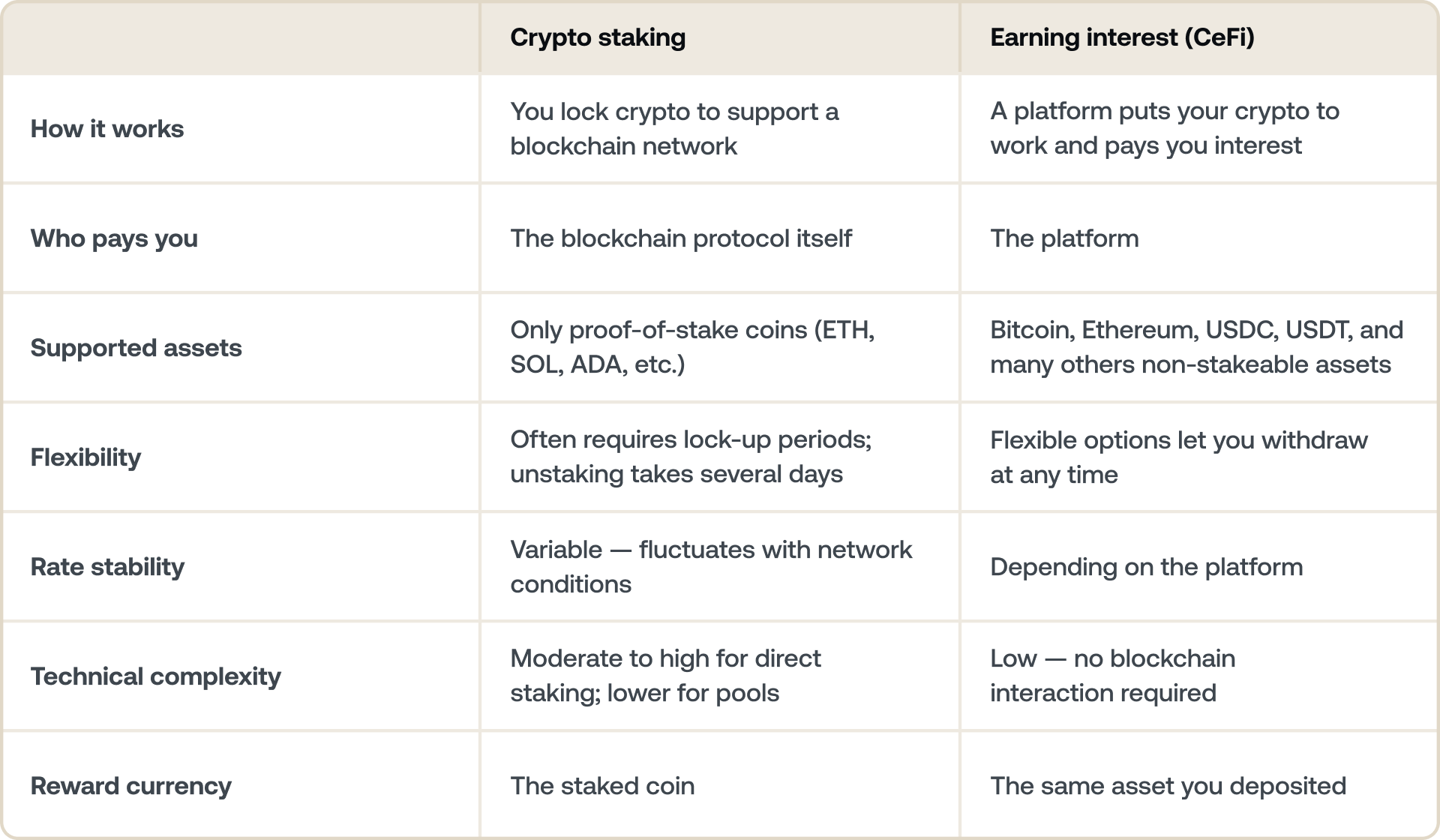
Neither approach is universally better. The right one depends on which assets you hold, how much access you want to your funds, and your appetite for the specific risks each carries.
When staking tends to make sense: You hold proof-of-stake coins like ETH or SOL for the long term, you're comfortable with lock-up periods, and you want exposure to the network's yield mechanism directly.
When earning interest tends to make sense: You want to earn on assets like Bitcoin or stablecoins that can't be staked, you value flexibility, or you want a simpler setup without managing validator exposure or smart contract risk.
Many holders do both — staking a portion of their ETH or SOL, and earning interest on stablecoins or Bitcoin separately. If you want to go deeper on the yield side, the APR vs. APY explainer is a useful next read.
How Nexo's earn products fit in
Nexo's earning products operate on a different model from staking. Rather than locking crypto into a validator network, you deposit your assets with Nexo and earn interest, paid daily, into your account.
- Flexible Savings — your crypto earns interest daily, and you can withdraw at any time. It works for over 40 assets, including Bitcoin, Ethereum, USDC, USDT, and others that cannot be staked at all.
- Fixed-term Savings — you lock your assets for a set period in exchange for a higher rate. It suits holders with a longer-term outlook who want stronger returns. See Fixed-term Savings at a locked-in rate.
Both are straightforward to set up. There's no validator to run, no smart contract to interact with, and no waiting period to unstake.
For current rates across assets, explore Nexo's Savings products.
The bottom line
Staking and earning interest both let your crypto work while you hold it — but they operate on entirely different mechanics, carry different risks, and suit different assets. Staking is native to proof-of-stake blockchains and pays protocol-level rewards; earning interest through a platform like Nexo applies to a broader range of assets with more predictable terms and no validator complexity.
Neither approach is right for everyone. The best starting point is understanding both clearly — which is exactly what this guide set out to do.
Frequently asked questions
1. What is crypto staking?
Staking is the process of locking up cryptocurrency to help validate transactions on a proof-of-stake blockchain. In return, stakers receive rewards — typically paid in the same coin they staked. It's one of the two main ways to earn on crypto you already hold.
2. How does staking crypto work?
You commit a certain amount of a compatible cryptocurrency (like ETH, SOL, or ADA) to a blockchain network. This signals that you have a financial stake in the network behaving correctly. Validators who run the technical process receive rewards; in pooled and liquid staking, those rewards are shared with participants like you.
3. What is the difference between staking and earning interest on crypto?
Staking ties your crypto to a blockchain network and pays you protocol-level rewards. Earning interest means depositing your crypto with a platform that puts it to work and pays you a return. Staking only works with proof-of-stake coins; earning interest can apply to Bitcoin, stablecoins, and many other assets that cannot be staked.
4. Is staking crypto worth it?
It depends on what you hold, how long you plan to hold it, and whether you're comfortable with lock-up periods and variable reward rates. For long-term holders of ETH or SOL, staking can be a meaningful way to earn. For those who hold Bitcoin or stablecoins, or who want flexibility, earning interest is often the more practical option.
5. What does slashing mean in staking?
Slashing is when a validator loses a portion of their staked crypto as a penalty for behaving incorrectly — either through malicious action or technical failure. In pooled or liquid staking, participants share exposure to this risk even if they didn't cause it.
6. Can you stake Bitcoin?
No. Bitcoin uses proof of work, not proof of stake. There is no native staking mechanism for BTC. To earn on Bitcoin, the available options are through lending platforms or savings products that accept BTC deposits — such as Nexo's Flexible or Fixed-term Savings.
7. Are staking rewards taxable?
In most jurisdictions, yes. Staking rewards are typically treated as taxable income at the time they are received, not when they are sold. The rules vary significantly by country, so consulting a qualified tax adviser is recommended before staking significant amounts.
These materials are accessible globally, and the availability of this information does not constitute access to the services described, which services may not be available in certain jurisdictions. Rates are subject to change and may vary by region, loyalty tier, and other applicable factors. Always refer to the Nexo app for your applicable rates. These materials are for general information purposes only and not intended as financial, legal, tax, or investment advice, offer, solicitation, recommendation, or endorsement to use any of the Nexo Services and are not personalized, or in any way tailored to reflect particular investment objectives, financial situation or needs. Digital assets are subject to a high degree of risk, including but not limited to volatile market price dynamics, regulatory changes, and technological advancements. The past performance of digital assets is not a reliable indicator of future results. Digital assets are not money or legal tender, are not backed by the government or by a central bank, and most do not have any underlying assets, revenue stream, or other source of value. Independent judgment based on personal circumstances should be exercised, and consultation with a qualified professional is recommended before making any decision.