How a stock market sell-off reached crypto
In this patch of your weekly Dispatch:
- tocks drag down crypto
- Leverage unwinds
- Wall Street giant holds ETH
Market cast
BTC: Support in focus as bearish momentum eases
On the weekly chart, Bitcoin’s price sits below most of the major moving averages, and bearish momentum prevails. It bounced off the lower Bollinger Band, a volatility-based indicator, but it is still too early to call a reversal. The RSI, a momentum oscillator, is at very low levels, the Stochastic, another momentum oscillator, is in oversold territory, and the MACD, a trend and momentum indicator, has its histogram in negative territory.
On the daily chart, bearish momentum has faded marginally, as price bounced off the lower Bollinger Band and the Stochastic moved back above the 20 threshold. The MACD lines are also close to a bullish crossover. However, the RSI is still in oversold territory, so a move back above 30 would be the next sign to watch that bearish momentum is fading.
Key levels to watch: On the downside, immediate support sits in the $58,000 to $59,000 zone, with further support around $55,000 — the weekly lower Bollinger Band may also lend dynamic support. To the upside, resistance comes in around $64,000, followed by the $66,000 to $67,000 zone.
The big idea
How crypto felt Wall Street's bad week
Digital assets looked to be finding their footing early last week, until another headwind arrived midweek. Having absorbed a hotter-than-expected October CPI and the strongest dollar since April 2025, BTC closed above $64,000 every day through last Tuesday. The calendar offered a chance to confirm that footing: Nvidia's earnings, the Fed's minutes on Wednesday and Anthropic's debut on Thursday. Nvidia delivered first, beating expectations and guiding above analyst estimates. Its shares nonetheless fell 2.9% on Wednesday, an early sign that good news was no longer enough for the AI trade.
That afternoon, the Fed's minutes gave the caution a context. The committee had held rates at 3.75%–4.00% in October by a 10–2 vote, with Governor Lisa Cook and Cleveland Fed President Beth Hammack dissenting in favor of a hike. The minutes showed that almost all officials expected further increases to be appropriate, with a couple willing to consider more than 25 basis points in December. Governor Christopher Waller said the same day that he favored a half-point move, or a quarter-point paired with a clear signal of a January hike. The line that connected the Fed to the tech trade was a different one: many officials viewed the AI buildout as "a material source of inflation risk.”
Markets' initial reaction was mixed. The dollar firmed, gold fell 3.2% to a 14-month low and silver futures fell 4.9%, while the Dow lost 1.1% and the Nasdaq edged up 0.4%. A December quarter-point hike was already largely priced in by CME FedWatch. The minutes did not break the market on Wednesday. They changed what it was standing on.
The break came in equities. On Thursday, Anthropic's debut, the largest IPO on record, failed to revive appetite for AI stocks. Its shares closed 17% above the $83 offer price, then fell 8.5% the next day and at one point traded within cents of it. Thursday also saw the S&P 500 fall 2% and Bitcoin slip below $62,000. Ether fell to $1,640, its lowest level since July, and Solana slipped below $70, a level it had last closed under in June. The Wall Street Journal had reported on Tuesday that the SEC was probing Nvidia. Its stock fell 14%, the Nasdaq 5.3% and the S&P 500 closed in correction.
The equity sell-off then carried into crypto, where leverage amplified it. Bitcoin reached about $55,100 early Saturday as more than $2.5 billion in leveraged positions were liquidated within 24 hours, about 90% of them longs. Glassnode's November 17 report had shown leveraged longs clustered between $59,500 and $62,200, a band Bitcoin then fell through. US spot bitcoin ETFs had seen $1.79 billion in outflows over the week, the third-largest weekly outflow on record. From Sunday's close to Friday's, Bitcoin fell about 10%, almost exactly the Nasdaq's 10% decline, the index's worst week since March 2020. By Monday it had recovered above $61,000.
What turns a bounce into a recovery is specific. QCP Group names three conditions: steadier technology stocks, consistent ETF inflows and calmer options markets, with implied volatility back below 40. The first condition has begun to move, with Nasdaq-100 futures up about 1.6% in the first four hours of Monday trading. The second and third need time, and the calendar will shape both. October PCE inflation arrives Wednesday. US markets close Thursday and at 1 p.m. ET Friday, leaving liquidity thin into Friday's Deribit options expiry. The December 8–9 FOMC is the larger test, with a quarter-point hike widely expected and the open question being size.
Glassnode marks the $53,700 realized price as the next reference level, and a reclaim of the $74,100, the average price recent buyers paid, would signal a bottom is forming. Bitcoin's recovery above $61,000 from Saturday's low near $55,100 suggests the search for a floor is under way. Any floor would show up in measurable places: steadier equities, ETF inflows that persist, calmer options markets and a clearer rate path. Wednesday's PCE report and the December 8–9 FOMC are the next readings on the last of those.
TradFi trends
Gold fails the safe-haven test
Markets began this week with a sharp reversal. On Monday, Nvidia's board reinstated Jensen Huang as CEO and the shares jumped more than 30%, lifting the Nasdaq more than 6% at midday. A rebound from oversold levels does not erase the week before, which showed how widely the retreat had spread.
Crypto’s drop was one part of a much wider retreat. The Nasdaq had its worst week since March 2020, and the S&P 500 lost 8.6% and closed about 11.6% below its October 6 record. Gold, already about 36% below its January record, slid toward $3,540, and silver is down more than 60% from its January peak. Copper fell about 11% from its September record. Gold, a common shelter in equity sell-offs, gave back ground midweek.
Each market had its own story, from AI spending doubts to weak demand in China. The common thread was rates: a dollar at its strongest since April 2025 and a December hike largely priced in after the Fed's minutes. That is why the next test for Bitcoin sits in traditional markets as well, in the same rate outlook that has weighed on stocks, metals and Bitcoin alike.
Ethereum
Ethereum waits, Wall Street was already in
Ethereum's Glamsterdam upgrade has been postponed, with mainnet now possible between mid-January and May 2027, but Wall Street's exposure to Ether was built well before the delay. Goldman Sachs held $1.22 billion in Ether ETFs at the end of September, nearly six times its June level, spread across seven funds, including two that stake the underlying ETH. Wells Fargo more than doubled its stake in BlackRock's Ether ETF. The build came in a quarter when Ether rose nearly 71% and U.S. spot Ether ETFs drew more than $3 billion, their strongest quarter of 2026. Those are the latest filings and predate this month's sell-off, and U.S. spot Ether ETFs have since logged seven straight weeks of outflows through Nov. 13.
The week's most interesting data story
How Bitcoin's leverage built, then unwound
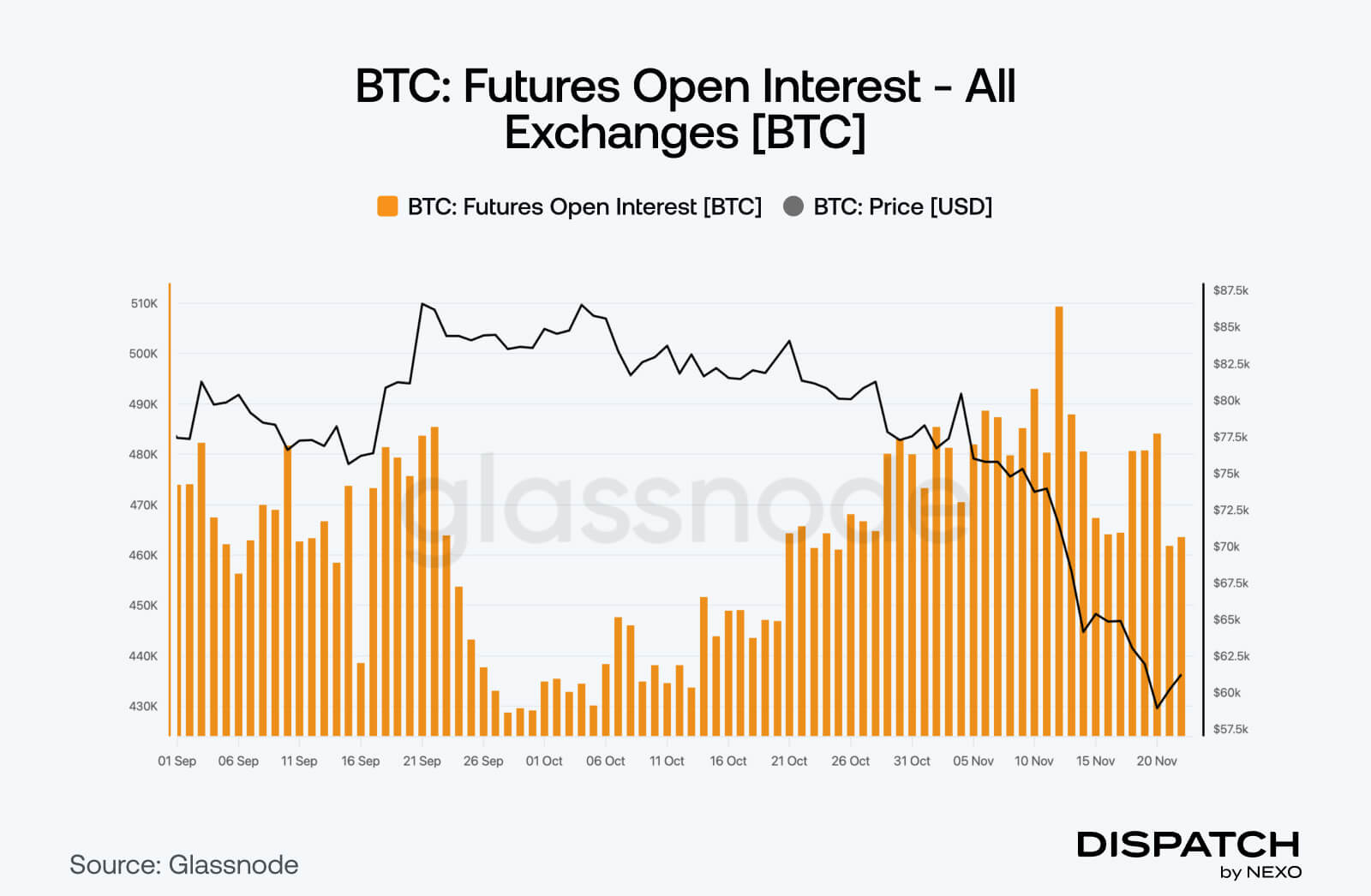
Beneath the price action, the week's most telling data came from the futures market. According to Glassnode, over the eight days to November 12, Bitcoin fell 11% while futures open interest rose 8%, to about 509,000 BTC, as traders kept adding exposure into the decline. Then the market reset. Glassnode counted some of the largest long liquidations since 2023 on November 13 and 14, and Friday's drop forced out more, with more than $2.5 billion of leveraged positions liquidated in 24 hours. Open interest is now about 9% below its peak, and most of the longs that sat above $62,000 are gone. Whether buyers replace it is the open question, and open interest is still about 8% above its September low.
The numbers
The week’s most interesting numbers
66,000 BTC – Added to the $62,000-$66,000 buyer cluster over two days of heavy selling, per Glassnode.
$4 billion – Value of tokenized stocks onchain, about five times its level on January 1, according to The Block.
7,819 ETH – Ether bought by Bitmine Immersion Technologies over the past week, bringing its holding to 6,085,564 ETH.
Hot topic
What the community is discussing
Was crypto a safer haven than metals?
Here is one BTC bull providing support.
Another 2026 high for the U.S. Dollar.
Dispatch is a weekly publication by Nexo, designed to help you navigate and take action in the evolving world of digital assets. To share your Dispatch suggestions and comments, email us at [email protected].
This content is for informational purposes only and does not constitute investment, legal, or tax advice. Crypto assets are highly volatile and their value can go up or down significantly, including to zero. Past performance and historical correlations are not indicative of future results. Nexo has a commercial interest in the adoption of digital assets.
The availability and use of any products or services made available through Nexo US LC (“Nexo US”) are subject to the applicable terms and conditions on the Nexo US platform. This message is for informational purposes only and does not constitute financial, investment, legal, or tax advice. Any decision you make based on this information is solely your responsibility. Nexo US provides the user interface and routes client instructions to third-party service providers. Investment advisory services for eligible digital asset strategies are provided by Gravitalix Financial, LLC (“Gravitalix”), an investment adviser registered with the U.S. Securities and Exchange Commission. Registration with the SEC does not imply a certain level of skill or training. Please review Gravitalix’s Form ADV and related disclosures carefully before investing. Digital assets are not money or legal tender, are not backed by any government or central bank, and are not insured or guaranteed by any governmental or private insurance scheme (including FDIC or SIPC). Any rates, yields, or rewards displayed in the Nexo US app or related materials are subject to change, may be reduced or discontinued at any time, are not guaranteed, and may not be available in all jurisdictions or for all clients. Past performance is not indicative of future results.
Digital Asset services are provided by Bakkt Financial Solutions I, LLC (NMLS ID 1890144) through a software licensing agreement between Bakkt Financial Solutions I, LLC (“Bakkt”) and Nexo US LLC. Bakkt is not a registered broker-dealer and is not a member of SIPC or FINRA. Digital assets are not FDIC- or SIPC- insured. Bakkt Financial Solutions I, LLC is licensed to engage in virtual currency business activity and money transmission by the New York State Department of Financial Services. Digital asset borrowing requires sufficient collateral. Failure to maintain collateral value due to market volatility may result in the liquidation of your assets. Please ensure that you fully understand the risks involved before trading. See here for Bakkt Licenses and Bakkt Disclosures. If you no longer wish to receive marketing communication from us, including product updates, industry news and exclusive promotions, click here.