Crypto’s 2026 catalyst search
In this patch of your weekly Dispatch:
- Crypto’s paths to recovery
- Bitcoin futures traders re-engage
- Wall Street goes onchain
Market cast
BTC: Bouncing from support, awaiting confirmation
On the weekly chart, price has held above the middle Bollinger Band, a volatility-based indicator, and is now hovering around the 50-period SMA. The RSI, a momentum oscillator, and the Stochastic, another momentum oscillator, are both neutral and offer no significant signals. The MACD, a trend and momentum indicator, has its histogram declining but still above the zero line.
On the daily chart, price has bounced off the lower Bollinger Band, though bearish momentum still dominates this timeframe. The Stochastic is currently below the 20 threshold, and a move back above it would be a potential bullish signal, or at least a sign of fading bearish momentum. The RSI is also at low levels, but not in oversold territory for now. The MACD histogram remains below the zero line.
Key levels to watch: on the downside, immediate support sits around $73,500, with the next level at the round $70,000 mark — the weekly middle Bollinger Band may also act as dynamic support. To the upside, resistance comes in around $76,000, followed by $79,000.
The big idea
What could set crypto on a path to recovery
What could turn things around: Recoveries tend to begin when selling pressure fades, and there are early signs of that. Long-term holders, the steadier hand in this market, are still net sellers, but their selling has eased in recent days. Recent buyers’ average entry price also sits only just above where Bitcoin trades, so even a modest recovery would bring many of them back toward breakeven and reduce the incentive to sell into strength.
Crypto ended the week lower as a strong jobs report and a tech sell-off weighed on digital assets. The data made a December rate hike look likelier, equities pulled digital assets down with them, and ETF flows turned negative. Bitcoin closed at $74,750, down 4.5% on the week, and Ether fell 6.5% to $2,125, while Solana and XRP also lost ground. Yet cycles cut both ways, and the more useful question at this stage is no longer why prices fell but what could set the market back on a path to recovery. We take both in turn.
Where the pressure came from: It started in equities. AI stocks sold off on Thursday on concerns that tighter policy could slow AI spending, and the Nasdaq slid into correction. Bitcoin fell about 5.5% that day, to roughly $76,000, and the rest of the market followed.
Friday’s jobs report added to the pressure. Employers created 165,000 jobs against about 59,000 expected, unemployment fell to 4.1% and earlier months were revised higher. That is a healthy signal for the economy and an awkward one for crypto assets, because it strengthens the case for another Fed rate hike. Bitcoin held near $75,800 through Friday and Saturday before the slide resumed on Sunday, closing at $74,756, its lowest close since August. U.S. spot Bitcoin ETFs lost $1.28 billion, their worst week since June, while Ether funds recorded a sixth straight week of outflows and Solana funds a fifth. Ether ended the week near $2,125 and Solana near $90. Flows tell us demand has stepped back for now; they do not tell us it has gone.
What is already priced in: October CPI, released on Tuesday, rose 0.4% on the month, above the 0.3% expected but slower than September’s 0.6%. Core prices rose 0.3%, a tenth above forecasts. Bitcoin slipped below $74,000 on the release, to about $73,600, before steadying. A move of roughly 1% on a firmer-than-expected print suggests the market had already priced in a December hike.
With a December hike largely priced in, the data this week matters at the margin. Because of gaps in last year’s data collection, markets are focused on the monthly figures rather than annual comparisons, and it would take a clearly softer core reading in the producer prices due later in the week to change the path.
Other developments could give that recovery something to build on. A softer core inflation reading in the next report, due December 10, would reduce rate pressure. Steadier results from the AI names, with CoreWeave reporting Tuesday, Cisco and Applied Materials on Thursday and Nvidia on November 17, would settle the equities that Bitcoin has been following lower. Three consecutive days of ETF inflows would show institutional demand returning. And any Fed signal that one more hike is enough would matter more than a single data point.
Recoveries rarely begin with a single headline; they begin when selling pressure fades and conditions steady, and these are the places where that would show first.
Ethereum
Ether: ETF selling, whale buying and Vitalik’s forward view
Ether fell 6.5% last week and closed Sunday at $2,125, its lowest close since mid-August, as U.S. spot ETFs posted a sixth straight week of outflows, about $2 billion. Large holders went the other way. Three whale wallets added roughly 35,000 ETH in recent days, one funded with a loan, at $2,150 to $2,300, while exchange reserves fell to 14.62 million ETH from about 16.9 million in January. ETF demand has yet to follow.
On the development side, Glamsterdam’s testnet fork is on hold while developers review audit findings on proposed gas changes, with no new date set. Vitalik Buterin urged positioning ETH as a store of value, and Justin Drake hopes to complete the post-quantum transition by December 2028.
TradFi trends
Wall Street moves onto blockchain rails
While markets look for a current path to recovery, a development in traditional finance adds to the longer-term case for crypto. Major assets are moving onto blockchain rails, a direction crypto has long argued for. DTCC’s new tokenization service, which went live on October 28, lets institutions turn select U.S. Treasuries, index ETFs and large-cap stocks into tokens, with 20 firms signed up. DTCC, the depository behind U.S. markets, holds more than $114 trillion in assets, and each token mirrors a security it holds, with the same ownership rights. For now it is an initial phase for institutional use only, running on the Canton Network and DTCC’s private Besu network, with more chains planned for 2027.
Tokenized real-world assets now total about $39.6 billion onchain, according to RWA.xyz. If DTCC’s move is a signal of where markets are heading, that figure looks more like a starting point than a ceiling.
Macroeconomic roundup
Beyond U.S. inflation: what else could move markets
Last week, the Bank of England raised Bank Rate to 4% and euro area GDP beat expectations with 0.4% growth. This week brings official German inflation, UK growth data and a long run of Fed speakers, alongside U.S. CPI and PPI.
German CPI (Wednesday): Confirms last week’s preliminary 2.8%, down from 3.3%, which a fuel tax cut helped lower. Lagarde speaks the same morning.
UK GDP (Thursday): RSM forecasts third-quarter growth of 0.4% to 0.5%, the first read since the BoE’s hike.
Jobless claims (Thursday): After last week’s 189,000, the fewest since mid-July, another low print keeps labor-market strength in focus.
ECB Economic Bulletin and EU forecasts (Thursday): Updated outlooks for euro area growth and inflation.
Fed speakers and 30-year auction (Thursday and Friday): Barr, Williams and Daly speak, and the Treasury sells $25 billion of 30-year bonds. Weak demand would lift long-term borrowing costs.
Euro area GDP (Friday): The second estimate follows a 0.4% flash that beat expectations.
The week's most interesting data story
Futures traders are coming back
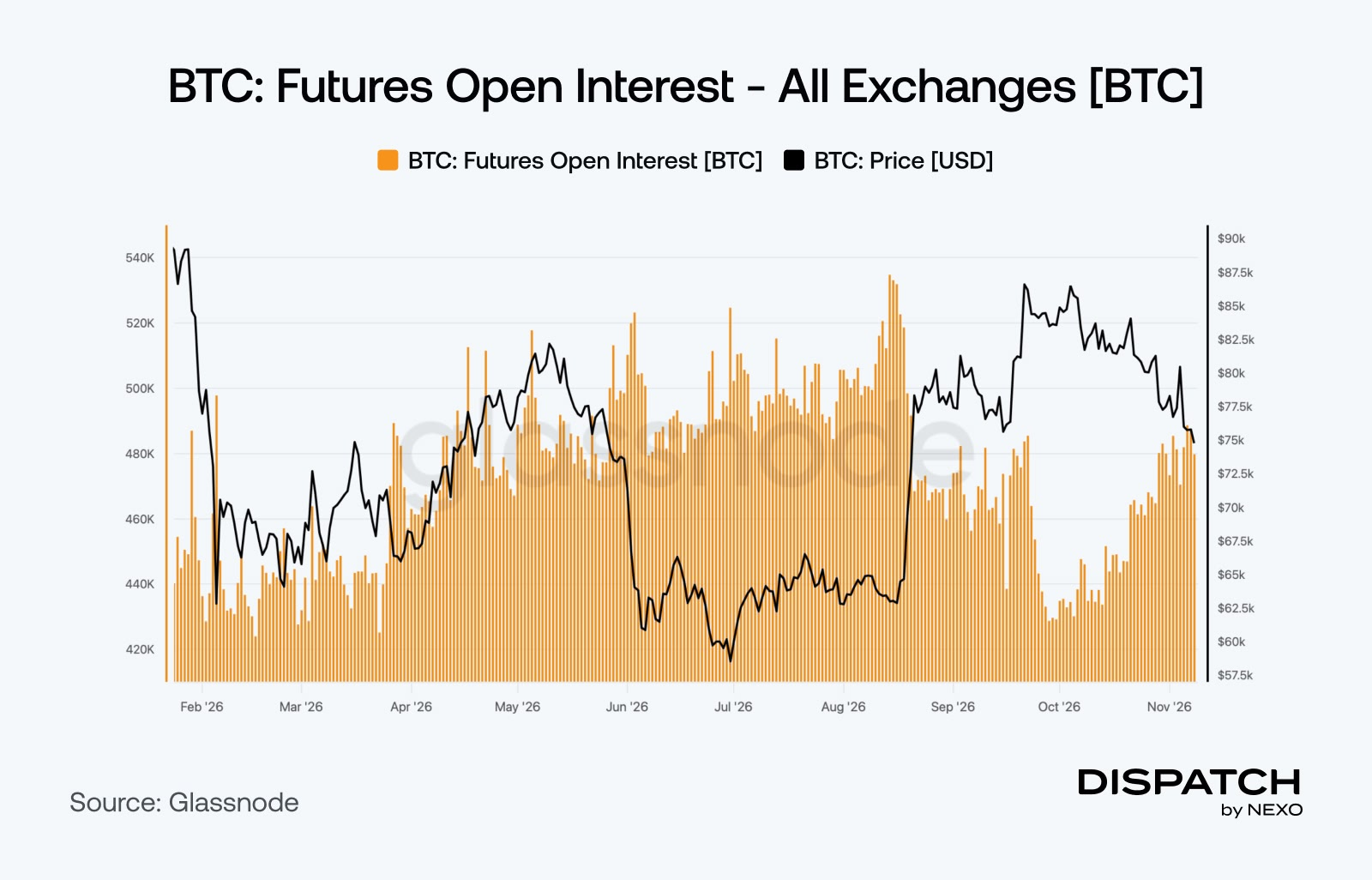
Futures positioning points to traders re-engaging. Bitcoin futures open interest has rebuilt 12% from its September 28 low, the lowest level since March, to 479,771 BTC, per Glassnode data. It has risen three weeks in a row and reached over 488,000 BTC on Friday, an 11-week high. It did so while the price fell, which means traders chose to hold more contracts at lower prices rather than step aside. The dollar value of open positions – sitting at about $36 billion – is little changed, so this is a rebuild in participation, not a rise in capital at risk.
That is a healthy development. More participants have a stake in the next move, and it is happening without stress: forced closures totaled only about 2% of open interest this week. Traders have been shaken, not flushed out. If the catalysts in this week’s Big idea line up, from softer inflation to steadier AI earnings and returning ETF inflows, that participation is what a recovery would build on.
The numbers
The week’s most interesting numbers
$23.41 trillion – U.S. M2 money supply in September, a record, up 5.7% from a year earlier, per the Federal Reserve.
85% – Grayscale’s estimate of the share of global crypto activity that takes place outside the U.S.
1,036 BTC – Bought by Strategy for $81.9 million last week, lifting its holdings to 850,364 BTC, more than 4% of bitcoin’s supply cap.
Hot topic
What the community is discussing
The NYSE and more tokenization talk.
Three scenarios for the main inflation driver.
The AI-chip titans battle.
Dispatch is a weekly publication by Nexo, designed to help you navigate and take action in the evolving world of digital assets. To share your Dispatch suggestions and comments, email us at [email protected].
This content is for informational purposes only and does not constitute investment, legal, or tax advice. Crypto assets are highly volatile and their value can go up or down significantly, including to zero. Past performance and historical correlations are not indicative of future results. Nexo has a commercial interest in the adoption of digital assets.
The availability and use of any products or services made available through Nexo US LC (“Nexo US”) are subject to the applicable terms and conditions on the Nexo US platform. This message is for informational purposes only and does not constitute financial, investment, legal, or tax advice. Any decision you make based on this information is solely your responsibility. Nexo US provides the user interface and routes client instructions to third-party service providers. Investment advisory services for eligible digital asset strategies are provided by Gravitalix Financial, LLC (“Gravitalix”), an investment adviser registered with the U.S. Securities and Exchange Commission. Registration with the SEC does not imply a certain level of skill or training. Please review Gravitalix’s Form ADV and related disclosures carefully before investing. Digital assets are not money or legal tender, are not backed by any government or central bank, and are not insured or guaranteed by any governmental or private insurance scheme (including FDIC or SIPC). Any rates, yields, or rewards displayed in the Nexo US app or related materials are subject to change, may be reduced or discontinued at any time, are not guaranteed, and may not be available in all jurisdictions or for all clients. Past performance is not indicative of future results.
Digital Asset services are provided by Bakkt Financial Solutions I, LLC (NMLS ID 1890144) through a software licensing agreement between Bakkt Financial Solutions I, LLC (“Bakkt”) and Nexo US LLC. Bakkt is not a registered broker-dealer and is not a member of SIPC or FINRA. Digital assets are not FDIC- or SIPC- insured. Bakkt Financial Solutions I, LLC is licensed to engage in virtual currency business activity and money transmission by the New York State Department of Financial Services. Digital asset borrowing requires sufficient collateral. Failure to maintain collateral value due to market volatility may result in the liquidation of your assets. Please ensure that you fully understand the risks involved before trading. See here for Bakkt Licenses and Bakkt Disclosures. If you no longer wish to receive marketing communication from us, including product updates, industry news and exclusive promotions, click here.