Crypto loans with no credit check: What they are and how borrowing on Nexo works
Oct 15•9 min read
Crypto loans with no credit check are loans secured by your crypto instead of your credit score. The lender doesn't review your credit history or income, because the collateral you pledge covers the loan.
"No credit check" doesn't mean no checks, though. You still verify who you are, and availability depends on where you live.
This guide explains how crypto loans work, how they differ from a bank loan, what other platforms do, and how borrowing works on Nexo in the United States.
The short answer
- What it is: A crypto-backed loan is secured by crypto you already own.
- What "no credit check" means: Your credit score and income aren't part of the decision. Your collateral is.
- What still applies: Identity verification, location-based eligibility, and a collateral requirement.
- The main thing to watch: If your collateral drops in value, part of it may be sold to repay the loan.
- On Nexo: Borrow from $50 to $2 million against BTC, ETH, and 30+ other assets, and repay on your own schedule.
What is a crypto loan?
A crypto loan lets you borrow cash or stablecoins by pledging crypto as collateral. You keep ownership of the crypto, and you get it back when the loan is repaid.
How much you can borrow depends on the loan-to-value (LTV) ratio - the amount you've borrowed compared with the value of your collateral. If you pledge $100,000 of Bitcoin and borrow $50,000, your LTV is 50%.
Because you pledge more than you borrow, crypto loans are overcollateralized. That's what lets the lender skip the credit check: the collateral, not your credit history, covers the risk.
Does "no credit check" mean no checks at all?
No. It means your credit score isn't part of the decision. Other checks still apply:
- Identity. Platforms verify your identity before you can borrow.
- Location. Rates, product availability, and features vary by jurisdiction, eligibility, and loyalty tier, and they can change at any time.
- Collateral. Every loan needs enough eligible crypto, and each asset has its own LTV limit.
So the honest version of "no credit check" is this: your credit history doesn't matter, but your collateral does. With a bank loan, the question is whether you can repay. With a crypto loan, it's also what your collateral is worth.
It also means crypto loans depend on owning enough crypto to pledge. They don't depend on your credit history, but they're only available to people who already hold eligible assets.
How is borrowing against crypto different from a bank loan?
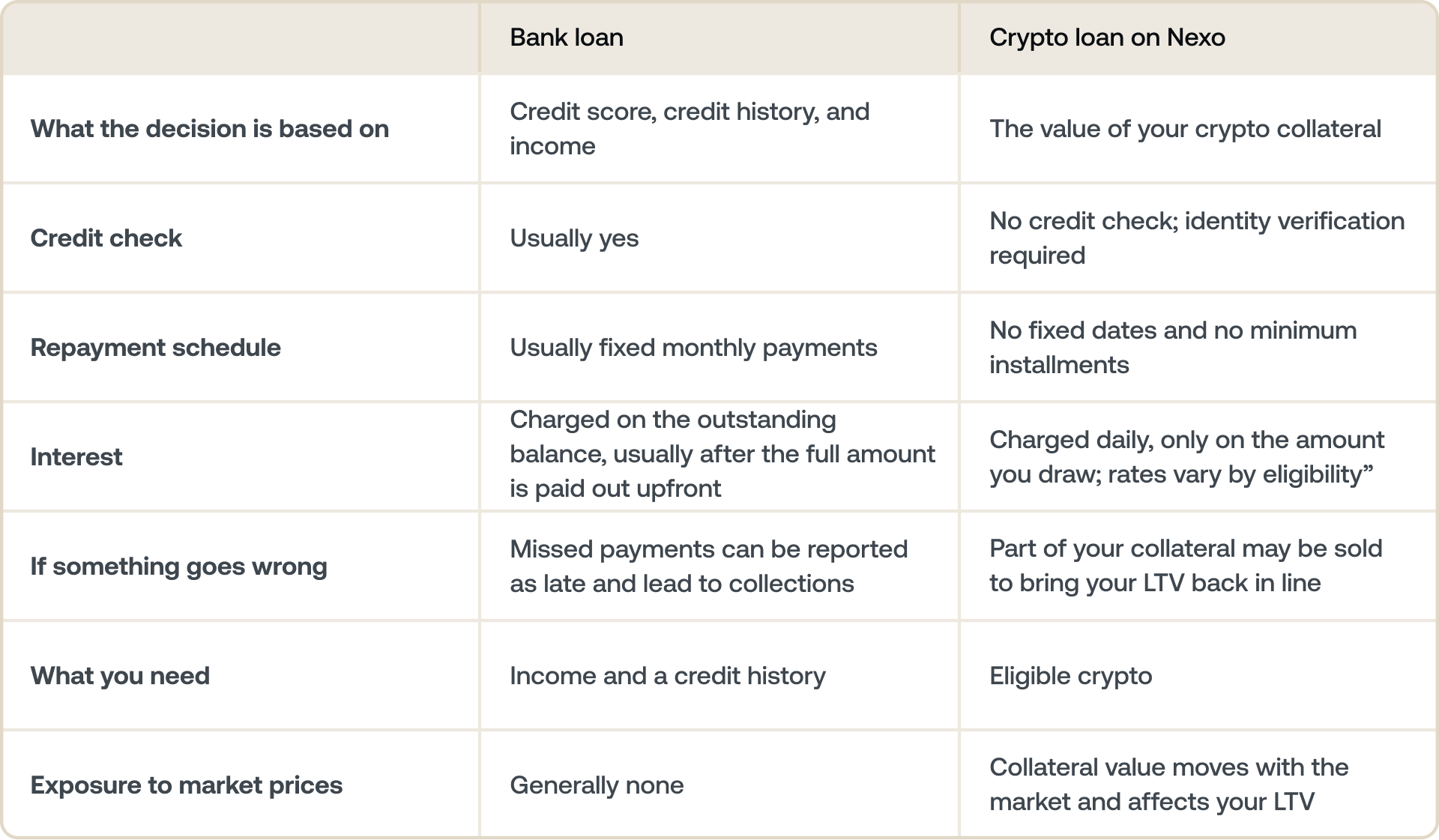
Neither option is better in every case. They handle risk in different ways, so the trade-offs fall in different places.
A bank loan asks more of you at the start: a credit review, proof of income, and usually a fixed repayment plan. With a fixed-rate loan, your payments are predictable. With a variable-rate loan, they can change when interest rates move. Either way, what you owe doesn’t depend on the price of an asset you’ve pledged. Repaying on time can also help build your credit history.
Bank loans also come with standard consumer protections, such as required disclosure of the loan’s full cost and set rules for how lenders handle missed payments and collections. Crypto loans may not offer the same protections.
A crypto loan asks for collateral instead. That removes the credit review and the fixed schedule, but it links your loan to the price of your crypto. If prices fall quickly, your LTV can rise faster than you can respond. Part of your collateral may then be sold automatically, sometimes without prior notice.
The comparison above is general. Bank loan terms vary widely by lender and product, and Nexo’s terms depend on your jurisdiction and eligibility. Before you decide, compare the full terms of any loan, including rates, fees, and what happens if conditions change.
What do other crypto lenders do?
Crypto-backed lenders all use collateral instead of credit checks, but the mechanics differ. Here is how four compare, as of September 2026:
- Nexo offers a Credit Line against BTC, ETH, and 30+ other assets, with no credit check. Automatic repayments may begin when LTV reaches 83.33%.
- Ledn lends against Bitcoin only. It sends LTV alerts at 70% and 75% and automatically sells collateral at 80% or above.
- Arch Lending, a US lender, accepts Bitcoin, Ethereum, and Solana and states it conducts no credit checks. It holds collateral with Anchorage Digital, a federally chartered digital asset bank, and uses margin calls and partial liquidations.
- Coinbase offers USDC loans against Bitcoin that run on-chain through the Morpho protocol. Collateral is liquidated if the loan reaches 86% of its value. A fixed-rate option was added on September 22, 2026.
Important note: Terms change often, so make sure to confirm current details with each provider.
How does borrowing on Nexo work in the US?
Nexo's Credit Line is built around collateral. For US clients, it works like this:
- Add collateral. Combine BTC, ETH, and 30+ other supported assets. Each asset has its own LTV: 50% for BTC and ETH, 30% for SOL and XRP, 15% for the NEXO token, and 90% for USDT and USDC.
- Borrow. Receive between $50 and $2 million with no credit check. Approval is instant once eligible assets are in your account. Clients who join Nexo Private can borrow up to $200 million.
- Choose how to receive funds. Take them into your bank account, or as USDT or USDC in your Nexo account.
- Repay your way. Repay partially or fully at any time, in crypto or stablecoins. There are no fixed dates and no minimum installments.
- Get your collateral back. When the Credit Line is fully repaid, your collateral is available immediately.
You pay interest only on the amount you borrow, for the days you use it. Rates start at 0.9% per year.
Important note: Rates vary by eligibility, Wealth Tier, and other factors, so it may not be available to every client.
Here's a simple example. You pledge $100,000 of BTC and borrow $50,000, a 50% LTV. You pay interest on $50,000, not on the full $100,000.
Borrowing against crypto may also avoid the taxable events that come with selling it. Tax laws vary, so check with a qualified tax professional before you borrow.
To see how much you could borrow, use the calculator on the Nexo Credit Line page.
What happens if your collateral falls in price?
When the price of your crypto falls, your LTV rises. On Nexo, if LTV reaches 83.33%, partial automatic repayments may occur, and only the minimum amount of crypto needed is sold to bring the ratio back.
Here’s an example. You pledge $100,000 of BTC as collateral and borrow $50,000. That’s a 50% LTV, because $50,000 is half of $100,000.
Now, say the price of BTC falls 40%, so your collateral is worth $60,000 instead of $100,000. You still owe $50,000, so your LTV is now about 83.33% ($50,000 ÷ $60,000). That’s the level where partial automatic repayments may begin. Part of your BTC could then be sold to repay some of the loan.
In practice, this point can come sooner. Interest adds to what you owe, and prices can move quickly, sometimes before you have time to respond. This is an illustration, not a prediction.
The way to stay ahead of it is simple: add collateral or repay part of the loan, and your LTV comes back down. Nexo lets you add, remove, or swap collateral without closing your Credit Line, and provides notifications and tools to help you follow your LTV.
How can you keep your LTV healthy?
A few habits make a big difference:
- Borrow less than the maximum. A lower starting LTV leaves more room before any threshold.
- Add collateral when prices fall. It lowers your LTV right away.
- Repay part of the loan. A partial repayment also lowers LTV.
- Check your LTV regularly, especially during large market moves. Nexo's Help Center explains how LTV works.
What should you know before borrowing against crypto?
A few things are worth understanding before you start:
- Price moves. Crypto prices can change quickly, and a fall in collateral value raises your LTV.
- Automatic repayments. They can happen during fast-moving markets, including without prior notice.
- Costs can change. Interest, fees, and spreads may apply and can change over time.
- Rules vary. Availability, rates, and tax treatment depend on where you live.
Frequently asked questions
1. Can you borrow crypto without a credit check?
Yes. With the Nexo Credit Line, your crypto acts as collateral, so your credit score isn't part of the decision. Identity verification and eligibility requirements still apply.
2. Does a crypto loan affect your credit score?
Applying with no credit check means no hard inquiry. Crypto-backed lenders typically don't report loans to the major credit bureaus, so on-time repayment usually doesn't build credit either.
3. How much can you borrow on Nexo in the US?
Between $50 and $2 million. Nexo Private clients can borrow up to $200 million.
4. What is LTV on a crypto loan?
LTV is the loan-to-value ratio: the amount you've borrowed compared with the value of your collateral. On Nexo, BTC and ETH have a 50% LTV limit, and USDT and USDC have 90%.
5. What happens if the price of my collateral drops?
Your LTV rises. If it reaches 83.33% on Nexo, partial automatic repayments may occur. You can avoid this by adding collateral or repaying part of the loan.
6. How is a crypto loan different from a bank loan?
A bank loan depends on your credit score, history, and income, and usually has fixed payments. A crypto loan depends on your collateral, and the main thing to watch is that part of it can be sold if its price falls.
These materials are accessible globally, and the availability of this information does not constitute access to the services described, which services may not be available in certain jurisdictions. These materials are for general information purposes only and not intended as financial, legal, tax, or investment advice, offer, solicitation, recommendation, or endorsement to use any of the Nexo Services and are not personalized, or in any way tailored to reflect particular investment objectives, financial situation or needs. Yield and interest rates are not guaranteed, are subject to change, and may vary by eligibility, selected term, and wealth tier. References to Yield are product names and do not represent rates of return or performance. Nexo products are not bank deposits and are not insured by the FDIC or SIPC. Digital assets are subject to a high degree of risk, including but not limited to volatile market price dynamics, regulatory changes, and technological advancements. The past performance of digital assets is not a reliable indicator of future results. Digital assets are not money or legal tender, are not backed by the government or by a central bank, and most do not have any underlying assets, revenue stream, or other source of value. Independent judgment based on personal circumstances should be exercised, and consultation with a qualified professional is recommended before making any decision
Borrowing against digital assets involves risk. If collateral value declines, you may be required to add collateral or repay promptly. The platform may execute partial or full automatic repayments or collateral sales to manage loan-to-value thresholds, including during fast-moving markets when notifications may not be timely. Interest, fees, spreads, and other charges may apply and can change. Clients are responsible for monitoring their Loan-to-Value ratio.
Rates, product availability, features, and applicable terms may vary based on jurisdiction, eligibility, loyalty tier, and other factors, and are subject to change at any time. When terms such as "up to" or "from" are used to denote limits, achieving these maximum or minimum thresholds may be conditional on additional actions or fulfillment of certain criteria and requirements that may not be attainable by all clients.
This information does not constitute tax advice. Please consult a qualified tax professional regarding your specific circumstances.
Services are provided by Bakkt Crypto Solutions, LLC. Digital assets may be held or serviced by third-party custodians, exchanges, lenders, or other service providers. Your ability to access or recover assets depends on the provider’s operational resilience and financial condition. If a provider becomes insolvent or experiences an operational disruption, you may experience delays in access to assets and could lose some or all of your assets. For more information, visit Bakkt Disclosures.