Crypto exchanges for beginners in the U.S.: A practical guide for 2026
Oct 15•6 min read
Choosing your first crypto platform involves more than picking a familiar name. Fees, supported assets, funding methods, custody, and withdrawal rules all affect your costs. This guide walks you through the types of platforms available to U.S. residents, the criteria worth comparing, and the steps of a first purchase.
What is a crypto exchange?
A crypto exchange is a platform where you can buy, sell, or swap digital assets. Some operate order books where buyers and sellers post prices. Others aggregate prices from several venues and execute your order against them. For a new user, the practical differences are pricing, order types, and how the platform holds assets between transactions.
Types of platforms U.S. beginners commonly compare
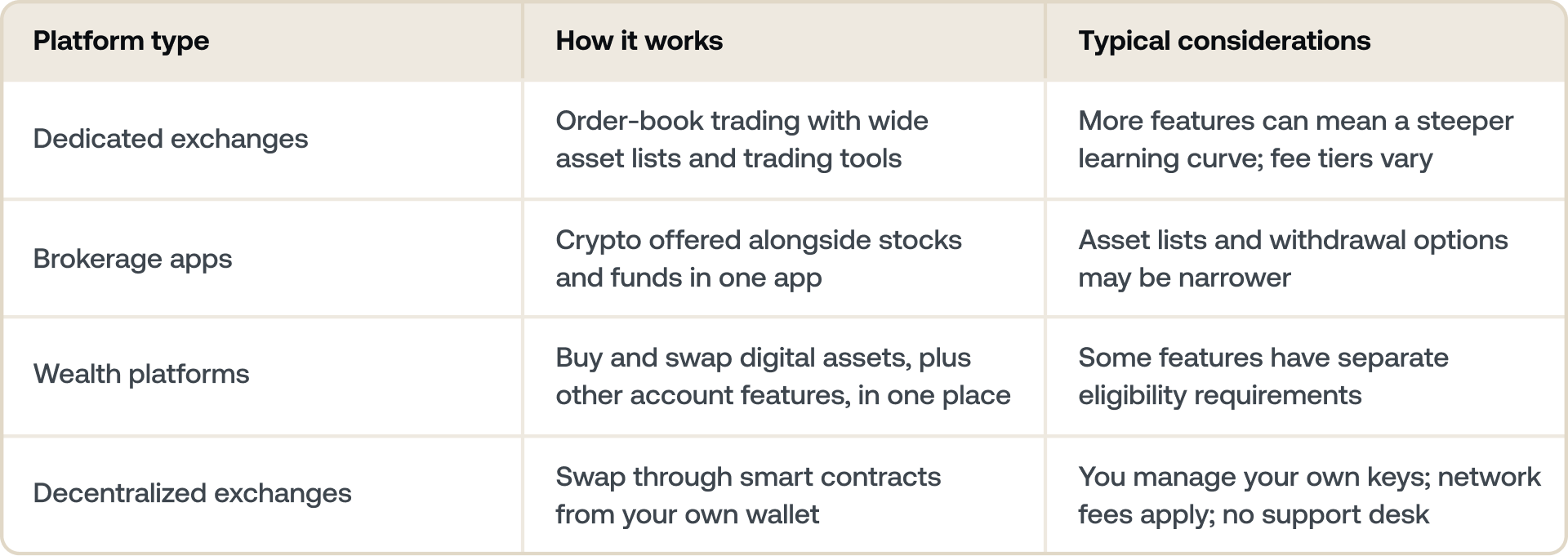
Educational overview. Features vary by provider.
There is no single type that fits everyone. Many people use more than one, for example, a brokerage app for convenience and a wallet they control for long-term holdings. What matters is that the platform matches how you plan to buy, hold, and use your assets.
What to look for in a crypto exchange
A short checklist keeps the comparison objective. Write down the assets you want, how you plan to fund your account, and how often you expect to trade, then check each platform against the same list.
Total cost, not only the headline fee
Trading fees, spreads, funding charges, and withdrawal fees all add up. The same purchase can cost different amounts on different platforms and with different order types, so compare the amount of crypto you would receive for the same dollar amount.
Supported assets and pairs
Check that the assets you want are supported and which pairs you can swap between. On Nexo, U.S. clients can swap 30+ digital assets, including blue-chip assets, altcoins, and stablecoins, using a wide range of pairs. See the full list in our supported pairs article.
Ways to add funds
Compare ACH, wire, and card options, along with processing times and limits. Larger amounts often suit wires, while smaller recurring amounts often use ACH. Nexo's local U.S. payment rails, such as ACH and Fedwire transfers in USD, let you fund your account directly from your bank without converting currencies.
Custody and withdrawals
Find out who holds your assets between transactions and whether you can withdraw to your own wallet. Our guide to custodial vs non-custodial wallets explains the trade-offs.
Support and account recovery
Look at how you can reach support and what the process is if you lose access to your account, for example, if you change phones or forget a password. At Nexo, our human Client Care team is available 24/7 and escalates issues to the right specialists.
Where Nexo fits for U.S. clients
Nexo is a premier platform for digital assets. In the U.S., custody is provided by Bakkt, a publicly listed digital asset platform. You can buy crypto and swap between more than 30 supported digital assets on the Nexo Exchange, which aggregates liquidity from multiple venues. Funding is by ACH or wire transfer, and eligible Exchange activity can receive crypto cashback, subject to eligibility and terms that may change.
Our platform may suit you if you want purchases, swaps, and other account features, like crypto-backed credit and yield solutions, in one place. If you prefer a dedicated trading venue or self-custody, other options may fit better. Some features, such as our interest-generating solutions, require opting in and a minimum portfolio balance. You can read how they work in our guide to how interest on crypto works.
Our Help Center has articles on how the Nexo Exchange works and on account creation and verification for U.S. clients. Learn more about our approach to security and compliance.
How to make a first purchase on Nexo
- Create your account and verify your identity. Sign up on the Nexo app or platform and complete identity verification. Our Help Center article covers account creation and verification for U.S. clients.
- Add funds. Add funds with an ACH transfer, or use Fedwire transfer, designed for larger amounts. Check the limits and processing times for each method. Your bank may apply a processing fee, over which Nexo has no control.
- Choose your asset and amount. Buy crypto by selecting the digital asset you want and entering the amount, or swap supported digital assets on the Nexo Exchange.
- Review the fees before you confirm. Check the total cost and the amount you will receive.
- Turn on two-factor authentication. Use an authenticator app where possible, and set up an anti-phishing code. Address whitelisting is mandatory on Nexo, so add your withdrawal addresses in advance. Our account protection checklist covers more ways to protect your account.
- Keep records for tax reporting. Import your Nexo transaction history into Koinly, our tax reporting partner, to calculate capital gains, losses, and income and generate reports for your tax filing. Learn more about Nexo’s tax reporting tools. This is not tax advice, so consult a qualified tax professional.
Common first-time mistakes
- Judging by price alone. Spreads and withdrawal fees can outweigh a low headline fee.
- Using unverified websites. Fraudulent sites imitate real platforms. Use our channel validator to check whether a Nexo contact is official.
- Sending to the wrong address or network. Test with a small transfer first.
- Skipping two-factor authentication. Accounts without it are easier to compromise.
- Ignoring tax records. Digital asset transactions can be taxable events.
Frequently asked questions
1. Do I need an exchange to buy crypto?
Not always. You can buy through exchanges, some brokerage apps, wealth platforms, or peer-to-peer markets. Each has different fees, asset lists, and custody arrangements.
2. What is a spread?
A spread is the gap between the price to buy an asset and the price to sell it at the same moment. It’s part of the overall cost of a trade, which is why comparing the total amount you’d receive is often more useful than comparing fees alone.
3. How can I tell whether a platform is legitimate?
Check which legal entities provide the service, read the published disclosures, and make sure you reach the platform through its official website or app. Be cautious of unsolicited messages, guaranteed-return promises, and pressure to move quickly.
4. Can I keep crypto on a platform long term?
Many people do, and others move assets to their own wallet. Keeping assets on a platform means relying on its custody arrangements and financial condition. Our guide on whether you need a cold wallet covers self-custody.
5. How is buying crypto taxed in the U.S.?
Selling or swapping digital assets can create a taxable gain or loss for U.S. taxpayers. The rules are complex and can change, so consult a qualified tax professional. Our crypto tax guide gives an overview, and our tax reporting tools, built with Koinly, can help you keep records.
To see which assets you can swap, visit the Nexo Exchange page.
These materials are accessible globally, and the availability of this information does not constitute access to the services described, which services may not be available in certain jurisdictions. These materials are for general information purposes only and not intended as financial, legal, tax, or investment advice, offer, solicitation, recommendation, or endorsement to use any of the Nexo Services and are not personalized, or in any way tailored to reflect particular investment objectives, financial situation or needs. Yield and interest rates are not guaranteed, are subject to change, and may vary by eligibility, selected term, and wealth tier. References to Yield are product names and do not represent rates of return or performance. Nexo products are not bank deposits and are not insured by the FDIC or SIPC. Digital assets are subject to a high degree of risk, including but not limited to volatile market price dynamics, regulatory changes, and technological advancements. The past performance of digital assets is not a reliable indicator of future results. Digital assets are not money or legal tender, are not backed by the government or by a central bank, and most do not have any underlying assets, revenue stream, or other source of value. Independent judgment based on personal circumstances should be exercised, and consultation with a qualified professional is recommended before making any decision.
Services are provided by Bakkt Crypto Solutions, LLC. Digital assets may be held or serviced by third-party custodians, exchanges, lenders, or other service providers. Your ability to access or recover assets depends on the provider’s operational resilience and financial condition. If a provider becomes insolvent or experiences an operational disruption, you may experience delays in access to assets and could lose some or all of your assets. For more information, visit Bakkt Disclosures.