Markets Today - September 25, 2026
Sep 25•5 min read

Daily analysis of crypto markets and the forces shaping them, from the Nexo research desk.
Bitcoin holds near $84,000 as ETF demand returns even and bond markets flash warning signs
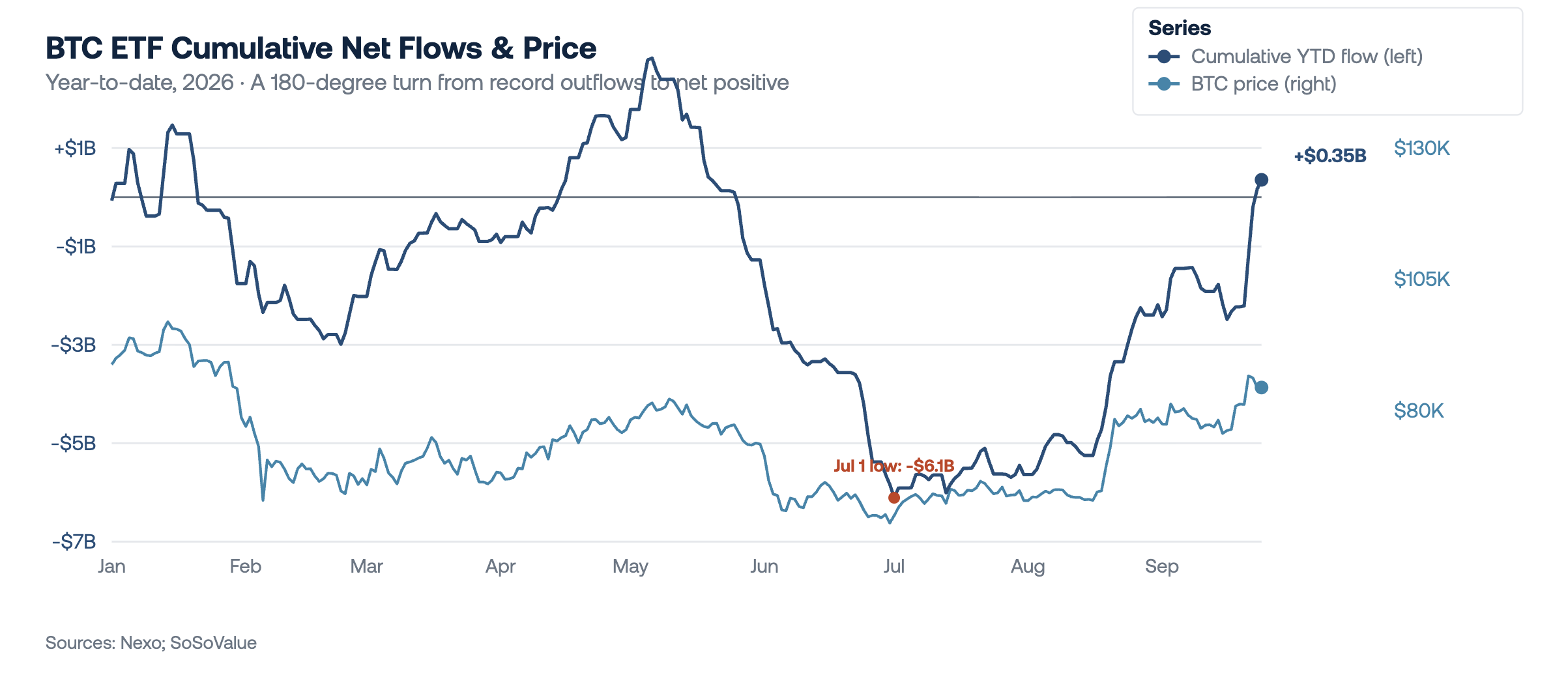
Bitcoin trades near $84,500 on Friday, up modestly on the day and about 3.4% for the week, capping its best quarter since late 2024 with a roughly 44% gain after three straight quarters of losses. U.S. equity futures point modestly higher, with the Dow, S&P 500, and Nasdaq all firmer after a mixed close Thursday, as oil's pullback offers some relief following a volatile week for stocks. That rebound has been matched by an equally sharp reversal in institutional demand: U.S. spot Bitcoin ETFs have swung from being down $5.8 billion for the year in July to nearly $800 million in net inflows now, powered partly by a six-day streak that has pulled in $2.84 billion. The backdrop, though, remains genuinely tense — the 10-year Treasury yield touched its highest level since 2007 this week, and a closely watched gauge of bond-market volatility has surged to its highest reading since March even as volatility in both Bitcoin and U.S. stocks stays near year-to-date lows, a divergence worth watching closely.
Bitcoin
Bitcoin trades near $84,000, largely consolidating after climbing from below $63,000 in August to nearly $87,000 on Tuesday. The rally has been unusually orderly by the market's own standards: investors have realized roughly $2.4 billion in profits over the recent surge, a fraction of the $7 billion to $10 billion in daily realized profits typically seen at prior cycle tops — a sign this run hasn't yet drawn the kind of aggressive selling that has capped past rallies.
The more interesting signal sits outside crypto entirely. The MOVE index, which tracks expected volatility in U.S. Treasuries, has jumped from around 80 on Tuesday to 104 on Thursday, its highest level since March. Bitcoin's own 30-day implied volatility remains subdued near its year-to-date low, and the equivalent gauge for the S&P 500 tells the same story. That gap matters: bond-market stress of this kind typically tightens financial conditions broadly, and crypto and equities not yet pricing in any of that tension suggests either genuine confidence the rate shock stays contained, or a lag that hasn't caught up yet.
The ETF turnaround deserves its own scrutiny. Nearly $4 billion of this year's net inflows have arrived since the U.S. Treasury's August announcement of expanded bond purchases — a direct line from that liquidity intervention to renewed crypto demand. The current six-day streak, while genuinely strong, is only the third of its kind on record and ranks behind a comparable run in November 2024; full-year inflows of $800 million also remain well short of the $35.2 billion and $21.4 billion the funds pulled in during 2024 and 2025 respectively. The turnaround is real, but there's meaningful ground still to recover.
Ethereum & Altcoins
Ether trades near $2,700, up modestly, while the broader altcoin complex has outperformed sharply — 93 of the 100 largest tokens by CoinDesk's index were higher over the past 24 hours even as Bitcoin itself stalled. That rotation is a familiar pattern once Bitcoin's own rally pauses, and CoinMarketCap's altcoin season index now reads 56, up from 38 a month ago and its highest level in over three months. Chainlink, alongside Internet Computer and Bittensor, led a sharp advance in compute-linked tokens specifically, a distinct pocket of strength within the broader move.
Macro & Institutional
The dominant story remains the bond market. The 10-year Treasury yield touched an intraday peak of 5.225% this week before settling near 5.18%, its highest level since July 2007, while the 30-year climbed to its highest since 2004. Traders are increasingly watching 6% on the 10-year as the next threshold that could force broader deleveraging across risk assets. The drivers are stacking on top of each other: a wave of hawkish commentary from Fed officials arguing more hikes are likely needed, resilient economic data that keeps giving the central bank cover to stay tight, and simultaneous tightening from the ECB and Bank of Japan that has effectively closed off any near-term hope of a global easing cycle. October rate-hike odds have climbed to 70% from 50% a week ago. Corporate debt issuance tied to the AI infrastructure buildout is adding further pressure, competing directly with Treasuries for capital. The Treasury's own bond-buyback program continues, but by most accounts remains too small to meaningfully offset the scale of selling.
Oil eased Friday on reports that U.S. and Iranian negotiators are exploring a phased arrangement in which Tehran would reopen the Strait of Hormuz in exchange for Washington lifting its economic blockade — a more concrete de-escalation signal than earlier in the week, though still unconfirmed. Brent staying above $100 through much of the session suggests real skepticism that a breakthrough is imminent. Elsewhere, the yen snapped a five-day losing streak after Japan disclosed that President Trump had personally raised concerns about the currency's weakness in a recent meeting, while gold edged higher but remains on track for a weekly decline as the same yield pressure that's rattling bonds works against it.
Looking Ahead
Next week brings a dense run of data: Tuesday's calendar includes the Reserve Bank of Australia's rate decision, U.S. consumer confidence, JOLTS job openings, and UK second-quarter GDP; Wednesday delivers ADP private payrolls, core PCE — the Fed's preferred inflation gauge — and the ISM and S&P Global manufacturing PMIs; and Friday's September jobs report, including nonfarm payrolls and the unemployment rate, stands as the week's most consequential release given how directly labor-market strength has fed into this week's rate-hike repricing. For Bitcoin, the setup remains genuinely two-sided: an ETF base that has clearly turned a corner, against a bond market signaling more stress than crypto's own pricing currently reflects.
Author: Iliya Kalchev, Analyst at Nexo’s Dispatch
This material is produced by Nexo for informational purposes only and does not constitute financial, investment, legal, or tax advice, or a recommendation to transact in any digital asset. Views are the author's as of the date of publication and may change without notice. Information is from sources believed reliable, but Nexo makes no warranty as to its accuracy and accepts no liability for any loss arising from reliance on this material.