Markets Today - September 24, 2026
Sep 24•5 min read
.png)
Daily analysis of crypto markets and the forces shaping them, from the Nexo research desk.
Bitcoin slides toward $83,500 as Treasury yields hit their highest since 2007
Bitcoin trades near $83,500 on Thursday, down sharply after touching close to $87,300 earlier this week, as a historic selloff in U.S. government bonds pushes the 10-year Treasury yield above 5% for the first time since 2007. The move follows a surprisingly strong September business-activity survey and increasingly hawkish Fed commentary, both read by markets as reasons for further rate hikes rather than signs of a healthy economy. U.S. equity futures point sharply lower, with the Dow, S&P 500, and Nasdaq all indicated to open down, as high-flying AI and chip stocks bear the brunt of the bond-market rout. Oil has jumped back above $100 a barrel after Iran's president delivered defiant remarks at the UN that dashed hopes for a quick resolution to the regional conflict, reversing much of the optimism that had built earlier in the week. Gold has extended its own decline, and the dollar has climbed to a two-month high. The day's main scheduled event is the face-to-face meeting between President Trump and Chinese President Xi Jinping, ahead of which the two sides have already confirmed a two-month extension to their tariff truce.
Bitcoin
Bitcoin trades near $83,500, extending overnight losses after touching nearly $87,300 earlier this week. The connection to Wednesday's bond-market rout is direct: Bitcoin's steepest drop came in the hours immediately following the U.S. business-activity report, underscoring how closely the asset is now trading as a real-time referendum on the rate outlook. Higher yields raise the bar for holding an asset that pays nothing, and make it more expensive to borrow against leveraged positions elsewhere – both work against Bitcoin specifically this week.
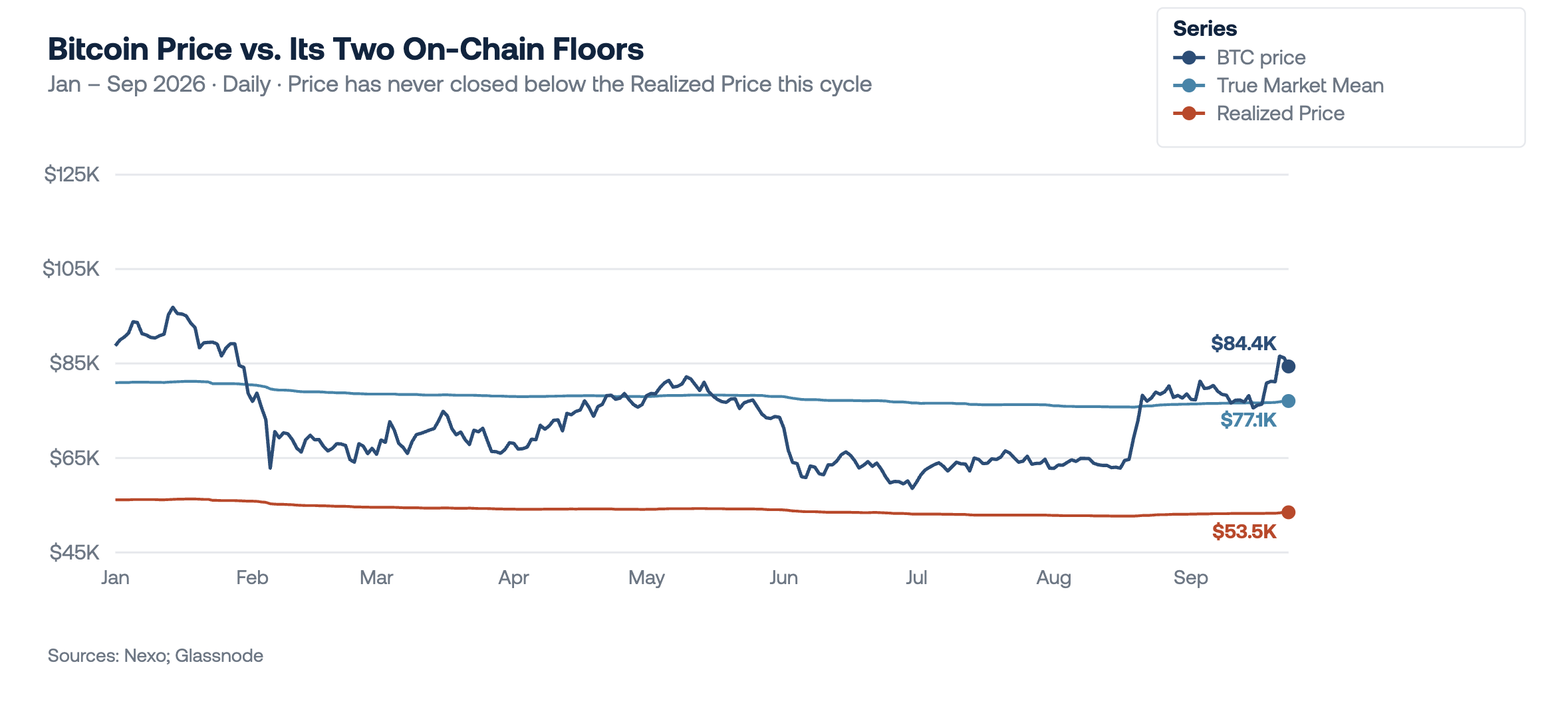
There's a sharper way to frame what's actually at stake in today's drop. Heading into this week, Glassnode research had identified $84,000–$85,000 – a dense cluster of long-term holder supply – as the line separating a continued run toward $95,000–$97,000 from a retreat back toward this cycle's key support near $77,000, the average price paid for every coin in circulation. Bitcoin has now broken below that upper level, making today's session a live test of that framework rather than an abstract one. The broader cycle context still favors the bulls, though: according to Glassnode, Bitcoin has yet to close a single day below that $77,000 support level this entire downturn, a feat neither of the two prior bear markets managed, and heading into this week's shock, profit-taking had stayed remarkably light while spot trading volume was recovering alongside rising prices rather than falling ones – a healthier pattern than the capitulation-driven volume spikes that defined most of the past year.
Friday adds a mechanical wrinkle to that picture. Roughly $15.9 billion in Bitcoin options expire, one of the year's largest quarterly settlements, with positioning skewed heavily toward calls and a max pain level sitting near $75,000–$76,000 – well below where Bitcoin has traded most of this week.
Ethereum & Altcoins
Ether trades near $2,657, down alongside the broader market. XRP has fallen hardest among the majors to $1.465, and Dogecoin has slipped to just above 9 cents. Solana, Cardano, and BNB are all lower, while Tron has held roughly flat. The pullback looks like broad profit-taking after a strong run through September – much of it built on optimism around the SEC's new exemption for blockchain-based stock offerings – rather than anything specific to individual tokens. That earlier rally was itself unusually healthy by one measure: Glassnode data show nearly three-quarters of tracked tokens were outperforming Bitcoin over the past week, well above the roughly 40% seen during August's squeeze, with little evidence of fresh leverage behind the move – a spot-driven advance rather than a leveraged one.
Macro & Institutional
The dominant story is a historic move in U.S. Treasury markets. The 10-year yield climbed to 5.142%, its highest since July 2007, building on Wednesday's jump – the sharpest single-day move since last year's tariff-driven selloff. The 30-year touched its highest level since 2004, and the 2-year hit levels not seen since May 2024. The cause is unusual: September's flash business survey came in unexpectedly strong, but rather than reassuring markets, it reinforced fears the economy has too much momentum for the Fed to ease, a reading compounded by Fed officials signaling further hikes remain likely. A same-day auction of five-year notes met weak demand, clearing at the highest yield since 2006. Markets now price close to a 70% probability of an October hike, up sharply from roughly half that a week ago.
The Treasury's own bond-buyback program, continuing today, appears to be struggling against the scale of current selling – a shift from earlier in the month, when similar operations helped calm the same market. A genuine turn from here likely needs either real Middle East de-escalation that brings oil down, or a larger Treasury intervention than deployed so far.
Oil is the week's other driver. Brent has climbed back above $100, touching as high as $106.50, after Iran's president used sharply defiant UN language – a reminder the diplomatic opening described just a day earlier remains fragile. Separately, uncertainty over a possible U.S. diesel-export restriction has kept European diesel futures near record highs. European yields moved in tandem with U.S. Treasuries on a stronger-than-expected eurozone business survey, though at least one major bank still expects the ECB to resume cutting rates from mid-2027 – a reminder this week's hawkish repricing and the multi-year trajectory aren't the same conversation. The dollar has extended to a two-month high, the euro has fallen to its own two-month low, and the yen has weakened toward a level that has previously drawn direct intervention from Japanese authorities.
Looking Ahead
Today's Trump-Xi meeting is the session's headline event, with any signal on a broader trade agreement likely to move sentiment across risk assets, while a breakdown would revive the tariff-war risk markets have spent recent weeks pricing out. Friday also brings a roughly $18 billion combined options expiry on Deribit across Bitcoin and Ether, alongside the simultaneous settlement of CME Bitcoin futures – a rare overlap that could sharpen whatever move the day's other catalysts produce. Beyond that, attention stays on whether the Treasury's buyback operations gain traction against current selling, and how the Iran standoff evolves. For Bitcoin, the more immediate test is the one Glassnode's own framework now points to directly: whether $84,000 holds as support, keeping the path toward $95,000–$97,000 open, or gives way further toward the $77,000 level that has anchored this entire cycle.
Author: Iliya Kalchev, Analyst at Nexo’s Dispatch
This material is produced by Nexo for informational purposes only and does not constitute financial, investment, legal, or tax advice, or a recommendation to transact in any digital asset. Views are the author's as of the date of publication and may change without notice. Information is from sources believed reliable, but Nexo makes no warranty as to its accuracy and accepts no liability for any loss arising from reliance on this material.