Markets Today - September 10, 2026
Sep 10•5 min read
.png)
Daily analysis of crypto markets and the forces shaping them, from the Nexo research desk.
Bitcoin slides below $77,000 as the ECB delivers an insurance hike against a $100 oil shock
Bitcoin trades near $78,000 on Thursday, giving back Wednesday's advance and sitting roughly 5% below last week's high, as renewed Middle East tensions and rising Treasury yields weigh on risk appetite broadly. The total crypto market cap sits around $2.76 trillion, down modestly on the day. U.S. equity futures point modestly higher after the Dow, S&P 500, and Nasdaq all fell for a third straight session Wednesday, while Brent crude has pushed above $101 a barrel — its highest since July — and the European Central Bank has raised interest rates for the second time this year, lifting its policy rate to 2.50% from 2.25%, as the energy shock pushes eurozone inflation further above target. Gold trades in a tight range near $4,400 as dollar softness offsets the pull of higher yields. Beneath Bitcoin's pullback, however, a detailed on-chain picture suggests the token's summer recovery may have more structural support than the daily price action implies.
Bitcoin
Bitcoin trades near $77,000, down about 3% over 24 hours and roughly 5% below the $82,284 high it touched last week. The headline number obscures a striking statistic: over the past 21 trading sessions, Bitcoin has returned 23% while the S&P 500 and Nasdaq 100 stood still — yet it remains down about 10% for the year, a reminder of how much ground was lost earlier in 2026. Spot Bitcoin ETFs saw $122 million of outflows Wednesday, a signal of potential profit-taking following the recent uptick rather than a broader change in trend.
Three independent measures now converge on the same resistance zone. Long-term holder cost-basis data shows roughly 1.07 million BTC was accumulated between $83,000 and $86,000, largely untouched for the past month; the futures liquidation map shows that same band holding its heaviest concentration of short-liquidation levels on record; and the U.S. spot ETF complex breaks even near $86,000, having narrowed its collective paper loss from $18 billion in February to about $3.9 billion now. This month's rally tested that ceiling for the first time on September 3 before stopping about 1.5% short.
What stands out, according to Glassnode, is who isn't selling into it: realized profit-taking has fallen to less than half its August pace, and long-term holders' share of that selling has dropped from 88% to 47% — most of the recent selling belongs to newer buyers, and even they're doing less of it. A broad basket of cycle indicators that flagged historically cheap conditions in over 80% of readings back in June has since fallen to just 2%, evidence valuations have genuinely repaired, while altcoins have gained over the past month without gaining share relative to Bitcoin — a pattern distinct from the rotation typically seen ahead of past cycle tops.
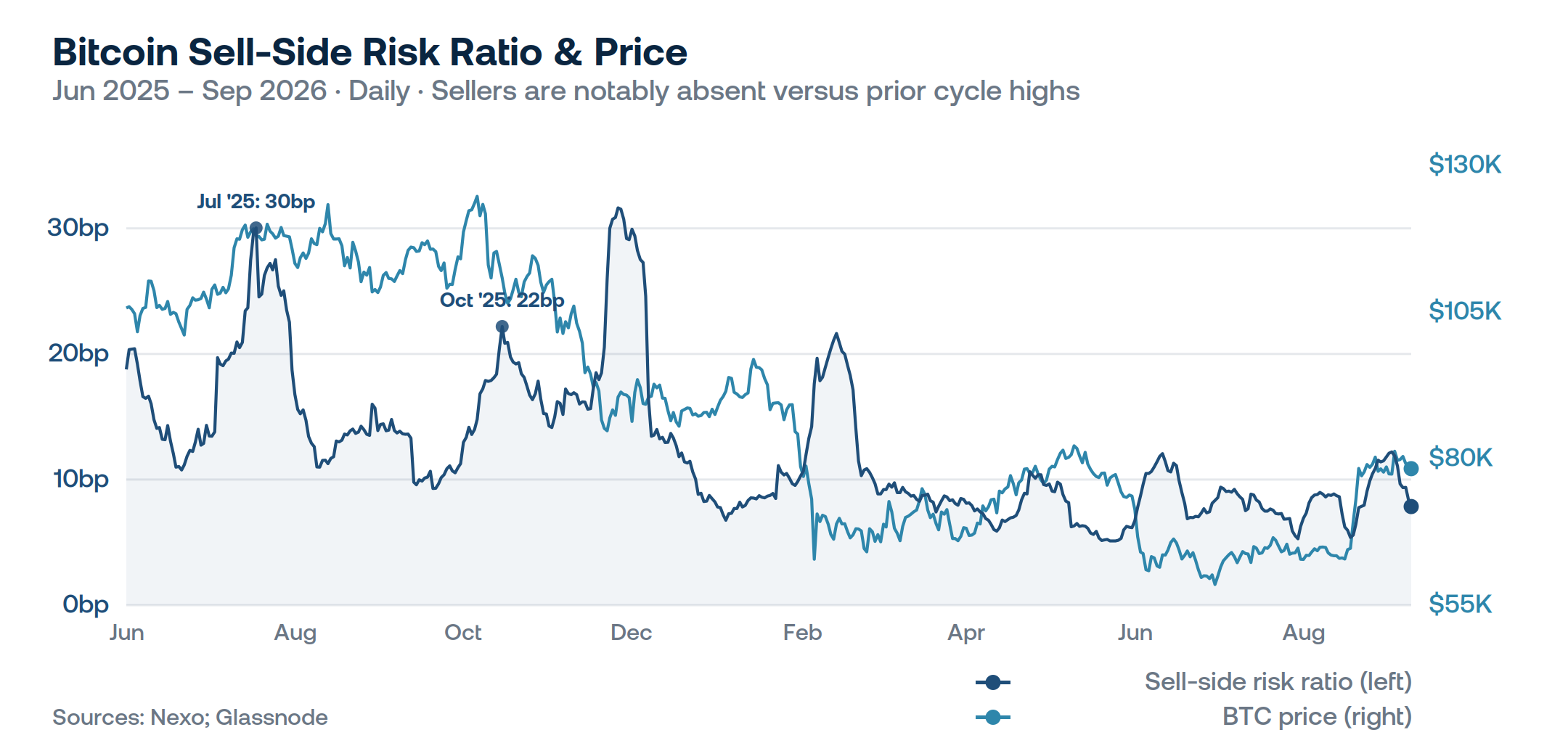
Near-term positioning is more cautious: open interest has risen even as price has fallen over the past 24 hours, generally a sign of fresh short-building, and options flow into Friday leans toward downside protection, with the most heavily traded Bitcoin put targeting $70,000. Funding rates, though, have stayed moderately positive across most major tokens — longer-horizon positioning hasn't turned outright bearish even as short-term flow has.
Ethereum & Altcoins
Ether trades near $2,470, little changed on the day but down over the past 24 hours, while BNB has been the session's weakest major, falling sharply to around $718. XRP, Solana, and Cardano have all declined more than the largest tokens, with selling concentrated most heavily in smaller and more speculative names. Spot Ether ETFs bucked that softer tone, recording a not-insignificant $34 million of inflows — a divergence from Bitcoin's own outflow day that suggests institutional demand for Ether has held up better through this week's pullback.
Macro & Institutional
The European Central Bank's rate decision was the day's central event. The Governing Council raised its policy rate to 2.50% from 2.25%, its second hike of the year, as it looks to counter an energy-driven rise in inflation tied to the Middle East conflict — a move that just weeks ago looked far from certain, with consensus having leaned toward a hold before the latest escalation reshaped expectations. Eurozone headline inflation has accelerated to 3.3% on a sharp jump in energy costs. The central bank also lifted its inflation projections to 3.0% for this year, 2.5% for next, and 2.1% for 2028, alongside modestly higher growth forecasts, while stopping short of signaling its next move — financial markets are pricing at least one further hike this year, though policymakers repeated only that future decisions will depend on incoming data.
Brent has climbed above $101 a barrel amid continued tensions in the region, feeding directly into Treasury markets: the 10-year yield touched its highest level since late 2023 this week, a move a smaller-than-expected Treasury buyback operation failed to reverse. Markets now price roughly a 60% chance of a Fed rate hike at its September 15–16 meeting, reinforced by last week's stronger-than-expected payrolls report. Today's producer price data and Friday's CPI print are the last major inputs before that decision.
That backdrop sits awkwardly with the actual inflation data: core U.S. inflation has fallen to a two-year low of 2.5%, even as household inflation expectations sit at 3.6% — the widest gap between the two in three years. Friday's CPI print will test that tension directly: a rise in core prices toward expectations would strengthen the case for tighter policy, while a reading that holds near its recent low would suggest the bond market has moved further than the data currently justifies. Elsewhere, gold has held a tight range near $4,400 as dollar weakness offsets higher yields, with global gold-backed ETFs pulling in $18 billion in August — their second-largest monthly inflow on record.
Looking Ahead
Following today's ECB rate hike, the producer price report remains the session's other key focus, with Friday's August CPI standing as the week's most consequential release — the final inflation reading before the Federal Reserve's September 15–16 meeting. The Bank of Japan follows on September 18, with markets broadly expecting its own rate increase. For Bitcoin, the more meaningful test isn't Friday's number in isolation but whether the current absence of aggressive selling persists through it: a sustained move through the $83,000–$86,000 ceiling with selling pressure still subdued would mark genuine absorption of that resistance, while a revival of August-level selling or a loss of the $62,000–$65,000 floor beneath the market would suggest the current range has more work left to do.
Author: Iliya Kalchev, Analyst at Nexo’s Dispatch
This material is produced by Nexo for informational purposes only and does not constitute financial, investment, legal, or tax advice, or a recommendation to transact in any digital asset. Views are the author's as of the date of publication and may change without notice. Information is from sources believed reliable, but Nexo makes no warranty as to its accuracy and accepts no liability for any loss arising from reliance on this material.