Markets Today - October 9, 2026
Oct 09•5 min read
.png)
Daily analysis of crypto markets and the forces shaping them, from the Nexo research desk.
Bitcoin rebounds to $83,000 as oil eases, but is set to end a three-week winning streak ahead of U.S. CPI
Bitcoin trades near $83,000 on Friday, rebounding from a Thursday low near $80,300 as oil eased on signs of diplomacy, but it is set to end a three-week winning streak, down from above $87,000 a week ago. The total crypto market cap sits around $2.8 trillion. On Thursday the S&P 500 and Nasdaq closed lower for a second straight session as doubts about OpenAI’s revenue hit tech, with the S&P 500 down 0.5% to 7,765.36 and the Nasdaq Composite down 1.3% to 27,193.34, while the Dow edged up 0.1% to 51,231.64. Futures are higher this morning, with the Dow up 0.2%, the S&P 500 up 0.4% and the Nasdaq-100 up 0.8%. Brent trades near $102.55, spot gold rose 1.3% to $4,187.65, and the 10-year Treasury yield sits near 5.3%, easing from its two-decade peak. CME FedWatch prices an 18% chance of an October Fed hike and 82% for December, and next week’s U.S. CPI report is the next test.
Bitcoin
Bitcoin’s rebound followed a Thursday drop that reset about $1.19 billion of leveraged positions and took it to a low near $80,300, before oil eased and buyers returned. ETF demand has cooled: U.S. spot Bitcoin ETFs lost about $244 million on Thursday, taking two-day withdrawals to roughly $729 million and putting the funds on course for their first weekly outflow in four, at more than $700 million, per SoSoValue.
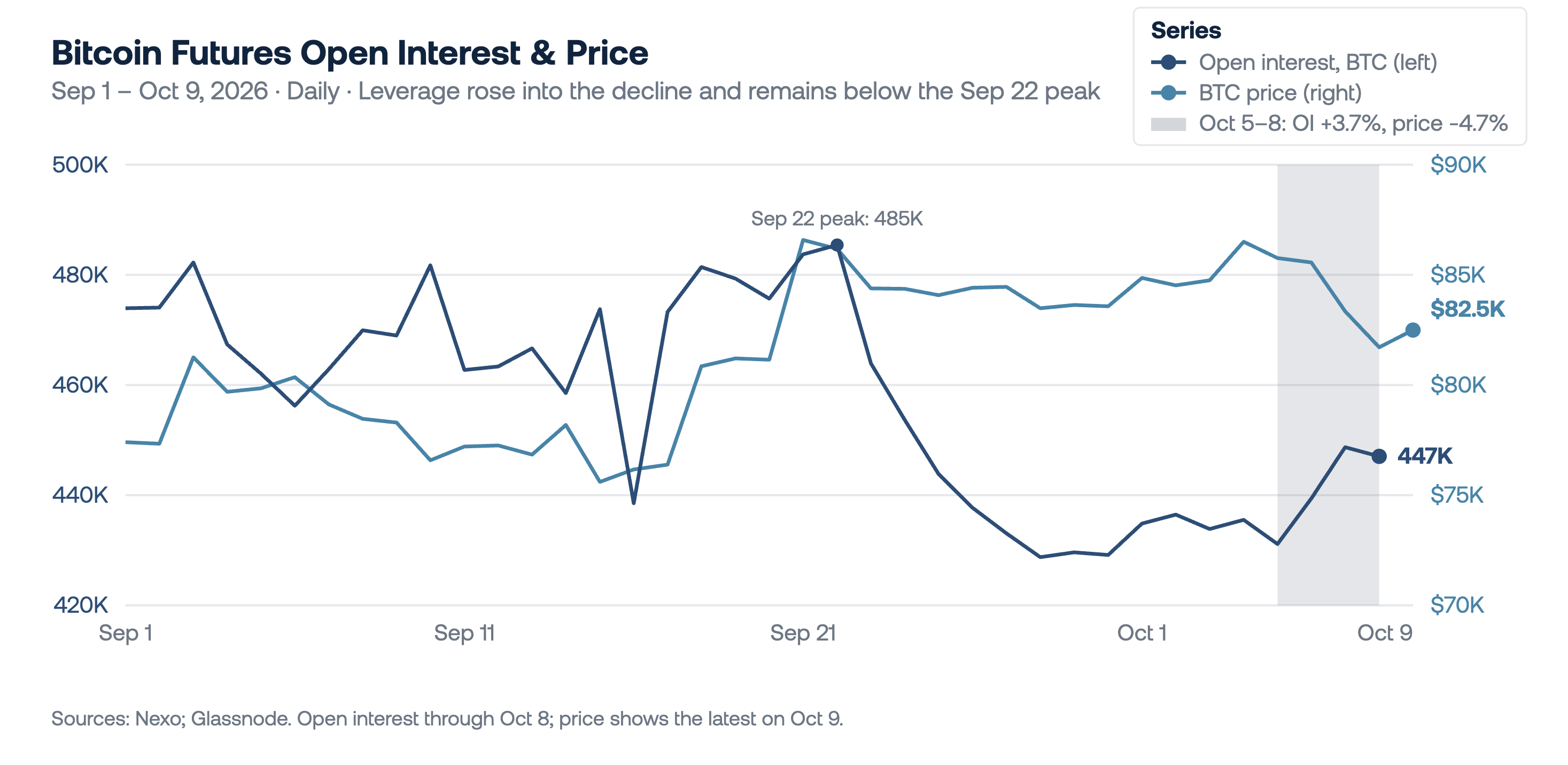
Open interest rose into the decline. Futures open interest climbed about 4% over the three sessions to Thursday’s close, to roughly 447,000 BTC, while price fell about 5%, and it ended Thursday down only 0.4% despite the reset, suggesting positions were rebuilt as price fell. That combination has appeared only a handful of times in six months, mostly during the May to June decline, and it leaves positioning more sensitive to the next move in either direction. Open interest is still about 8% below its September 22 peak, so leverage is not at an extreme. Glassnode notes Bitcoin has fallen back from a sell wall at $86,500 toward large buy orders, the biggest near $81,000, which it expects to cushion further declines. Thursday’s low sat just below that zone.
QCP’s fourth-quarter map, which hinges on ETF flows, oil and the Fed, puts Bitcoin in a base-case range of $80,000 to $90,000, with upside above $100,000 and downside below $68,000 to $70,000. A year on from the $126,000 peak, the 54% drawdown to July’s low was far shallower than the 70% to 85% declines of prior cycles, according to one industry economist.
Ethereum & Altcoins
Ether trades near $2,500, down sharply on the week, while XRP and BNB also slipped and smaller tokens led Friday’s bounce but remain lower over 24 hours. ETF flows split on Thursday: Ether funds shed about $73 million, Solana and Zcash funds also lost money, and XRP funds were the only crypto ETFs to take in money, about $8 million, bringing their total since launch to $1.81 billion, ahead of the $1.59 billion in Solana funds. The Zcash fund’s October outflows of about $86 million have erased roughly a third of its net inflows since launch.
Macro & Institutional
The Fed is debating timing, not direction. St. Louis Fed President Alberto Musalem said further tightening is needed to bring inflation back to 2% within a reasonable timeframe, with rates possibly rising over the next six to nine months, though he did not say whether he would back an October move. Initial jobless claims fell to 197,000, the lowest since July, and economists read September’s soft payrolls as a low-hire, low-fire market that leaves the Fed free to focus on inflation.
A further rise in the 10-year yield toward 6%, a level last seen 26 years ago, is possible, though part of the recent selling reflects technical selling by leveraged funds, and higher yields tend to draw buyers back into Treasuries, which limits how far they can rise. Thursday’s 30-year auction tailed, while France’s two-year yield is heading for its first weekly decline in nine.
Oil eased after President Trump signaled Washington would hold off on new action before the November 3 midterms while talks with Iran continue, and Iran said it is reviewing a U.S. proposal and will respond within days. Brent is still roughly flat on the week after Thursday’s 4% jump. Even on better headlines, markets are pricing a longer period of disruption into next year, because high shipping costs and a shortage of refined products keep prices elevated. A Gulf storm has shut in about 1.3 million barrels a day, or 63% of local output, though China’s resumption of refined fuel exports adds supply.
The AI debate is shifting from spending to monetization. Tech led Thursday’s decline after reports that OpenAI’s annualized revenue is about $50 billion, below the $70 billion previously signaled, though the company expects to reach $70 billion by year-end. The dollar index sits near 102.3, close to an 18-month high, while the euro near $1.12 is at its lowest since May 2025.
Looking Ahead
The lead event is Wednesday’s U.S. September CPI report, the centerpiece of an inflation-heavy week that opens with German CPI on Monday and closes with euro-zone CPI on Friday. August’s readings, 0.4% for headline and 0.3% for core on the month, are the comparison. With the labor market in low-hire, low-fire mode and Fed officials still talking about further tightening, inflation data now carries the decision, with an 18% chance of an October hike and 82% for December priced. A cooler reading would reinforce the pause, while a hot one would revive the case for an earlier move. Today’s University of Michigan sentiment survey, expected at 47.5 from 48.1, puts inflation expectations in focus after September’s jump to the highest since June. Thursday brings U.S. retail sales (previously up 1.2%), producer prices, weekly jobless claims and the Philadelphia Fed manufacturing index, alongside UK GDP, and Friday brings a speech from Fed Chair Kevin Warsh. Earnings season opens with the big banks next week, and the Fed meets October 27 to 28. For Bitcoin, the CPI print and the response in oil and yields will decide whether the $81,000 buy orders hold or the $86,500 sell wall comes back into play.
Author: Iliya Kalchev, Analyst at Nexo’s Dispatch
This material is produced by Nexo for informational purposes only and does not constitute financial, investment, legal, or tax advice, or a recommendation to transact in any digital asset. Views are the author's as of the date of publication and may change without notice. Information is from sources believed reliable, but Nexo makes no warranty as to its accuracy and accepts no liability for any loss arising from reliance on this material.