Markets Today - October 1, 2026
Oct 01•5 min read
.png)
Daily analysis of crypto markets and the forces shaping them, from the Nexo research desk.
Bitcoin holds near $84,000 as a global bond rout outweighs soft PCE ahead of Friday's jobs report
Bitcoin trades near $83,900 on Thursday, little changed on the first day of the fourth quarter after a 42.7% third-quarter gain, its best since early 2024. Ether rose 70.8% over the same stretch, its strongest quarter since 2021. The total crypto market cap sits around $2.85 trillion. Momentum stalled as Treasury yields hit multi-decade highs, even after Wednesday's softer-than-expected core PCE reading trimmed bets on an October Fed hike. Wall Street closed Wednesday with the S&P 500 at 7,651.54 (-0.25%), the Dow at 50,906.05 (-0.86%) and the Nasdaq Composite at 26,861.06 (+0.24%). For September, the S&P 500 fell 0.45%, the Dow 4.29% and the Nasdaq gained 1.86%. U.S. equity futures are mixed, with the Dow lower, the S&P 500 slightly higher and the Nasdaq firmer on strong Micron results. Friday's jobs report is the next test.
Bitcoin
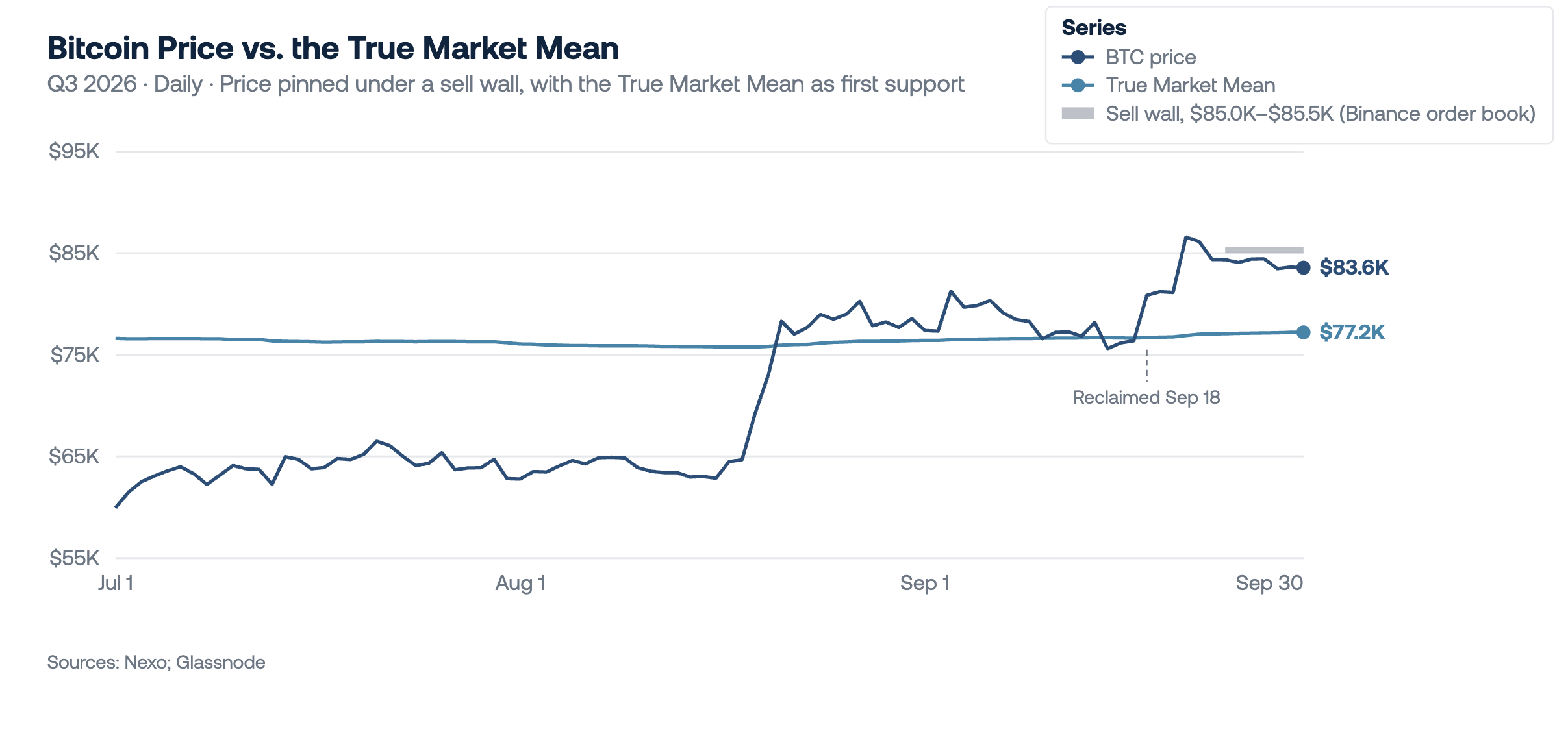
Bitcoin remains stuck between $82,000 and $85,000, extending more than a week of sideways trading. It briefly touched $85,600 on Wednesday as the PCE data cooled hike bets, but the move faded as yields rose and AI optimism after Micron's results pulled flows toward chip and tech stocks.
U.S. spot Bitcoin ETFs recorded $148.7 million of net outflows on Wednesday, ending a nine-day inflow streak that drew in $3.08 billion, the year's largest in dollar terms, per SoSoValue. The streak was already fading: daily inflows peaked near $1 billion on September 21 and shrank in the days after. Cumulative 2026 flows remain positive at about $970 million, with assets above $100 billion, though still roughly $5 billion short of last October's cumulative peak.
Derivatives look calm rather than stretched. Open interest eased to $20.9 billion from $21.8 billion, funding is stable near 3% annualized, and liquidations were modest at about $100 million, split evenly between longs and shorts. Calls account for 83% of 24-hour options volume, though traders are paying little premium for the upside.
Glassnode's weekly on-chain report describes an early uptrend that has yet to draw broad participation. Profit-taking is light next to past tops, though long-term holders now account for 55% of realized profit, up from 34% in the breakout week, and trading volume sits near the bottom of its range since the ETFs launched. A wall of sell orders between $85,000 and $85,500 caps price, with the True Market Mean at $77,200 the first support below. A break above the wall on rising volume, with ETF inflows returning, would point to a broadening uptrend, while a daily close below $77,200 would weaken it.
Ethereum & Altcoins
Ether trades near $2,700, flat on the day. U.S. spot Ether ETFs saw $59.6 million of net outflows on Wednesday, a second straight day after a seven-day, $850 million inflow run. XRP and Solana eased, Cardano slipped slightly and BNB was flat.
Beneath the flat prices, altcoin positioning looks healthier than the day's moves suggest. Glassnode's weekly data shows most of the top 500 tokens have outpaced Bitcoin over the past month, though the advance stalled this week. Leverage has stayed modest: only around a fifth of altcoins pay above-neutral funding on perpetual futures.
Macro & Institutional
Wednesday's PCE data was the one piece of good news for rates. Core PCE rose 0.2% in August, below expectations, and July was revised lower. Per CME's FedWatch tool on Thursday, the odds of an October hike fell to 38%, from 50% a day earlier and about 70% earlier in the week. Spending, however, grew at its fastest pace in more than a year, and FedWatch still discounts at least three further hikes by mid-2027. The PCE print bought time for October, not for the cycle.
The bond market is where the real pressure sits. The 10-year Treasury yield briefly topped 5.3% overnight, its highest since 2002, before dip buyers pulled it back to about 5.28%. It rose 87 basis points in the third quarter, the biggest quarterly increase since 1994, LSEG data show. The selloff is global. France's 10-year yield gained 120 basis points in the quarter, the most since 1987, and touched 4.96% as the government unveils its 2027 draft budget. Its gap over German Bunds is the widest since 2012, and the UK 30-year gilt yield hit 6%, its highest since 1998. Energy-driven inflation, an AI investment boom lifting expectations for where rates settle, and heavy government borrowing all feed the move. That mix helps explain why yields kept rising after a soft PCE print. The ECB has signaled its bond-buying tools are about price stability, not defending spread levels, and money markets price three more ECB hikes by mid-2027.
Brent's December contract trades near $100, up 42% over the quarter, as ceasefire diplomacy continues. Iran says it has received a U.S. response to its latest proposal, and Middle East crude exports in September reached their highest since the conflict began, though still about 3.2 million barrels a day below February levels. Gold trades around $4,150, down 6% in September, its worst month since June. The dollar index sits near 101.7 after its largest monthly gain since June, and the euro is near $1.13. European stocks are lower, with the STOXX 600 off 0.75% and banks down 1.8%, while Japan's Nikkei and South Korea's KOSPI rallied on Micron's results.
Looking Ahead
Today's ISM manufacturing survey is expected at 54.8, up from 54.6, with prices paid seen rising to 72.9 from 71.1, a test of both growth and inflation. France's draft budget will set the tone for European bonds. Friday's September jobs report is the main event, with consensus at 90,000 jobs and unemployment steady at 4.1%. Weekly jobless claims fell to 197,000, so there is little sign of labor stress. Stronger data has been feeding the bond selloff, so a firm print could extend it, while a soft one would reinforce the PCE-driven easing in October hike odds. A benign next CPI reading would ease the pressure for an October move further. For Bitcoin, the $82,000-$85,000 range is the frame, and flows and yields will likely decide the break. Stress in traditional finance has at times helped crypto, though history cannot say when caution gives way to something sharper.
Author: Iliya Kalchev, Analyst at Nexo’s Dispatch
This material is produced by Nexo for informational purposes only and does not constitute financial, investment, legal, or tax advice, or a recommendation to transact in any digital asset. Views are the author's as of the date of publication and may change without notice. Information is from sources believed reliable, but Nexo makes no warranty as to its accuracy and accepts no liability for any loss arising from reliance on this material.