Markets Today - July 30, 2026
Jul 30•6 min read
.png)
Daily analysis of crypto markets and the forces shaping them, from the Nexo research desk.
Bitcoin climbs toward $65,000 as cooling data eases the Fed's hand
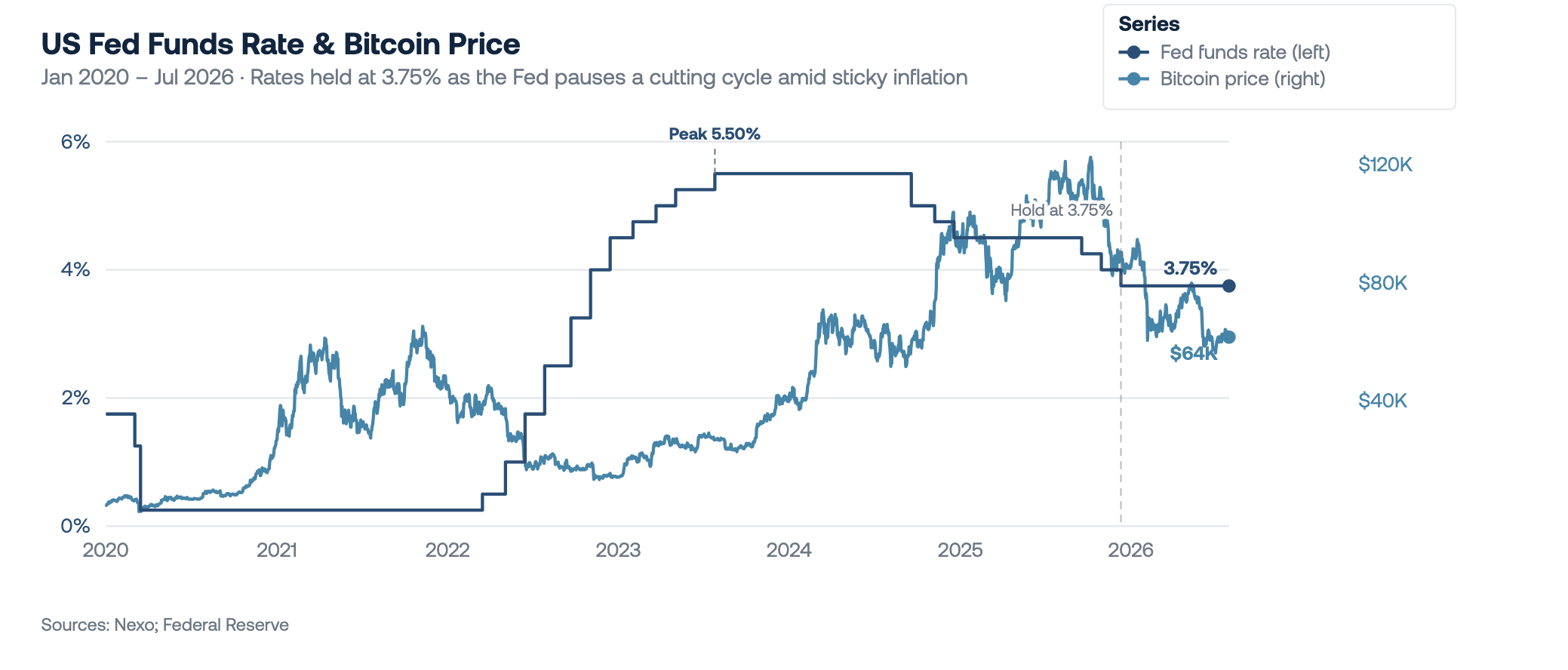
Bitcoin is firming on Thursday, rising toward $65,000 and holding above $64,500 as a run of softer U.S. economic data eased fears of another Federal Reserve rate hike, offsetting the hawkish tone of Wednesday's decision and a split set of megacap tech earnings. The crypto market's defining feature this week remains its composure: despite renewed U.S.-Iran escalation, oil near $92, and a semiconductor index down more than 14% over five sessions, digital assets have held firm. Ether has climbed back above $1,900, the total crypto market cap has stabilized above $2.2 trillion, and altcoins are mixed. After a fortnight in which equity turbulence set the rhythm, crypto's steadiness through this week's cross-currents is becoming a story in its own right.
Bitcoin
Bitcoin is changing hands near $64,600 and pressing toward $65,000, firmer on the day and strikingly stable given the backdrop. It traded in a tight band through both the Fed decision and Chair Warsh's press conference, then edged higher as Thursday's data landed — a composure that stands out against a Nasdaq 100 that has fallen into correction and a chip index in a bear market. The 48-hour pattern is by now familiar: Bitcoin has absorbed a hawkish central bank, a renewed oil spike, and a global tech selloff with only a shallow weekly move, far less than the assets at the center of the storm.
The interpretation worth drawing out is about what is not transmitting. For most of July, Bitcoin moved as a leveraged expression of the semiconductor trade; this week that grip has loosened, with crypto holding through a $797 billion drop in U.S. megacap tech last Thursday, Korea's record two-day equity decline, and now a divided Fed. The more sober reading is that some of this week's calm reflects thinning summer liquidity rather than genuine strength — a quiet tape can mask fragility as easily as resilience. But the consistency of the pattern is hard to ignore: whatever the cause, the assets whose valuations depend most on cheap money and AI optimism are falling, and Bitcoin is not following them down.
The rate outlook, the main near-term swing factor, shifted in Bitcoin's favor as Thursday's data landed. The Fed's hawkish hold had pushed September hike odds higher, and higher-for-longer policy raises the cost of the leverage and carry that fund speculative positions — but softer core inflation alongside slowing growth and rising jobless claims undercuts the case for another hike, easing precisely the pressure that has weighed on the sector. There are signs of underlying demand to match: U.S. spot Bitcoin ETFs flipped back to net inflows on Wednesday, and while the $32 million added was modest, it suggests investors continue to view current levels as an attractive entry point. Attention now turns to Strategy's results after the close: with the largest corporate holder having sold Bitcoin this year for the first time in nearly four years and made no purchases in the four weeks into earnings, any signal on further sales will be read closely as a gauge of treasury-model stress.
Ethereum & Altcoins
Ether climbed back above $1,900, outperforming the majors, with XRP at $1.07, Solana near $74, BNB holding at $572, and Hyperliquid's HYPE the weakest at $54. The weekly picture remains softer than Thursday's firmer tone suggests — HYPE down 8% over seven sessions, XRP off 6%, and Solana 5% lower, with BNB the lone major holding a modest weekly gain.
The texture of the recent selling is the point. Rather than a sharp response to any single catalyst, the altcoin softness has looked more like thinning liquidity than conviction-driven selling — a market drifting on light volume rather than being actively sold. That distinction matters, because liquidity-driven weakness tends to reverse more readily than fundamentally driven declines once participation returns. Ether's move back above $1,900, even as the smaller tokens lag, is consistent with the pattern seen all month: capital is discriminating within crypto, favoring the larger, more institutionally held assets over the higher-beta names.
Macro & Institutional
The Fed held its benchmark rate at 3.5% to 3.75%, but the decision was anything but unanimous — three policymakers dissented in favor of a hike, producing a 9–3 vote that underscored how live the inflation debate has become. Chair Warsh set the tone by declaring there is "no soft inflation target," reiterating that any reading above 2% is unacceptable to him and stressing that a hold does not mean the committee is unwilling to act. Markets took the message: long-dated Treasury yields rose and September hike odds climbed as investors recalibrated.
Thursday's data run complicated that hawkish message almost immediately. Core PCE — the Fed's preferred inflation gauge — rose just 0.1% in June, below the 0.2% expected and down from 0.3% previously, a clear step down in price momentum. At the same time, second-quarter GDP growth came in at 1.5%, well short of the 2.1% forecast, and initial jobless claims ticked up to 197,000. Taken together, the readings sketch an economy cooling on multiple fronts: inflation softening, growth decelerating, and the labor market loosening at the margin. That combination cuts against the case for further tightening — if price pressures are easing on their own as activity slows, the argument for a September hike weakens considerably, whatever the tone of Wednesday's meeting. For crypto, that is the constructive read: the data takes some of the sting out of the hawkish hold.
The more revealing corporate story was in tech earnings, where the market's new discipline came into sharp focus. Microsoft surged around 8% after its Azure cloud unit grew 43% and crossed $100 billion in annual revenue for the first time, and crucially, it held capital-spending plans steady rather than raising them — reassuring investors that its vast AI outlay is translating into returns. Meta fell about 8% on the opposite reading: record revenue overshadowed by a spending outlook lifted toward $130 billion, a 14% profit decline, and free cash flow collapsing below $1 billion. The divergence is the signal — markets are no longer paying indiscriminately for AI exposure but separating the companies monetizing the buildout from those still mostly funding it, with Apple and Amazon reporting after today's close.
Geopolitics stayed in the frame but contained: tensions between the U.S. and Iran escalated again overnight, though the response was reportedly limited to military targets rather than civilian infrastructure. Brent held above $92 after surging nearly 8% on Wednesday, and with U.S. crude inventories dropping to their lowest since 2018, the energy-inflation risk that is complicating the Fed's task remains firmly in place.
Looking Ahead
With core PCE, GDP, and jobless claims now in hand and pointing to a cooling economy, focus shifts to how the Fed weighs softening inflation against its hawkish rhetoric into September. Today the Bank of England is expected to hold, and after the U.S. close Apple and Amazon round out the megacap earnings that will complete the market's verdict on the AI trade; Strategy's results will draw crypto-specific attention for any signal on further Bitcoin sales. Friday brings the Bank of Japan decision, with the yen near multi-decade lows keeping normalization speculation alive, alongside China's manufacturing PMI. For Bitcoin, the test is whether its composure outlasts the summer's thin liquidity: pressing toward $65,000 through a hawkish Fed is notable, and if the softer data continues to erode the case for a September hike, the improvement in ETF flows and on-chain accumulation could harden this week's resilience into something more durable.
Author: Iliya Kalchev, Analyst at Nexo’s Dispatch
This material is produced by Nexo for informational purposes only and does not constitute financial, investment, legal, or tax advice, or a recommendation to transact in any digital asset. Views are the author's as of the date of publication and may change without notice. Information is from sources believed reliable, but Nexo makes no warranty as to its accuracy and accepts no liability for any loss arising from reliance on this material.