Markets Today - July 24, 2026
Jul 24•5 min read
-1.png)
Daily analysis of crypto markets and the forces shaping them, from the Nexo research desk.
Bitcoin holds firm as Big Tech falls, with the Fed decision the next test
Bitcoin is showing a notable measure of resilience, holding near $65,000 in the wake of Thursday's rout that wiped roughly $800 billion from the largest U.S. technology stocks in their worst session since early 2025. After weeks of trading as a near-pure proxy for the AI complex, that steadiness is the most consequential development in crypto this week — and it comes not because the backdrop is easy, but despite a backdrop that is decidedly hostile. Across other assets the strain was visible: U.S. equity futures are steadying on Friday after Thursday's slide, Brent crude sat near $97 after briefly topping $100 on the U.S.-Iran conflict, the dollar pushed to a three-week high, the 10-year Treasury yield climbed above 4.7%, and gold held near $4,030. Fresh U.S. tariffs on 60 trading partners took effect on top of it all. That Bitcoin absorbed this with only a marginal dip, while equities buckled, is what makes the session worth close attention. The total crypto market cap eased only slightly, with altcoins softer than Bitcoin.
Bitcoin
Bitcoin trades around $65,000, down less than 1% on the day and up around 3% on the week. The number matters less than the divergence behind it. The megacap technology group that has led U.S. markets for three years fell nearly 5% on Thursday, dragging the Nasdaq 100 down almost 2% on renewed fears over the scale of AI spending. Through most of July, a move of that magnitude in the AI complex would have carried Bitcoin down with it. This time it did not — and the anxiety driving the equity selloff is the very one that has whipsawed crypto all month, which is what makes the non-reaction significant rather than coincidental.
The question is whether this is the beginning of a genuine decoupling or a single session that reads better in hindsight than it will in a week. There is reason for caution: the link between crypto and the AI capital cycle is now structural, not merely correlative. The cleaner test arrives next week. If Bitcoin has genuinely broken from the AI trade, it should begin responding to its own drivers — liquidity, rates, the dollar, and flows, rather than to the Nasdaq tape. The Fed meeting is where that will show up: a Bitcoin that trades on the rate decision rather than on equity beta would be the first real confirmation that the tether has loosened.
Flows give the thesis some early footing. Spot Bitcoin ETFs are on track for their strongest weekly intake since early May, having drawn close to $1 billion across a seven-session run before that streak ended Thursday with around $225 million of outflows as stocks fell. That single-day reversal is less telling than the fact that the week's net position stayed firmly positive through an unusually adverse tape — institutional buyers spent much of July adding into weakness, behavior that tends to precede, rather than follow, a shift in an asset's trading character.
Ethereum & Altcoins
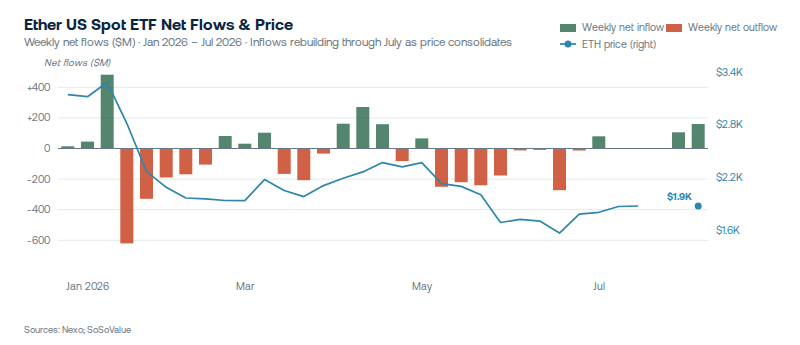
Ether eased to around $1,888, with XRP near $1.11, Solana around $76, and Cardano among the weaker performers, while BNB held comparatively steady. After leading the majors earlier in the week, the altcoin complex gave back some of those gains on Friday as the broader risk mood soured, leaving the group set for a middling stretch rather than a decisive move.
The more interesting signal sits in Ether's flows. Its ETFs extended an inflow streak to a fifth session with a further $26.3 million even as risk appetite faded and Bitcoin's own ETF run snapped. One reading is that allocators are beginning to position for a crypto narrative less defined by correlation to tech, one in which Ether's staking yield and its role as settlement infrastructure matter more than its sensitivity to the Nasdaq. If the AI trade is entering a more volatile phase, an asset with an income component and a distinct demand story becomes easier to underwrite — and the steadiness of the Ether bid through a shaky week suggests that case is quietly gaining adherents.
Macro & Institutional
Beneath the equity selloff, a more discriminating market is emerging. Alphabet lifted its capital-expenditure guidance toward $205 billion for the year and Tesla flagged 2026 as a heavy investment year while reporting soft profits, while Intel — posting its strongest quarterly revenue growth in over fifteen years, sales up 25% — showed the other side of the trade. The split is instructive: the market is no longer paying indiscriminately for AI exposure but beginning to separate the companies spending on the buildout from those already earning from it — a shift that could gradually loosen crypto's month-long grip on the AI trade.
The harder pressure is macro, and it is unambiguously risk-negative. The U.S.-Iran conflict is feeding directly into oil, with Brent briefly topping $100 for the first time since May — on rejected ceasefire efforts and Houthi attacks on Red Sea shipping — before easing toward $97. That energy impulse is colliding with a firmer rate outlook: jobless claims fell to their lowest in decades, pushing the 10-year Treasury yield above 4.7% and lifting the dollar toward a three-week high, with swaps markets edging toward a September Fed hike. President Trump's new tariffs on 60 trading partners layer a second inflationary impulse on top. The throughline of the whole week is that this backdrop should be weighing on speculative assets — and the fact that Bitcoin is holding through it is what lends the decoupling thesis its weight. Elsewhere, gold held a modest weekly gain near $4,030, steadied by its geopolitical bid.
Looking Ahead
Next week converts the decoupling question from observation into test, and the Federal Reserve's decision on Wednesday is the centerpiece. Markets lean toward rates staying on hold at 3.75%, but higher energy prices, fresh tariffs, and strong labor data have revived hike talk — and how Bitcoin trades around the decision, with the rate call or with the equity reaction to it, will say more about its independence than any single day this week. Tuesday brings U.S. consumer confidence for an early read on the household mood. Thursday is arguably the heavier data day: the Bank of England's rate decision, alongside U.S. core PCE — the Fed's preferred inflation gauge and a potential major mover for rate expectations into the autumn. Friday closes the week with the Bank of Japan's decision, where policymakers are expected to hold after last month's hike. For Bitcoin, the near-term task is straightforward — hold the $65,000 area it has defended all week — but the larger prize is what that would signify: an asset beginning to trade on its own terms, at exactly the moment the trade that governed it is coming under scrutiny.
Author: Iliya Kalchev, Analyst at Nexo’s Dispatch
This material is produced by Nexo for informational purposes only and does not constitute financial, investment, legal, or tax advice, or a recommendation to transact in any digital asset. Views are the author's as of the date of publication and may change without notice. Information is from sources believed reliable, but Nexo makes no warranty as to its accuracy and accepts no liability for any loss arising from reliance on this material.