Markets Today - August 31, 2026
Aug 31•5 min read
.png)
Daily analysis of crypto markets and the forces shaping them, from the Nexo research desk.
Bitcoin holds above $78,000 as a hawkish Fed and renewed Iran strikes test August's rally
Bitcoin holds near $78,000 on Monday, absorbing a genuinely difficult combination of news that has pressured almost every other asset class: fresh U.S. strikes against Iran over the weekend — the first since late July — sent oil surging past $90 a barrel, while Fed Chair Kevin Warsh's hawkish Jackson Hole address has pushed September rate-hike odds to around 58%, up sharply from roughly 35% before he spoke. Equity futures point lower, gold has pulled back to near $4,440 despite the fresh geopolitical shock, and the dollar is little changed. Bitcoin's composure amid all of that stands out: the token is on track for a gain of more than 24% in August, its best monthly performance since 2017. Ether, XRP, Solana, and Cardano have all posted strong monthly advances too, even as today's session is modestly softer across the board.
Bitcoin
Bitcoin trades near $78,700, up modestly on the day after touching an intraday low of $77,000, and is set to close August with a gain exceeding 24% — its strongest month since 2017 and its biggest single-month advance since November 2024. That rally was built earlier in the month on the U.S. Treasury's surprise decision to expand its long-bond buybacks, which pulled yields lower and revived broad risk appetite; the question now is whether those gains can survive a fresh, and genuinely different, kind of test.
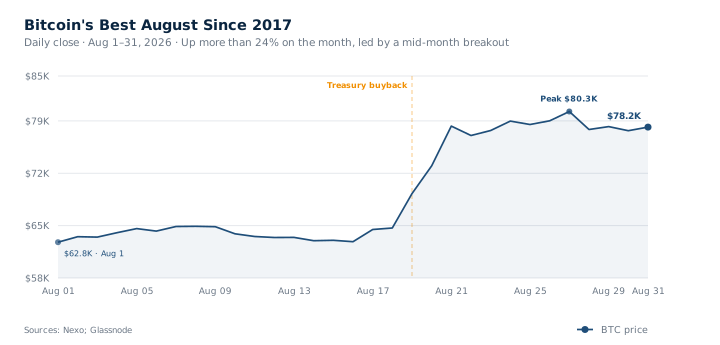
That test arrived over the weekend in two forms at once. Geopolitically, the U.S. and Iran exchanged fresh strikes for the first time since late July, reviving concerns over shipping through the Strait of Hormuz. On the monetary side, Warsh's refusal to describe recent inflation data as genuine progress has hardened the market's rate outlook just as that energy shock threatens to complicate it further. A hawkish Fed and a live geopolitical escalation rarely hit risk assets in the same week; Bitcoin holding its ground against both at once is arguably a more meaningful signal than the August gain itself.
The derivatives data suggests the market hasn't yet decided which way to lean. Twenty-four-hour trading volume more than doubled to $183 billion, while open interest has stayed roughly flat near $136 billion — a pattern consistent with traders actively repositioning rather than committing fresh capital in either direction, reinforced by a taker ratio that remains evenly split between longs and shorts. Total liquidations reached $431 million, though notably Bitcoin wasn't the epicenter: Ether accounted for $130 million of that figure against Bitcoin's $100 million, suggesting altcoin positioning had grown more stretched heading into the weekend's headlines than Bitcoin's own book.
Ethereum & Altcoins
Ether trades near $2,448, down slightly on the day but still on track for a monthly gain approaching 30%. XRP has eased modestly, up more than 27% for August, while Solana and Cardano — both softer today, head into month-end with gains of roughly 40% and 15% respectively, among the strongest performances across the sector this month. BNB is also lower on the day after a monthly advance north of 16%. Even the memecoin segment posted outsized August gains despite falling today, underscoring just how broadly speculative appetite spread through the market before this weekend's news arrived.
The liquidation data adds a useful footnote to that strength: Ether led all tokens in forced closures today, with Solana, XRP, and Zcash also among the largest losers — a sign that the very breadth of August's rally left altcoin positioning more leveraged, and therefore more exposed to a shakeout, than Bitcoin's comparatively steadier book.
Macro & Institutional
Warsh's Jackson Hole address is the week's dominant macro thread. Speaking Friday, he argued that summer inflation readings, while better than expected, don't point to meaningfully improved underlying trends — a message markets read as unambiguously hawkish despite the absence of explicit forward guidance. September rate-hike odds jumped from around 35% to near 60% within hours, and equities wobbled into the close even as all three major U.S. indexes still finished the week higher. The genuine open question now is whether that hawkish tone reflects true committee consensus or a more personal signal from a chair still establishing his own framework — a distinction Fed Governors Barr and Waller's scheduled remarks this week should help clarify.
Layered on top of that repricing is the weekend's military escalation, which adds a second and more urgent inflation channel. Brent crude has surged past $90 and WTI has climbed above $85, both up sharply as the strikes revive concerns that shipping through the Strait of Hormuz — which has continued carrying an average of roughly 5 million barrels a day even through months of underlying tension — could face renewed disruption.
Gold's reaction is telling in itself: despite the fresh geopolitical shock, the metal actually fell today to around $4,440, extending Friday's sharpest daily drop since early June, as the more hawkish rate outlook is currently outweighing its usual safe-haven pull. Even so, gold remains up roughly 10% for August — its best month since January, with the broader concern over widening fiscal deficits and currency debasement, reinforced by the Treasury's own bond-market intervention earlier this month, still seen as a floor under prices even as the pace of gains slows.
Looking Ahead
The week's data calendar could reinforce or complicate Warsh's hawkish framing. Tuesday brings July's JOLTS report alongside remarks from Fed Governor Barr; Wednesday delivers August ADP payrolls and ISM manufacturing data; Waller speaks Thursday; and Friday's nonfarm payrolls report is the week's key release, with economists expecting a rebound to around 58,000 jobs after July's surprise 23,000 contraction. Even a solid print may not settle the debate — the more decisive input for September's decision is the August CPI report due September 11. Beyond the calendar, whether the Iran situation calms or escalates further may matter just as much, given the direct line from oil to inflation. For Bitcoin, a month of exceptional gains now faces its first real dual stress test — a hawkish Fed and a live geopolitical shock arriving together — and whether it holds above $78,000 through the week's data may say more about August's durability than the gain itself.
Author: Iliya Kalchev, Analyst at Nexo’s Dispatch
This material is produced by Nexo for informational purposes only and does not constitute financial, investment, legal, or tax advice, or a recommendation to transact in any digital asset. Views are the author's as of the date of publication and may change without notice. Information is from sources believed reliable, but Nexo makes no warranty as to its accuracy and accepts no liability for any loss arising from reliance on this material.