Markets Today - August 19, 2026
Aug 19•5 min read
.png)
Daily analysis of crypto markets and the forces shaping them, from the Nexo research desk.
Bitcoin steady amid geopolitical deadlock
Bitcoin trades near $64,850, up 1% on the day, staying largely untouched even as a global rout in semiconductor stocks sent South Korea's Kospi down more than 6% and the Philadelphia Semiconductor Index through its worst session since late July. The selloff's real driver runs deeper than chips alone: a global bond rout has pushed 30-year U.S. Treasury yields to their highest since 2007, tightening financial conditions for the capital-intensive AI infrastructure spending that has driven markets this year. Brent crude sits near $91 a barrel, its highest in three weeks, as the Strait of Hormuz standoff drags on, while gold holds near $4,361 after paring some of Tuesday's losses. U.S. equity futures stayed subdued into the session, with the Nasdaq 100 among the softer performers following Tuesday's chip-driven selloff on Wall Street. Markets now turn to this afternoon's release of the Fed's July meeting minutes for a clearer read on how close the central bank actually came to a rate hike last month.
Bitcoin
Bitcoin holds near $65,000, extending a range that has now persisted since the start of June — roughly $58,000 to $66,500 — even as risk assets elsewhere came under real pressure this week. VanEck's research argues Bitcoin may be nearing the end of an extended correction, with eight of twelve signals in its capitulation framework currently active and all twelve having flashed at some point over the past three months. Prior bear-market drawdowns have averaged close to 13 months from peak to trough; Bitcoin is now roughly 11 months past its October high, which would place a potential accumulation phase somewhere between September and November on that historical pattern. VanEck cautions the signals haven't reliably marked short-term entry points in the past, though it expects a shallower trough this time given a larger institutional holder base and the absence of the exchange and lender failures that deepened prior downturns.
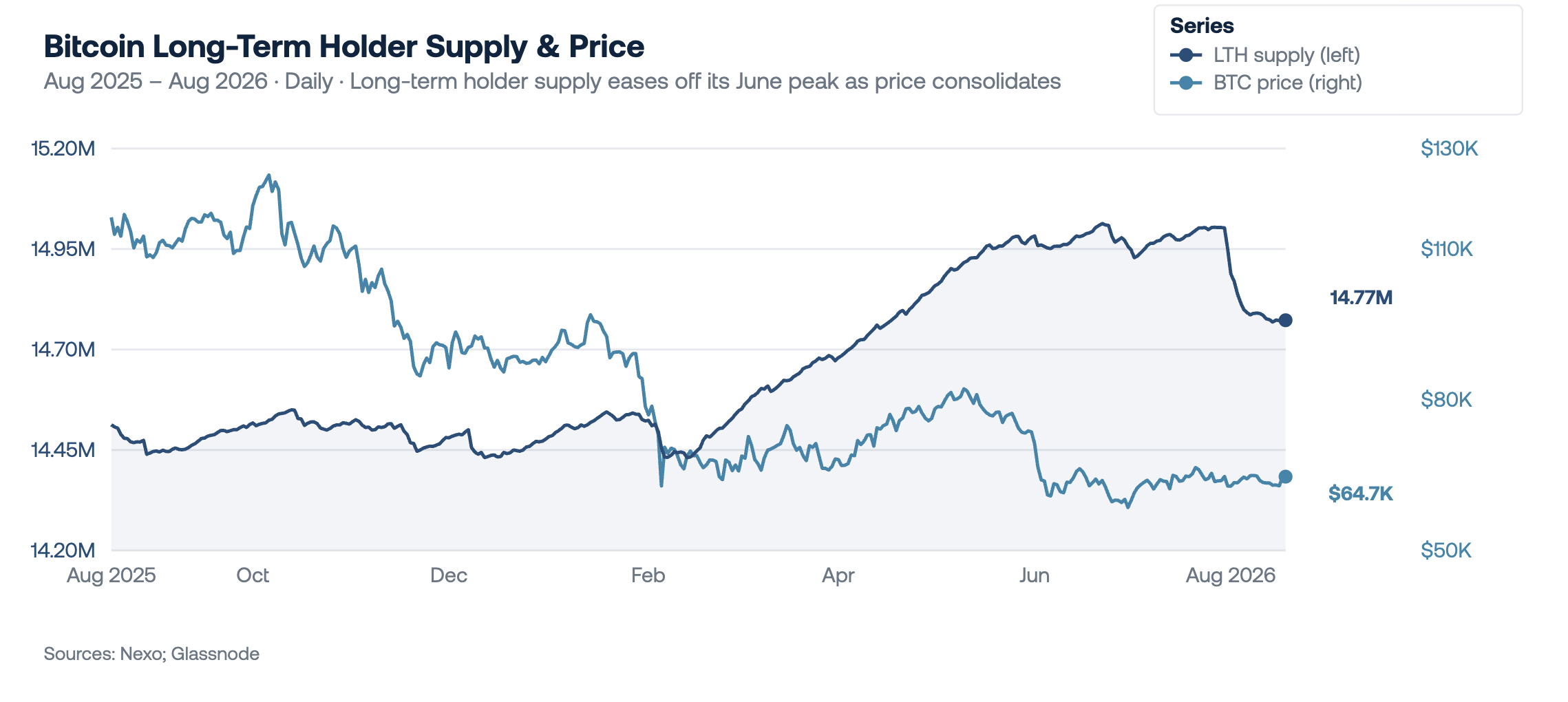
The flow picture lends some support to that thesis. Spot Bitcoin ETFs pulled in nearly $300 million on Monday, the strongest single day since early May, followed by a further $189 million on Tuesday. Beneath the surface, the composition of holders is shifting too: the amount of Bitcoin held for more than a year has fallen by roughly 356,000 coins over the past month, pushing long-term holders' share of supply below 60% for the first time in months — a gradual redistribution from older to newer hands typical of a market working through a bottoming process.
Ethereum & Altcoins
Ether trades just above $1,900, leading the week's gains among the majors with a roughly 1.5% advance. Solana is the day's standout, up 2% to near $77, while XRP has recovered to trade just under $1 after a softer week. BNB and Hyperliquid's HYPE moved in opposite directions on the week — HYPE remains the best-performing major over seven days despite a daily pullback, while BNB has lagged. The dispersion, even as the broader tape stayed calm through the chip-sector turmoil, suggests altcoin positioning is being driven by token-specific flows rather than a single macro narrative this week.
Macro & Institutional
Markets are focused squarely on this afternoon's release of the Fed's July meeting minutes, the first detailed look at internal deliberations since Chair Warsh's press conference left investors with little forward guidance beyond a pledge that the Fed will "not waver" on its inflation target. Warsh has since described that meeting as a "good family fight," a characterization that undersells how split the committee actually was — three members dissented in favor of an immediate quarter-point hike. With most economists still expecting the Fed to hold rates steady in September, the minutes matter less for resolving that outcome than for gauging how much internal pressure exists for a shift — a read markets have almost no other way to obtain given Warsh's reluctance to offer a clear rate-path signal.
The bond market has become the more immediate source of stress. Thirty-year Treasury yields have climbed to levels last seen before the 2008 financial crisis, and the resulting rise in borrowing costs strikes directly at the AI infrastructure buildout that has underpinned so much of this year's equity gains — a link that helps explain why chip stocks, rather than the AI story itself, bore the brunt of this week's selloff. That dynamic captures something worth sitting with: the market's biggest risk right now may not be whether AI's promise gets fulfilled, but whether it can get financed cheaply enough to be fulfilled on the current timeline.
Energy markets remain a persistent complication. The framework ceasefire agreement between the U.S. and Iran expired this week without renewal, and tanker traffic through the Strait of Hormuz has thinned further, with six vessels crossing on Tuesday against a ten-day average of eleven. Brent's climb to three-week highs near $91 feeds directly into the same inflation channel the Fed is trying to assess. Regulatory developments offered a rare bright spot: the SEC has proposed a new "Regulation Crypto Assets" framework offering streamlined capital-raising exemptions for digital asset issuers, moving forward independently even as the broader Clarity Act remains stalled in Congress ahead of a procedural vote now pushed to mid-September.
Looking Ahead
Today's Fed minutes are the session's central event, offering the clearest available signal on how seriously the committee's dissenting hawks are being taken internally, ahead of Chair Warsh's remarks at the Jackson Hole symposium next week — likely the next real catalyst for the rate debate given how little forward guidance the Fed has offered on its own. Thursday brings the Philadelphia Fed manufacturing index alongside weekly initial and continuing jobless claims; Friday rounds out the week with the S&P Global manufacturing and services PMIs. Beyond the calendar, markets will watch whether the Strait of Hormuz standoff shows any sign of easing, and whether this week's tentative signs of Bitcoin capitulation give way to the kind of sustained institutional inflows that would support a genuine transition toward accumulation. For Bitcoin, the range that has held since June remains the key marker to watch — a market that shrugged off this week's chip-sector turmoil has, at minimum, demonstrated it is not simply trading as a leveraged proxy for the broader AI trade right now.
Author: Iliya Kalchev, Analyst at Nexo’s Dispatch
This material is produced by Nexo for informational purposes only and does not constitute financial, investment, legal, or tax advice, or a recommendation to transact in any digital asset. Views are the author's as of the date of publication and may change without notice. Information is from sources believed reliable, but Nexo makes no warranty as to its accuracy and accepts no liability for any loss arising from reliance on this material.