What does Q4 hold for Bitcoin?
Sep 29•8 min read
In this patch of your weekly Dispatch:
- Bitcoin’s stronger Q4 setup
- The data behind the Fed’s next decision
- The strongest ETFs flows in 2026
Market cast
BTC: Near highs, daily chart takes a pause
On the weekly chart, Bitcoin’s price is still hovering near the upper Bollinger Band, a volatility-based indicator, with bullish sentiment remaining intact. The RSI, a momentum oscillator, is elevated but has not yet crossed the 70 threshold, while the Stochastic, another momentum oscillator, sits in overbought territory, with next week set to confirm whether this bullish momentum can hold. The MACD, a trend and momentum indicator, keeps its histogram deep in positive territory.
On the daily chart, momentum has slowed: price has pulled back from its recent high and shifted into a ranging pattern. Both RSI and Stochastic are approaching overbought levels, and the MACD histogram sits slightly below the zero line. The ADX, which measures trend strength, has also started to decline, confirming the loss of momentum.
Key levels to watch: on the downside, immediate support sits around $83,000, with the next level near $80,000. To the upside, resistance comes in around $85,000, followed by $87,000, with the weekly upper Bollinger Band also acting as dynamic resistance along the way.
The big idea
Is Bitcoin starting Q4 with tailwinds?
Bitcoin enters Q4 with stronger spot demand and improving market structure, but the outlook remains conditional – on ETF inflows persisting, overhead supply getting absorbed, and US inflation data not forcing the Fed into further tightening.
The technical signal drawing attention is Bitcoin's reclaim of its 365-day moving average last week, the first time since March 2023, a level whose reclaim has preceded past bull markets and whose loss has preceded past bear markets, according to CryptoQuant. Price, trading around $83,000, has cleared the $76,000-$81,000 band where long-term holders sold heavily earlier this year. Above that, a supply cluster sits near $88,000-$90,000, and beyond it, $96,700, where the average holder's paper profit returns to its historical norm, per Glassnode. Below, the Realized Price – a running average of every holder's cost basis – has risen to $77,000 and held as support through the recovery, something neither the 2018 nor 2022 bear market managed.
The demand-side data is constructive, with a caveat attached. Realized profit-taking has stayed light relative to the 2024–2025 tops, and most short-term holders are back in profit without selling into it. US spot Bitcoin ETFs just posted their strongest week of 2026, $2.39 billion (more in this week's data story), and spot volume has more than doubled off its August low. Options positioning leans the same way – a put/call ratio averaging 0.67 over two weeks, and the largest single position on the board is $140,000 calls expiring December 25 – with dealer hedging pointing to 95,000–97,000 as the first real resistance test.
Monday reminded us that Bitcoin doesn't move in isolation. The Nasdaq-100 slipped from 744.45 to 737.76 in premarket trading, gold fell from $4,260 to $4,147, and Bitcoin dropped from $84,500 to $82,800, all while the dollar index also traded lower. That's not classic flight-to-safety positioning, where the dollar would typically firm; it reads more like broad-based deleveraging across risk assets, Bitcoin included.
The calendar ahead is unusually concentrated. Two FOMC meetings remain this quarter, October 27–28 and December 8–9. Markets were pricing roughly 65% odds of another 25-basis-point October hike, versus 35% for a hold, at the start of this week, according to CME FedWatch – a figure that moves daily. Q4 has historically been bitcoin's strongest quarter, averaging a 77–85% return since 2013, but that record includes years it didn't hold.
What would strengthen the case: continued ETF inflows, the $88,000-$90,000 zone getting absorbed rather than rejected, and inflation data that doesn't force the Fed's hand further. Worth watching closely: at $83,000, price is hovering right around the $84,000-$85,000 zone Glassnode identified last week as the market's main cushion of recent buyers, rather than comfortably above it – whether it holds matters more than the number itself. What would weaken the case further: a hawkish surprise at either FOMC meeting, or a jump in realized profit signaling holders are exiting into strength. Worth remembering, too: each of Bitcoin's last four cycles has delivered a smaller multiple off its low than the one before – 600x, then 100x, then 22x, then roughly 8x – a pattern worth tempering expectations against.
Blockchain
The crypto economy that didn't crash with the price
Crypto's underlying economy barely dented during its worst bear market since 2022. Chainalysis found global crypto activity shrank just 1.6% to $9.4 trillion in the year through June, even as total market cap fell 50%. The growth came from real usage, not trading: domestic peer-to-peer transfers jumped 302.9% to $228.7 billion, and cross-border stablecoin flows rose 77.5% to $220.3 billion – payments averaging just $3,000, which Chainalysis says is "far too small to be institutional." Stablecoin balances held remarkably steady near $100 billion while broader crypto balances nearly halved. Brazil topped Chainalysis's new adoption index with a $252.5 billion crypto economy, ahead of the US, Nigeria, Japan, and South Korea, while Venezuela's crypto economy more than doubled to $39.1 billion.
TradFi trends
Mass tokenization is coming, CFTC says
The CFTC is preparing markets for what its chair calls "mass tokenization." Michael Selig told a Treasury Market conference this week that the next decade will likely bring more change to financial markets than the last several decades combined, driven by tokenization, on-chain finance, and 24/7 trading. The agency has spent the past year seeking comment on round-the-clock trading for energy derivatives and, in February, expanded eligible collateral to include stablecoins issued by national trust banks. It's part of a pattern: days earlier, the SEC rolled out its own innovation exemption for tokenized stock trading. Both agencies are moving under existing authority while the broader crypto bill remains stalled in the Senate.
Macroeconomic roundup
The data that could decide the Fed's next move
Bitcoin heads into this stretch near $80,000, riding its strongest ETF week of the year. Whether that holds depends less on the next Fed meeting than on four reports landing in three days.
PCE inflation (Wednesday): Core PCE is forecast at 3.4% for August, still well above the Fed's 2% target. A hotter print undercuts rate-cut hopes; a cooler one supports them.
U.S. GDP, Q2 (Wednesday): Growth was last put at 1.5% for Q2, down from 2.1% in Q1. A stronger revision gives the Fed more room to hold rates higher for longer.
ISM Manufacturing (Thursday): August's index came in at 54.6, still in expansion territory but down from July, with prices paid stuck at 71.1. A further slide would signal factories feeling the rate pressure.
Nonfarm payrolls & unemployment (Friday): Around 90,000 new jobs are expected, down sharply from August's 162,000, with unemployment seen holding at 4.1%. Bitcoin jumped after June's weak jobs report – a repeat here could do the same, while a strong print reinforces higher-for-longer.
The week's most interesting data story
Bitcoin ETFs just posted their best week in 2026
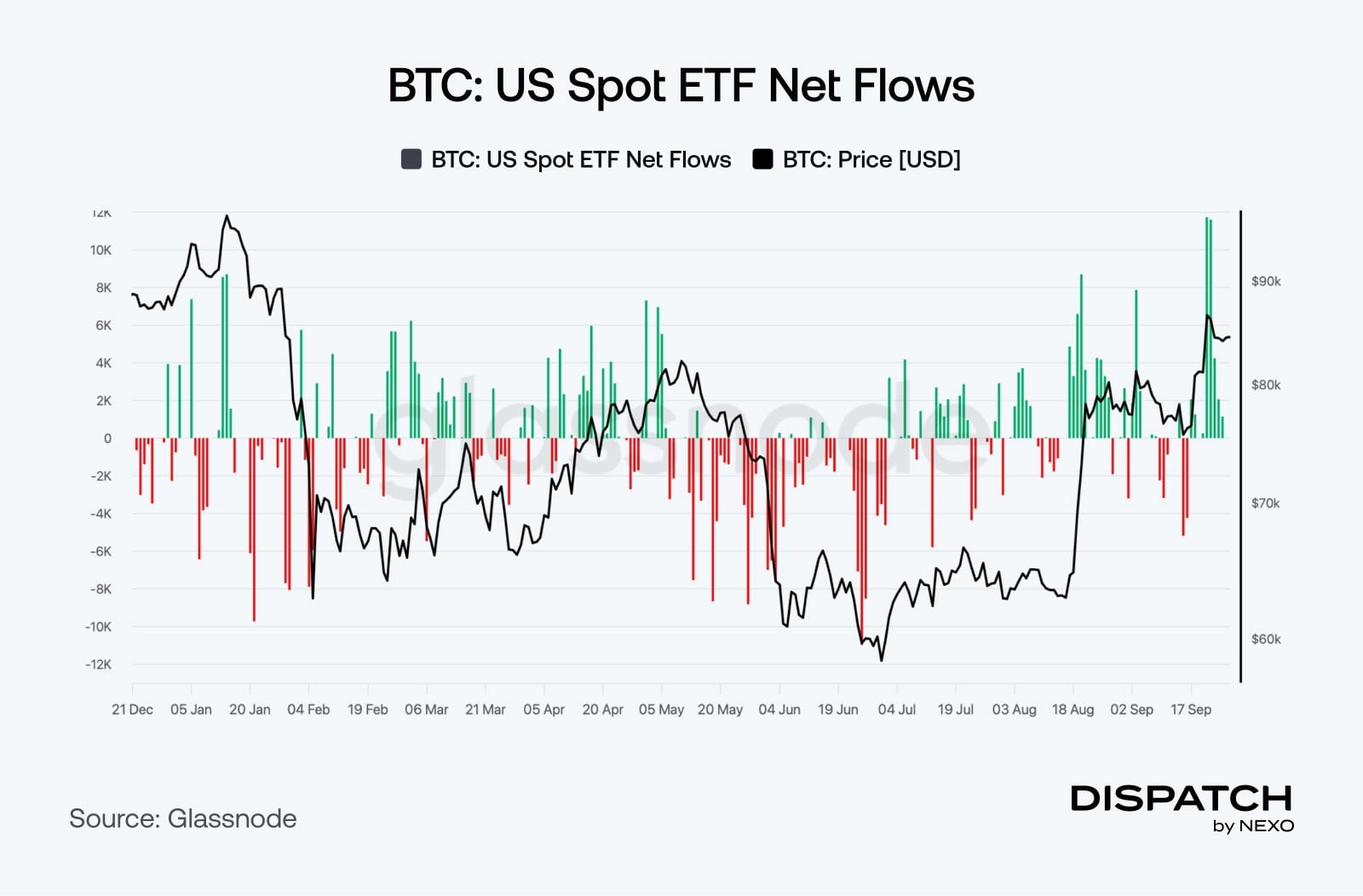
US spot Bitcoin ETFs pulled in $2.39 billion this week, their strongest since the week ending October 10, 2025, and the biggest week of 2026 so far. The funds were sitting on a $5.55 billion year-to-date deficit as recently as early July; by Friday, that had flipped to a $926 million net positive for 2026. Monday did the heavy lifting, with nearly $1 billion in a single day, before the pace cooled to $134.5 million by Friday – a normal fade after a big move, not a reversal. The timing is notable: inflows kept coming even as Bitcoin slipped from above $87,100 to around $83,000 by week's end. That's demand holding up through a pullback, not just chasing a rally higher.
The numbers
The week’s most interesting numbers
$5 – NEAR's price, topping this level for the first time since 2025, as investors piled in ahead of spot ETF listing.
$85,000 – JPMorgan's estimated Bitcoin production cost, cleared after 280 days below it, which the bank says reduces the risk of forced miner selling.
$188 million – Record weekly inflow into U.S. spot Solana ETFs, with every fund in the group posting gains.
Hot topic
What the community is discussing
The good news is that it is coming down, right?
Cause for concern in the stock market?
A deep-dive on where Ethereum is headed.
Dispatch is a weekly publication by Nexo, designed to help you navigate and take action in the evolving world of digital assets. To share your Dispatch suggestions and comments, email us at [email protected].
This content is for informational purposes only and does not constitute investment, legal, or tax advice. Crypto assets are highly volatile and their value can go up or down significantly, including to zero. Past performance and historical correlations are not indicative of future results. Nexo has a commercial interest in the adoption of digital assets.
The availability and use of any products or services made available through Nexo US LC (“Nexo US”) are subject to the applicable terms and conditions on the Nexo US platform. This message is for informational purposes only and does not constitute financial, investment, legal, or tax advice. Any decision you make based on this information is solely your responsibility. Nexo US provides the user interface and routes client instructions to third-party service providers. Investment advisory services for eligible digital asset strategies are provided by Gravitalix Financial, LLC (“Gravitalix”), an investment adviser registered with the U.S. Securities and Exchange Commission. Registration with the SEC does not imply a certain level of skill or training. Please review Gravitalix’s Form ADV and related disclosures carefully before investing. Digital assets are not money or legal tender, are not backed by any government or central bank, and are not insured or guaranteed by any governmental or private insurance scheme (including FDIC or SIPC). Any rates, yields, or rewards displayed in the Nexo US app or related materials are subject to change, may be reduced or discontinued at any time, are not guaranteed, and may not be available in all jurisdictions or for all clients. Past performance is not indicative of future results.
Digital Asset services are provided by Bakkt Financial Solutions I, LLC (NMLS ID 1890144) through a software licensing agreement between Bakkt Financial Solutions I, LLC (“Bakkt”) and Nexo US LLC. Bakkt is not a registered broker-dealer and is not a member of SIPC or FINRA. Digital assets are not FDIC- or SIPC- insured. Bakkt Financial Solutions I, LLC is licensed to engage in virtual currency business activity and money transmission by the New York State Department of Financial Services. Digital asset borrowing requires sufficient collateral. Failure to maintain collateral value due to market volatility may result in the liquidation of your assets. Please ensure that you fully understand the risks involved before trading. See here for Bakkt Licenses and Bakkt Disclosures. If you no longer wish to receive marketing communication from us, including product updates, industry news and exclusive promotions, click here.