Is Bitcoin preparing for a (bull) run?
Sep 23•8 min read

In this patch of your weekly Dispatch:
- Bitcoin won in the House
- Market rally on the rise
- ETH’s Glamsterdam arrives in October
Market cast
BTC: Bulls break higher
On the weekly chart, price broke above the 50-period SMA and is now hovering near the upper Bollinger Band, a volatility-based indicator, with the next upside target at the 100-period SMA. The RSI, a momentum oscillator, is rising, and while the Stochastic, another momentum oscillator, is in overbought territory, there are no signs yet of fading momentum. The MACD, a trend and momentum indicator, keeps its histogram deep in positive territory and continues to climb.
On the daily chart, price also looks strongly bullish, trading above all key moving averages. Both the RSI and Stochastic are in overbought territory, and the coming days will show whether this momentum can be sustained. The MACD histogram is positive, and the ADX, which measures trend strength, is at elevated levels and still rising.
Key levels to watch: On the downside, immediate support sits in the $82,000–$83,000 zone, with the next level near the round $80,000 mark. To the upside, resistance comes in around $88,000, followed by $90,000, with the weekly 100-period SMA also acting as dynamic resistance along the way.
The big idea
The signals for Bitcoin’s recovery
Bitcoin just did something it hasn't managed in 45 weeks: close above its 50-week moving average. History says that matters more than most single-week milestones do.
A week built to break it: The Senate's Clarity Act failed to clear cloture, falling short 49-50 and leaving the industry without the statutory framework it had been waiting on. Days later, the Federal Reserve delivered its first rate hike since 2023. The Bank of Japan followed with its own hike, pushing its benchmark rate to a 31-year high. Add a dollar index at a one-month high and oil above $106 a barrel, and the setup was for a broad risk-off move– one that, on paper, should have hit Bitcoin hardest of all. Spot Bitcoin ETFs still managed to turn out a positive result: a modest $6.2 million in net inflows, thin against the $55 billion the funds have taken in since launch, but positive all the same.
That week didn't hit Bitcoin the way the setup suggested. Bitcoin briefly dipped toward $75,000 after the Clarity Act vote and recovered within days, ending the week near $81,000.
The short-covering catalyst: Part of that recovery came from positioning unwinding rather than fresh demand. More than $230 million in Bitcoin shorts and $445 million across the market were liquidated in a single session, echoing the pattern from August's rally, when a 25% price gain coincided with a 12.6% drop in coin-denominated open interest. Short covering alone doesn't confirm new conviction is building, which is why what happened on the spot side matters more.
The buying underneath: And on the spot side, the signal is more direct. Long-term holders were net sellers through most of August, offloading roughly 16,000 to 20,000 Bitcoin a day. That reversed at the end of the month, and the pace of accumulation has built steadily since, reaching a net 25,735 Bitcoin accumulated on September 20 alone– the strongest single-day accumulation in a month. Spot volume backs this up: net spot flow stayed negative through the Clarity Act vote and the Fed hike, then turned decisively positive the same day Bitcoin broke back above $80,000. This is spot demand, not derivatives positioning unwinding, and it points to real buyers stepping in rather than sellers simply stepping back.
Sellers running out of road: There's also a milder read on the selling side. A seller-exhaustion measure from Glassnode, built to capture the intensity of active selling pressure, climbed earlier in September as Bitcoin softened from its highs, then fell sharply through the Clarity Act vote and the Fed's hike, reaching one of its lowest readings on record by September 20– lower even than the level seen after the December 2022 decline.
The technical case: Then there's the technical case. Bitcoin has reclaimed its 50-week moving average 13 times in prior bear markets. Eleven of those reclaims held, and each of the four major cycle bottoms since 2011 was followed by a multi-year rally before the market saw a new low. The two failures both happened in the 2021–2022 downturn– the one prior instance this cycle most resembles in terms of macro pressure and volatility.
That last point is also the honest caveat: this signal has failed before, in conditions not unlike today's. And Bitcoin's own seasonality argues for caution into next week even as Q4 has historically been the strongest quarter of the year.
What happens next: This recovery has had real buying behind it, not just sellers stepping back. Some consolidation from here wouldn't be surprising after a move this fast. On top of the on-chain and ETF signals, Bitcoin picked up a regulatory tailwind this week too, with the House advancing legislation to formally custody the government's bitcoin holdings (more on that below). Whether the rally extends beyond it is less about the moving average than about whether long-term holders and spot buyers keep stepping in the way they did this week, or whether that turns out to have been the exception rather than the start of a pattern.
Ethereum
Ethereum nears its October Glamsterdam test
Ether's ETFs snapped a four-week inflow streak last week, pulling a net $140 million out even as Bitcoin funds stayed positive. The more important story for Еther may be structural: Glamsterdam, its next major upgrade, is designed to roughly double block capacity toward a 200 million gas limit, creating room for more payments and trades before fees start climbing. The upgrade also brings the validator-block builder relationship directly into the protocol, formalizing a division of labor that today runs on informal, off-chain arrangements. A private rehearsal completed the transition cleanly on September 17, hitting the capacity target without losing finality, with the first public test set for October 6.
TradFi trends
А U.S. Bitcoin reserve is happening?
Bitcoin just won in the House what it lost in the Senate. Days after the Clarity Act stalled, the House Financial Services Committee voted 28-21 to advance the Strategic Bitcoin Reserve Bill – the first federal committee approval of legislation to formally custody the government's bitcoin. The bill locks in the roughly 324,527 BTC the U.S. already holds, worth about $24.8 billion, for 20 years, bars any sale or pledge, and directs Treasury and Commerce to find budget-neutral ways to add more. It still needs a House floor vote, the Senate, and the President's signature, but it's a real step toward bitcoin as a permanent government holding, not just a forfeiture windfall.
Macroeconomic roundup
The first data after the rate hikes
Last week's Fed and BOJ hikes are done; this week tests whether they bite. Bitcoin enters above $80,000, up roughly 8% over seven days, with Friday's inflation-expectations data as the key test.
Fed officials Williams and Barr speak (Sept. 23): No break from Powell's line is expected; any daylight on the pace of hikes would move markets more than the remarks warrant.
Bank of Japan rate hike takes effect (Sept. 24): The move to 1.25% raises the cost of yen-funded positions. Implementation doesn't force unwinds– whether the higher cost starts to bite is the open question.
University of Michigan Inflation Expectations (Sept. 25): Preliminary reading was 4.6%. A softer final print supports risk appetite; a firmer one pressures the recovery.
The week's most interesting data story
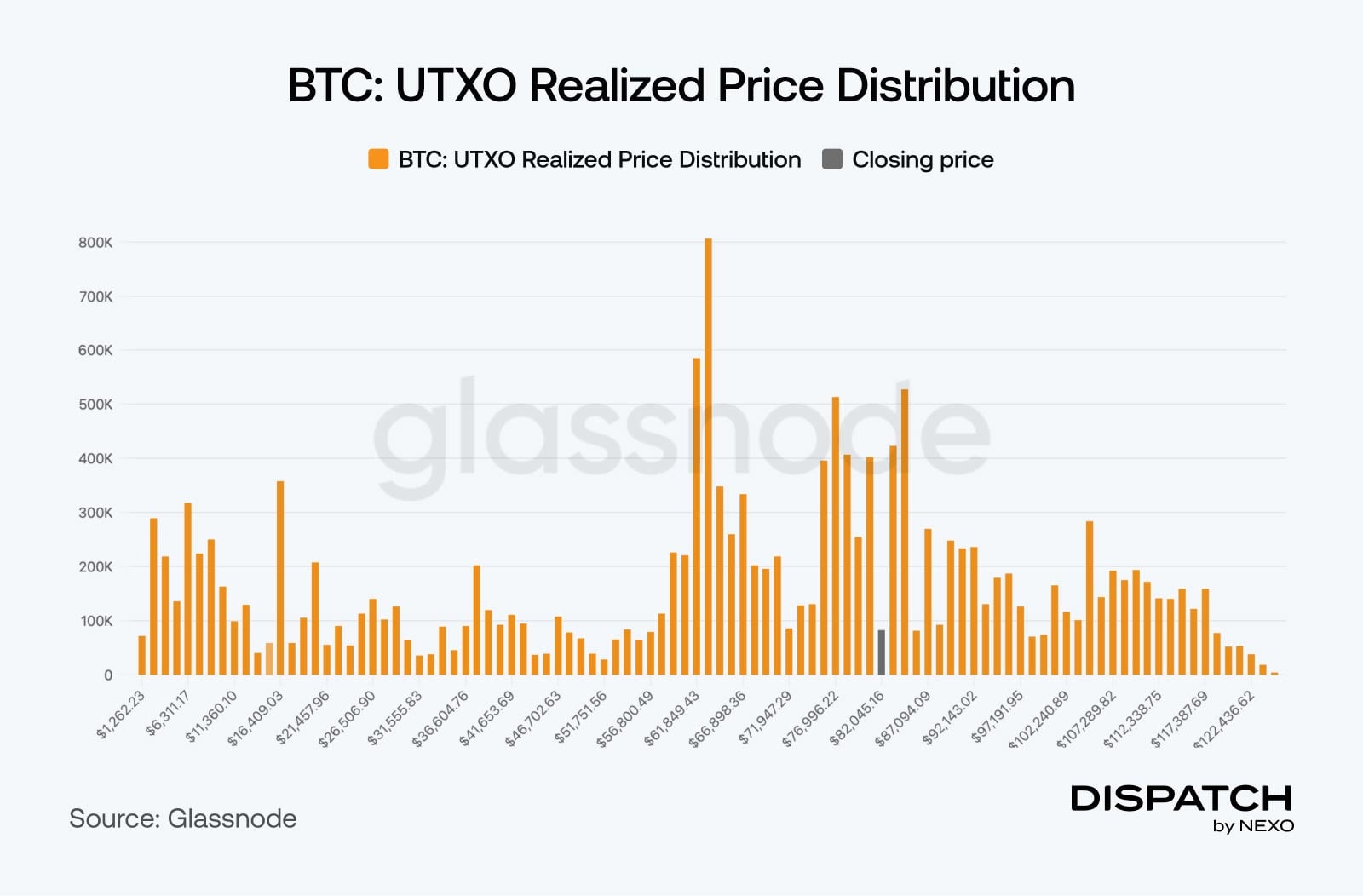
Why $80,000 is becoming Bitcoin's most crowded price level
This week's most interesting data point isn't a headline number– it's where Bitcoin's supply is actually sitting. Roughly 13% of all circulating Bitcoin, close to 2.7 million coins, was last bought between $75,700 and $84,600, a band that sits almost exactly on top of today's price. Nearly 11% of supply changed hands within 5% of the current level alone. That's an unusually dense cluster of cost basis forming in real time, and it cuts both ways: it confirms recent buying was concentrated right where price is now, not scattered, but it also leaves a large group of holders with almost no cushion. Whether that cluster becomes support on the next dip or supply overhead on the next rally will say more about conviction than any single indicator this week.
The numbers
The week’s most interesting numbers
$999 million — Monday's net inflow into U.S. spot bitcoin ETFs, the largest single-day haul in 11 months.
$96.20 — HYPE's new all-time high on September 23, on roughly $385 million in institutional buying.
$1 million — Kevin O'Leary's new bitcoin price target, alongside a raised $15 trillion market-cap call.
12 — Consecutive weeks of inflows for spot Solana ETFs, through a Fed hike and the Clarity Act's defeat.
Hot topic
What the community is discussing
Miners coming back from holiday?
Another key metric checked by Bitcoin.
Ethereum’s take on the recent rally.
Dispatch is a weekly publication by Nexo, designed to help you navigate and take action in the evolving world of digital assets. To share your Dispatch suggestions and comments, email us at [email protected].
This content is for informational purposes only and does not constitute investment, legal, or tax advice. Crypto assets are highly volatile and their value can go up or down significantly, including to zero. Past performance and historical correlations are not indicative of future results. Nexo has a commercial interest in the adoption of digital assets.
The availability and use of any products or services made available through Nexo US LC (“Nexo US”) are subject to the applicable terms and conditions on the Nexo US platform. This message is for informational purposes only and does not constitute financial, investment, legal, or tax advice. Any decision you make based on this information is solely your responsibility. Nexo US provides the user interface and routes client instructions to third-party service providers. Investment advisory services for eligible digital asset strategies are provided by Gravitalix Financial, LLC (“Gravitalix”), an investment adviser registered with the U.S. Securities and Exchange Commission. Registration with the SEC does not imply a certain level of skill or training. Please review Gravitalix’s Form ADV and related disclosures carefully before investing. Digital assets are not money or legal tender, are not backed by any government or central bank, and are not insured or guaranteed by any governmental or private insurance scheme (including FDIC or SIPC). Any rates, yields, or rewards displayed in the Nexo US app or related materials are subject to change, may be reduced or discontinued at any time, are not guaranteed, and may not be available in all jurisdictions or for all clients. Past performance is not indicative of future results.
Digital Asset services are provided by Bakkt Financial Solutions I, LLC (NMLS ID 1890144) through a software licensing agreement between Bakkt Financial Solutions I, LLC (“Bakkt”) and Nexo US LLC. Bakkt is not a registered broker-dealer and is not a member of SIPC or FINRA. Digital assets are not FDIC- or SIPC- insured. Bakkt Financial Solutions I, LLC is licensed to engage in virtual currency business activity and money transmission by the New York State Department of Financial Services. Digital asset borrowing requires sufficient collateral. Failure to maintain collateral value due to market volatility may result in the liquidation of your assets. Please ensure that you fully understand the risks involved before trading. See here for Bakkt Licenses and Bakkt Disclosures. If you no longer wish to receive marketing communication from us, including product updates, industry news and exclusive promotions, click here.