Bitcoin’s August holiday
Aug 18•7 min read

In this patch of your weekly Dispatch:
- A quiet macro week
- Institutional BTC love
- The leverage build-up
Market cast
BTC: Same range, new signals
Bitcoin's weekly chart remains range-bound, with price holding around the 200-period SMA, a key level of dynamic support. The RSI, a momentum oscillator, and the Stochastic, another momentum oscillator, are both rising, though neither has produced a clear signal yet. The MACD, a trend and momentum indicator, keeps its histogram just above the zero line — a mildly constructive tilt within an otherwise tight range.
The daily chart shows less conviction. Price bounced off the lower Bollinger Band, which marks the bottom of its recent volatility range, but the broader picture stays range-bound. The RSI and Stochastic are both in neutral territory, and the MACD histogram sits just below the zero line. The ADX, which measures trend strength, is falling and reads very low, confirming there's no decisive directional move underway.
Key levels to watch: on the downside, support sits around $62,000, with a deeper zone near $60,000. To the upside, resistance comes in around the $66,000–$67,000 zone, followed by $70,000.
The big idea
Muted price action: BTC’s time-off
Twice this summer we told you a catalyst was coming. First: a cooling jobs market would take rate hikes off the table. It did, and bitcoin shrugged. Then: soft inflation would do the same. It did too – cooler PPI stacked on an unchanged CPI, as benign a print as this cycle has offered – and bitcoin drifted below $64,000 anyway. Two clean macro setups, two muted reactions. At some point the calendar starts to look like a better explanation than the data – this is peak holiday season, after all.
Someone once described August as "the afternoon of the year" – the point where the momentum of spring and early summer has burned off, but the year isn't over, and everyone's mind is somewhere else. Beach, kids, the last long weekend before September snaps everything back into focus – inboxes go quiet, sunscreen replaces suits, and nobody's in a rush to make a big call. Trading desks thin out, and when so much of the market's usual activity is running on the same summer schedule, even good news can struggle to find much of a response.
That's not just a nice line – the data backs it up. Going back to 2011, July, September, and October are consistently the calmest months for bitcoin, and August sits right alongside them: over the last eight years, August's average monthly price swing is the second-smallest of any month, behind only September. Trading volume tells the same story – June, July, and August are the three lowest-volume months of the year, running 12–25% below each year's daily average. This year is an unusually deep version of that pattern. Daily spot volume has fallen every month since February, from roughly $11 billion a day to about $3 billion now, and 30-day realized volatility just hit 22% – its lowest reading in twelve months.
Worth remembering, too, that plenty of the market's regular participants are off picking kids up from camp or squeezing in one last trip before school starts. So the "everyone's on vacation" read isn't just a vibe. It's the calmest tape bitcoin has had in a year, arriving in the exact month it tends to arrive.
It's not just the calendar: The seasonal read explains why trading has gone quiet. The on-chain read explains why demand hasn't shown up. Glassnode's take on the non-reaction: "a weak response to good news is itself a warning." Spot is pinned between two cost-basis walls – just above the Median Realized Price ($63,000) and below the Short-Term Holder Cost Basis ($68,700), the average entry for anyone who's bought since October – and has been for nearly three months, on the thinnest spot volume Glassnode has recorded since 2019. That's independent confirmation of the same volume collapse we found going back to 2010.
The imbalance underneath is the more interesting part. Sellers look tired – supply in profit is near past bear-floor levels, and Glassnode's Seller Exhaustion Constant sits at a cycle low. But buyers haven't shown up to test that exhaustion: ETF flows only just turned positive, coins keep drifting onto exchanges, and leverage – the one corner showing any conviction – is crowded net-long against a bid that's thinned by a third since July.
Not every desk agrees – some voices point to Q3 ETF inflows and calmer options positioning as reasons $70,000–$75,000 is still in play by month-end. But a market stalling on good news, on record-low volume, is hard to wave off as just pre-Labor-Day drift.
The takeaway: Both explanations point in the same direction: low conviction, not low importance. The calendar says trading desks are half-empty until after Labor Day – September 7th this year – which might as well double as bitcoin's alarm clock; don't be shocked if volume, and conviction, both show up right on cue. The on-chain data says the two sides left in the market – tired sellers, absent buyers – are each waiting for the other to blink. Watch $68,000 above and $58,500 below: a reclaim of the former on rising volume, with ETF inflows following, would be the first real sign this afternoon is turning into evening. Until then, the honest read is patience, not prediction. And if you're reading this from a beach chair or a half-empty office, that's kind of the point – the market can afford to sit still for a while, but your assets always have the option to grow.
TradFi trends
Some banks don't take August off
Not everyone is on holiday. Banking giant UBS disclosed a 24x jump in call option exposure on BlackRock's IBIT last quarter (80,000 to 1.95 million shares), alongside fewer puts and a 12% rise in its outright holdings — timed with the bank opening bitcoin access to its Swiss clients. Hedging or conviction, hard to say from the filing alone, but the shape leans bullish.
Norway's sovereign wealth fund, some of the most cautious money on earth, just logged a sixth straight period of growth in its indirect bitcoin exposure — up 60% year-over-year to an all-time high of 11,549 BTC (~$725 million), mostly via its stake in Strategy. Less a choice than bitcoin working its way into a portfolio built to avoid it. Two very different bets, same direction, in a month when little else is moving.
Macroeconomic roundup
Fed minutes could break the quiet
This week's calendar is quieter than last week's CPI/PPI stretch, but not empty — Wednesday and Thursday both carry real potential to move the rate-path narrative crypto's been trading on.
Eurozone CPI (Aug 19): July's Eurozone inflation data. A cooler read backs the same disinflation story markets have been trading on.
FOMC Minutes (Aug 19): July's decision held rates at 3.5%–3.75%, but three officials favored a hike. Minutes show how wide that split is running.
Jobless Claims (Aug 20): Initial and continuing claims — another labor-cooling read feeding the Fed's calculus.
Philly Fed Manufacturing Index (Aug 20): A regional factory-activity gauge, one more slowdown signal.
Retail sales already cut against a hike — July fell 0.6%, the first monthly drop in nine months, and softer inflation and labor readings have trimmed the odds further.
The week's most interesting data story
The market's napping – leverage isn't
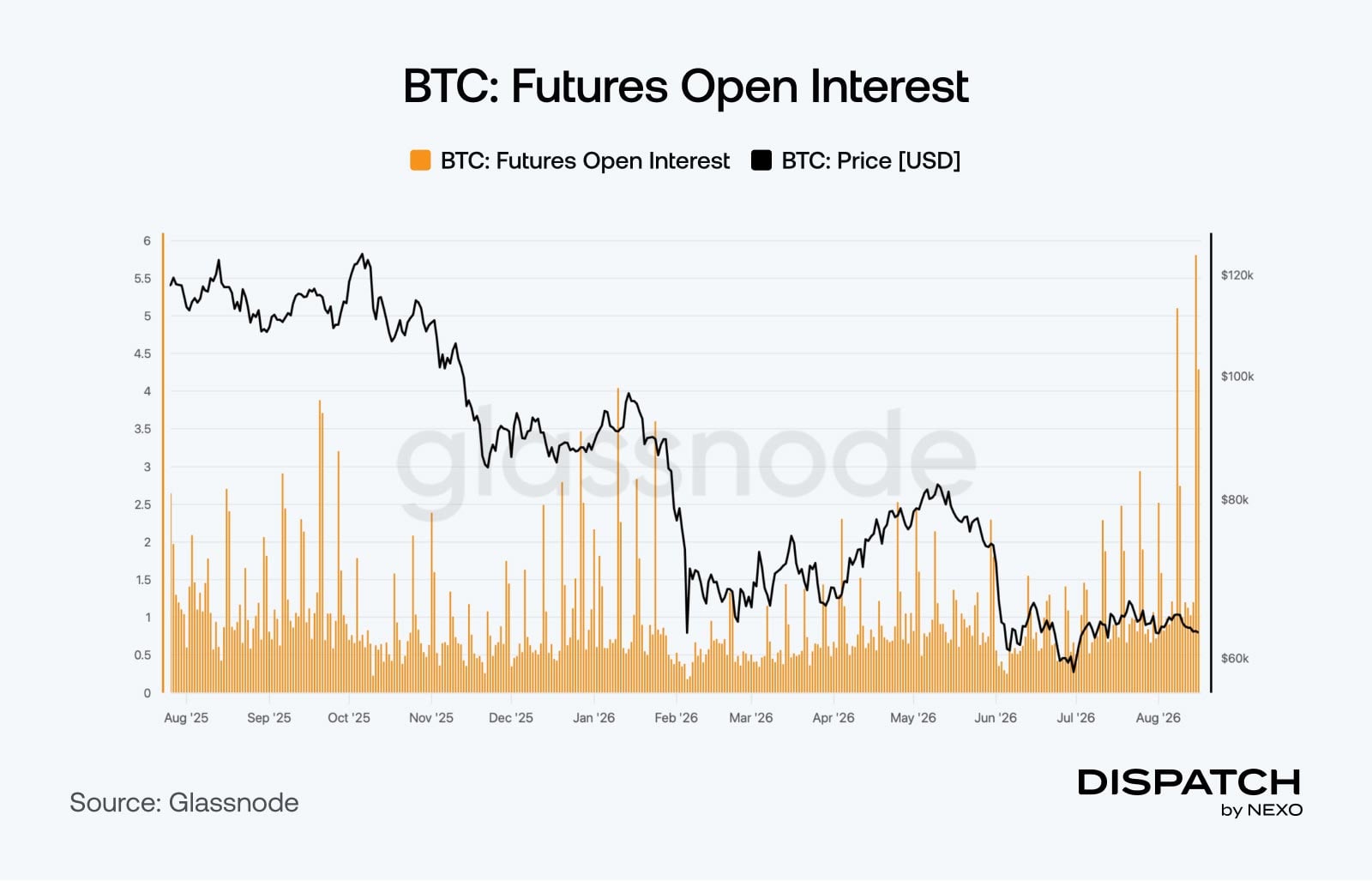
While spot markets nap, the futures side of bitcoin is anything but sleepy. Traders are sitting on more open leveraged positions than the entire market trades in a single day — that gap just hit an all-time high on August 15, and it's still unusually wide now. That beats the previous record set last September. It's also not a one-off: this kind of imbalance, rare a few years ago, has now shown up on roughly one in three days over the past two years. The risk is straightforward — with so many bets stacked up and so little actual buying and selling happening around them, there's little real trading activity to cushion a sudden move. If something does spark a swing, it could travel further and faster than usual, in either direction.
The numbers
The week’s most interesting numbers
$12.5 million — Combined inflows into Solana and XRP ETFs last week – Solana's strongest since May and XRP's fifth straight positive week.
46,420 BTC — Wallets holding over 10,000 BTC added this much over the past two months, their fastest accumulation pace since March, even as price stayed range-bound.
202% — Morgan Stanley's Q2 filing showed its stake in BlackRock's Ethereum ETF jumped this much, alongside a 23% increase in its bitcoin ETF holdings.
66 — The number of proposals Ethereum developers are narrowing down as they scope the 2027 Hegotá upgrade, with several aimed at bringing native privacy to the protocol.
Hot topic
What the community is discussing
So that means we are now at the bottom?
Another perspective on the current calm.
Can ETH upgrade with BTC technicals soon.
Dispatch is a weekly publication by Nexo, designed to help you navigate and take action in the evolving world of digital assets. To share your Dispatch suggestions and comments, email us at [email protected].