Bitcoin: A question of custody
Aug 04•6 min read
In this patch of your weekly Dispatch:
- The case for custody
- ETH’s 11th birthday
- Jobs data week ahead
Market cast
BTC: Bears lose their grip near oversold lows
Bitcoin's weekly chart shows price continuing to hover around the 200-period SMA, which is acting as strong dynamic support and keeping the broader trend range-bound. The RSI, a momentum oscillator, offers no clear directional signal, while the Stochastic, another momentum oscillator, sits near oversold territory. The MACD, a trend and momentum indicator, keeps its histogram slightly above the zero line — a mildly constructive sign even as the broader picture stays mixed.
The daily chart tells a similar story. Price remains confined to a tight range lacking strong directional momentum. The RSI sits in neutral territory, while the Stochastic's signal lines are turning upward from oversold levels, hinting at a possible short-term bounce. The MACD histogram stays slightly below the zero line.
Key levels to watch: On the downside, support sits around $62,000, with a deeper zone near $60,000; the weekly 200-period SMA offers additional dynamic support. To the upside, resistance comes in around $65,000, followed by $67,000.
The big idea
When cold storage meets its limits
Bitcoin was on track for a strong week. It was up nearly 10%, as fears of another Fed rate hike faded and geopolitical tensions cooled — a gradual uptick we've been tracking closely here on Dispatch. But nobody saw what was coming next. On July 30, a firmware flaw surfaced in a well-known Bitcoin-only hardware wallet, causing some devices to generate weak, predictable seed phrases — weak enough for attackers to work backward and reconstruct them. The sweeps have come in waves since, with a running total of roughly 1,816 BTC (about $114 million) taken from over 5,200 addresses. Many of the affected had done everything "right."
It wasn't a hack in the usual sense — no careless click, no phishing link. The flaw was baked into how the keys were created in the first place, a reminder that most self-custody setups rest on one thing alone: a single seed phrase.
Holders are already switching up their custody approach in response.CryptoQuant's Julio Moreno flagged a spike in daily exchange deposits of small Bitcoin transfers — under 10 BTC, the size retail holders typically move. Deposits hit 7,300 BTC the day after the exploit surfaced, the highest level since early February. In other words, a real slice of holders responded to a self-custody failure not by tightening their own security, but by moving coins to centralized platforms instead.
Modern custodial infrastructure isn't just someone else holding your coins for you. It's built specifically to remove the single point of failure. Many institutional-grade platforms now rely on multi-party computation: key material gets split across independent parties, so no single party ever holds the complete private key. Signing happens through a joint cryptographic process, not one exposed secret. Regulators have caught on to the same logic — newer custody rules in major markets now formally recognize these distributed models as secure and compliant, precisely because they cut single-point-of-failure risk. Self-custody isn't going away, and for some it's still the right call. But this week is a good reminder: platforms built around professional key management, redundancy, and real insurance may now be the sturdier place to actually hold your coins.
Ethereum
Eleven years in, ETH is still growing up
Heading into August, ETH is up 5% on the month, outpacing Bitcoin — a fitting present for a network that just turned 11 last week. It's a strong showing considering the backdrop: July brought its share of geopolitical tension and macroeconomic uncertainty, yet Ethereum still closed out the month with $365 million in net ETF inflows, part of over $11.2 billion in total inflows since 2024. So what has Ethereum actually accomplished in 11 years to earn that kind of steady institutional demand? Today, it secures roughly $148.8 billion in stablecoins and $15.5 billion in tokenized real-world assets, backed by multiple technological upgrades that have made it an integral part of digital finance. Increasingly, that growth is being driven by Wall Street itself, with BlackRock and JPMorgan both deepening their presence on the network over the past year.
That growing institutional footprint is landing on solid technical ground, too. Ethereum recently activated its Fusaka upgrade, a step toward making the network's layer-2 ecosystem faster and more efficient. Eleven years in, the network isn't slowing down — it's just getting started. Cheers, Ethereum.
Macroeconomic roundup
Crypto eyes Friday's jobs report
It's a heavy week for labor data, culminating in Friday's July jobs report, with Fed officials Cook and Barkin also set to speak on Tuesday and Thursday respectively. The setup matters: June payroll growth slowed sharply to just 57,000 jobs, and April and May were revised down by a combined 74,000. The Fed held rates at 3.5%–3.75% on July 29 anyway, citing solid activity despite the uncertainty. This week's releases could either confirm that cooling trend or undercut it entirely:
ADP Nonfarm Employment Change, Jul (Aug 5): The first hard look at private-sector hiring this week, and an early test of whether June's payroll miss was a one-off or the start of a pattern.
S&P Global & ISM Services PMIs, Jul (Aug 5): A read on the services side of the economy, where any signs of cooling would broaden the labor-market story beyond manufacturing.
Initial & Continuing Jobless Claims (Aug 6): A more real-time gauge of labor-market health heading into Friday's main event.
Nonfarm Payrolls, Unemployment Rate & Average Hourly Earnings, Jul (Aug 7): The week's headline release. A weak print here — echoing June's miss, would strengthen the case that labor demand is genuinely cooling, easing pressure on the Fed to consider any further tightening.
TradFi trends
SpaceX and AMD put tech spending to the test
SpaceX reports its first-ever quarterly earnings as a public company after U.S. markets close today, and the timing is pointed: shares have slumped nearly 20% since the company's blockbuster June debut, erasing roughly $1.2 trillion in market cap after briefly trading above $200. The IPO itself was the largest in history, raising $85.7 billion at a valuation near $2 trillion, with investors now looking for updates on Starlink, exploration plans, and the Starship rocket that underpins them all.
Also reporting this week is AMD, Nvidia's closest rival in the race to build AI chips, and a key bellwether for the broader AI infrastructure boom. The stakes are high: major hyperscalers — Alphabet, Meta, Microsoft, and Amazon — have committed to nearly $2.4 trillion in AI-related spending in the years ahead, and AMD has guided for Q2 revenue as high as $11.5 billion, up from $10.25 billion in Q1. The stock has more than doubled this year despite a recent pullback, making this report a real-time test of whether the AI spending story still has investors' confidence.
The week's most interesting data story
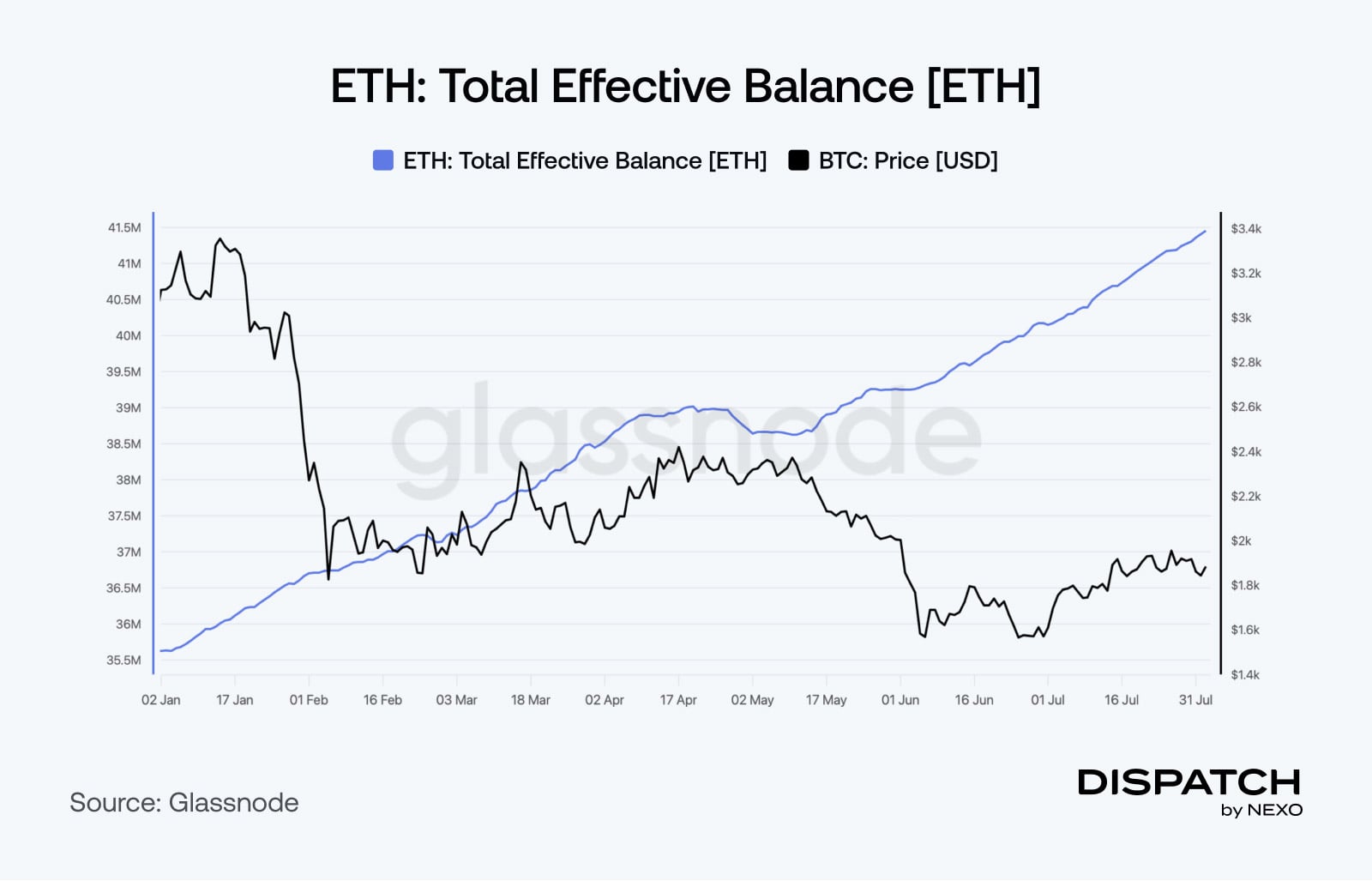
Conviction visualized: ETH staking sets a record
Ethereum's staking base just hit a new milestone: a record 41.2 million ETH — roughly 33.8% of total supply — is now locked up, the highest share in the network's history. New validators are facing a 43-day wait to join the queue, but the more telling number sits on the other side of the ledger: the exit queue is nearly empty. Almost nobody is unstaking, even with ETH trading below recent highs. That's a meaningful signal in its own right. Rather than short-term positioning, it points to real conviction — institutions increasingly treat staking yield as simply part of holding ETH, with the long-term thesis intact regardless of near-term price swings.
The numbers
The week’s most interesting numbers
62% to 38% — Calls vs. puts in Bitcoin's options market, still tilted bullish on a medium-term view even as short-term hedging picked up.
4 straight weeks, $365.2 million — Spot Ether ETFs' winning streak and their total net inflows for July.
$1.5 billion — Cumulative net inflows across spot XRP ETFs, crossing that mark for the first time since launching in November 2025.
$172.4 million — Bitcoin ETFs' net inflows for July, breaking a two-month streak of monthly outflows.
$1.1 billion — Cumulative inflows into Solana spot ETFs, now ahead of XRP's on a per-fund-category basis.
Hot topic
What the community is discussing
Is this the cycle’s absolute bottom?
Have Bitcoin HODLers switched storage for safety?
You know what to do when Bitcoin starts taking over X again.
Dispatch is a weekly publication by Nexo, designed to help you navigate and take action in the evolving world of digital assets. To share your Dispatch suggestions and comments, email us at [email protected].