Stablecoins: An alternative World Cup
Jul 21•6 min read

In this patch of your weekly Dispatch:
- ECB decides on rates
- Is AI earning?
- BTC inflows return
Market cast
BTC: Bulls regain control
Bitcoin's weekly chart shows a constructive setup taking shape. Price has bounced off the 200-period SMA and is now heading toward the middle Bollinger Band (the 20-period SMA) – a key volatility indicator. The RSI, a momentum oscillator, remains neutral but with its signal line trending upward, while the Stochastic, another momentum oscillator, is similarly neutral yet climbing. The MACD, a trend and momentum indicator, has generated a bullish crossover, reinforcing the constructive tone.
The daily chart tells an even more bullish story. Price has reached the upper Bollinger Band, with the RSI elevated and rising. The Stochastic sits in overbought territory but shows no signs of fading momentum, while the MACD histogram remains positive and rising – all pointing to bullish momentum building across both timeframes.
Key levels to watch: On the downside, immediate support sits around $64,000, with the next significant zone near $62,000; the weekly 200-period SMA could also serve as dynamic support. To the upside, the first resistance comes in around $67,000, followed by $70,000.
The big idea
Argentina’s first place in the stablecoin finals
Argentina gave everything it had in an intense, extra-time battle against Spain – this got us thinking about another arena where Argentina isn't just competing, it's setting the pace: stablecoins.
There's a reason the country is such fertile ground: currency debasement — a case playing out well beyond Argentina's borders. The peso has weakened substantially against the dollar over the past several years, with inflation still running above 30% year-over-year — one data point in a much broader global pattern. Turkey, Nigeria, and Lebanon have all seen annual inflation swing anywhere from 50% to 200% in recent years, and in each case, dollar-pegged stablecoins have become the accessible workaround — a way to hold something resembling a dollar without needing an actual bank account in dollars, especially where capital controls make that difficult.
Zoom out globally, and the numbers back up the hype. Citi's base case now puts the stablecoin market at $1.9 trillion by 2030, with a bull case as high as $4 trillion — both revised upward from last year's forecasts, while Standard Chartered projects the market hitting $2 trillion as soon as 2028. Citi and Brookfield research goes further still, suggesting stablecoins in circulation could grow as much as 15-fold by 2030. Tokenized real-world assets are riding a similar wave: RWAs (excluding stablecoin issuers themselves) hit a record $33 billion in Q2, up 45% year-to-date, led by tokenized Treasurys, corporate credit, stocks, and venture capital.
Visa's latest report with Artemis makes the case that stablecoins will quietly take over the sub-dollar "micro-commerce" machines that will transact with each other, while cards keep the bigger-ticket purchases. It's one of several backers, alongside Mastercard and BlackRock, of the new Open USD stablecoin — a reminder that the real story isn't one network's report, it's a scramble among all of them to not get left behind.
That scramble is playing out well beyond payment networks. Japan's JCB is piloting stablecoin rails with Circle, and convenience store chain Lawson will accept stablecoins starting in August. Sony just secured preliminary U.S. approval for its own dollar-backed stablecoin trust — a closed-loop network with no confirmed link to PlayStation purchases yet, but a clear signal of where large consumer platforms think payments are heading.
Tether, meanwhile, is finding traction at the sovereign level: Bolivia is weighing a framework to formally recognize USDT as a payment currency alongside the boliviano and the dollar, a response to a prolonged dollar shortage after the country abandoned its currency peg earlier this year.
The common thread echoes past tech cycles: the biggest gains rarely come from the invention itself, but from the infrastructure built around it. Railroads didn't drive industrialization — the surrounding logistics network did. Electrification wasn't about the light bulb, but the grid. Stablecoins may follow the same script: the lasting value may sit less with the coins and more with the issuance platforms, custody systems, and compliance tooling that connect them to the existing financial system.
Argentina may have to wait four more years for its next shot at the trophy. Stablecoins won't wait for anyone — but the real contest to watch isn't between coins, it's for the rails underneath them. That's where the next decade of returns will likely be decided.
TradFi trends
Big Тech earnings season starts
After a rough week that saw the Nasdaq shed 2.9% amid a brutal semiconductor sell-off, attention turns to the Magnificent Seven — Apple, Microsoft, Alphabet, Amazon, Meta, Nvidia, and Tesla — the handful of mega-cap tech names that have driven much of the market's AI-fueled gains. Alphabet and Tesla are both due to report Wednesday, with the rest of the group's earnings continuing to roll out over the coming weeks. The chip rout has wiped out more than $3 trillion in market value since June 22, much of it rotating into these names — making their earnings a real-time test of whether AI-driven optimism still justifies today's valuations, or whether the pullback becomes something broader.
Crypto has a stake in the outcome too. The AI trade has arguably pulled some capital away from Bitcoin over recent months, even as the two show some degree of correlation as risk assets. A wobble in Big Tech earnings could test whether that relationship holds, as Bitcoin continues working toward a decisive push above $65,000 to confirm its own recovery.
Oil climbs, inflation cools, and the ECB weighs the next move
Markets head into the week caught between rising geopolitical risk and diverging central bank paths. Crude oil has climbed sharply on continued Middle East tensions, while cooling inflation data has traders leaning toward a Fed hold — even as the ECB faces a tougher call of its own, deciding without the benefit of fresh Q2 growth or inflation data.
- ECB Rate Decision (Jul 23): Fresh off a June hike to 2.25%, markets lean toward a hold, though a hawkish tail remains.
- Weekly Jobless Claims (Jul 24): A rising trend would strengthen the case for eventual easing.
- S&P Global PMI (Jul 25): This week's main growth signal.
- Alphabet & Tesla Earnings (this week): An early read on whether tech's momentum still holds.
The week's most interesting data story
Bitcoin’s clearest signs of recovery?
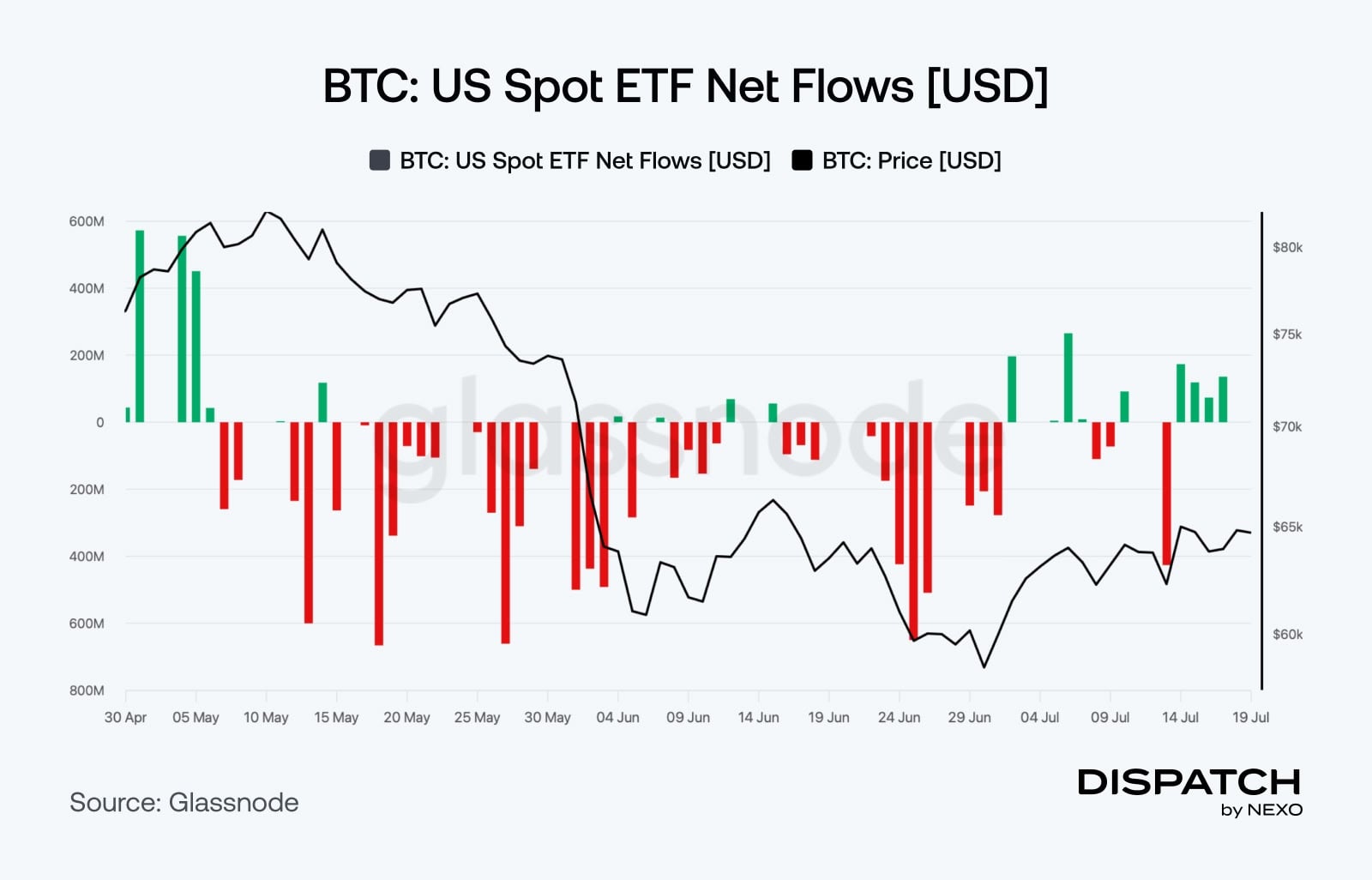
Bitcoin ETF flows have become one of the market's most closely tracked sentiment gauges, since they capture real money moving in or out of Bitcoin exposure on a daily basis. This week's data leans encouraging: US spot Bitcoin ETFs notched a second straight week of inflows, pulling in $75.7 million for the week ending July 17, building on the $197.4 million added the week before. It's a modest pace compared to earlier highs, but after a rocky June, two consecutive green weeks are a welcome signal that buying interest is returning. The next test: whether Bitcoin can push decisively above the $65,000-$65,500 range, to help confirm the recovery has legs.
The numbers
The week’s most interesting numbers
$727.3 million — US spot Bitcoin ETFs' haul over their longest inflow streak in nearly three months, five days running.
$70,000–$72,000 — Where Bitcoin's biggest options bets are clustered for July 31, a $2.5 billion bullish spread landing two days after the Fed's next decision.
110 — The number of reasons Michael Saylor cited in a critique of BIP-110, a proposal to restrict Bitcoin "spam," which he argues threatens the network's neutrality.
Hot topic
What the community is discussing
The never-ending Bull vs Bear duel.
Still early and big at the same time.
Another perspective on Bitcoin ETFs.
Dispatch is a weekly publication by Nexo, designed to help you navigate and take action in the evolving world of digital assets. To share your Dispatch suggestions and comments, email us at [email protected].