Crypto navigates towards clarity
Jul 08•6 min read

In this patch of your weekly Dispatch:
- Crypto clarity gets priced in
- Ethereum's next chapter begins
- Stablecoins hit a record high
Market cast
BTC action turns constructive?
Bitcoin's weekly chart is showing early signs of stabilization. Price bounced off the lower Bollinger Band – a volatility indicator, and is now hovering around the 200-period SMA, a key long-term trend indicator. The RSI, a momentum oscillator, sits at very low levels, on the verge of oversold, while the Stochastic, another momentum oscillator, is turning up from oversold territory – hinting that bearish momentum may be starting to fade. The MACD histogram, a trend and momentum indicator, is hovering near the zero line, leaving the broader trend without a clear tilt just yet.
The daily chart tells a more constructive story. Price bounced off the lower Bollinger Band, crossed above the 20-period SMA, and is now heading toward the upper Bollinger Band. The Stochastic lines have moved into overbought territory while RSI sits neutral, and the MACD histogram is deep in positive territory – all pointing to stronger near-term momentum than the weekly picture alone would suggest.
Key levels to watch: On the downside, immediate support sits around $61,000, with the next significant zone near $58,000–$59,000. To the upside, the first resistance comes in around $64,000, followed by $67,000.
The big idea
Regulatory clarity is leading the way
For most of the past years, crypto traded under a cloud of overlapping unclarity — nobody quite knew where US rates were headed, how the EU would actually enforce the MiCA rulebook, or whether Washington would ever agree on a framework of its own. That fog is lifting gradually, and it's happening on multiple fronts at once.
US: Start with the Fed. Kevin Warsh's first meeting as chair on June 17 came with a shorter, blunter statement and a dot plot showing nine of eighteen officials projecting a hike before year-end — a sharp shift from March's median forecast of a cut. Warsh himself submitted no dot, but the tone was unmistakably hawkish, and futures markets moved with it: traders are now pricing a quarter-point hike as the base case by October. This Wednesday's FOMC minutes are the first real test of how much of that hawkishness holds once the room isn't watching, and June's CPI print on July 14 will matter more than anything said in a press conference. By the July 28–29 decision, markets will know which read was right. The gap to watch: the dot plot moved before the data did, and markets have already followed the dot plot — if inflation cools even modestly between now and the CPI print, that repricing could just as easily reverse.
Europe already has its answer. Since MiCA’s grandfathering period ended on July 1, regulatory clarity has shifted from a policy debate to an economic variable. Authorization now determines who can scale across the EEA, serve, and build durable distribution. With only an estimated 17–20% of the roughly 1,200 previously registered firms making the transition, regulatory approval has become one of the sector’s scarcest assets.
The bar was deliberately high, and the firms that cleared it did the work. As regulatory uncertainty recedes, markets are beginning to recognize that discipline has value. Businesses operating within a predictable legal framework benefit from lower risk premiums, stronger investor confidence, and greater strategic flexibility. In Europe, compliance is no longer simply the cost of doing business—it is becoming a source of competitive advantage and long-term enterprise value.
The US isn't quite there yet, but it's closer than it's ever been. The CLARITY Act cleared the Senate Banking Committee in May, sits on the Senate calendar, and missed its symbolic July 4 target — a timing slip, not a stall. Lawmakers are now eyeing late July or early August, against a shrinking window before recess and midterm politics take over. If it lands, it does for US jurisdiction what MiCA just did for the European Economic Area.
Where does this leave the market? Two of the industry's largest markets– the US and the EU – are moving from "if" to "when" on their regulations within the same year — but the convergence isn't the real story. What matters is that clarity doesn't reward the sector evenly; it rewards preparation and effort. Clarity is becoming the foundation that decides who gets to build in the space.
Ethereum
Ethereum outperforms as its next chapter comes into focus
ETH was one of the better performers recently, up over to roughly $1,770 at the start of the week, as Bitcoin held firm above $63,000. That put it ahead of most majors, and it came despite wobbly AI stocks and a stronger dollar – two things that usually drag crypto down with them. Ethereum didn't just hold up; it led the pack.
The timing is fitting. Vitalik Buterin just dropped his vision for "Lean Ethereum", a multi-year rebuild he's calling the network's third major era – right up there with the Merge. The headline: a data storage redesign that could slash fees for everyday tokens and apps by 10x or more, no rewrites required. Quantum resistance and privacy are also getting fast-tracked as core priorities, not afterthoughts. Put together, it's a good reminder that Ethereum's momentum isn't only about price – there's real groundwork being laid for the next decade.
TradFi trends
SpaceX joins the Nasdaq-100
SpaceX enters the Nasdaq-100 before Tuesday's open, just weeks after its June 12 IPO valued the company near $2 trillion. The stock has since dropped roughly 29% from its all-time high, closing Monday at $160.42.
Funds that automatically track the Nasdaq-100 now have to buy SpaceX shares to keep matching the index – but JPMorgan expects that buying to be modest, since SpaceX only makes up about 1.3% of it, ranking around 21st behind names like Nvidia and Tesla. Meanwhile, early investors and employees start becoming free to sell over the next few months, which could offset much of that buying, with Musk's own stake locked up for a year.
Macroeconomic roundup
Fed minutes, gold dips, and a sliding yen
The big date this week is Wednesday, July 8 – FOMC minutes from last month's meeting. It's the first real window into how new Fed voices are thinking, and whether the hawkish rate outlook still holds up after a soft jobs report. Weekly jobless claims land the next day and could add more fuel either way. Markets are watching closely for any signal on where rates head next.
Elsewhere, JPMorgan just got more cautious on gold, slashing its Q4 2026 target by 25% to $4,500 (from $6,000), citing softer near-term demand – though it's still bullish long-term on central bank buying. And the yen keeps sliding: Goldman Sachs now sees it weakening to 165 per dollar within a year, one of the gloomier calls on Wall Street, as the currency sits at its weakest since 1986.
The week's most interesting data story
Bitcoin buyers are coming back
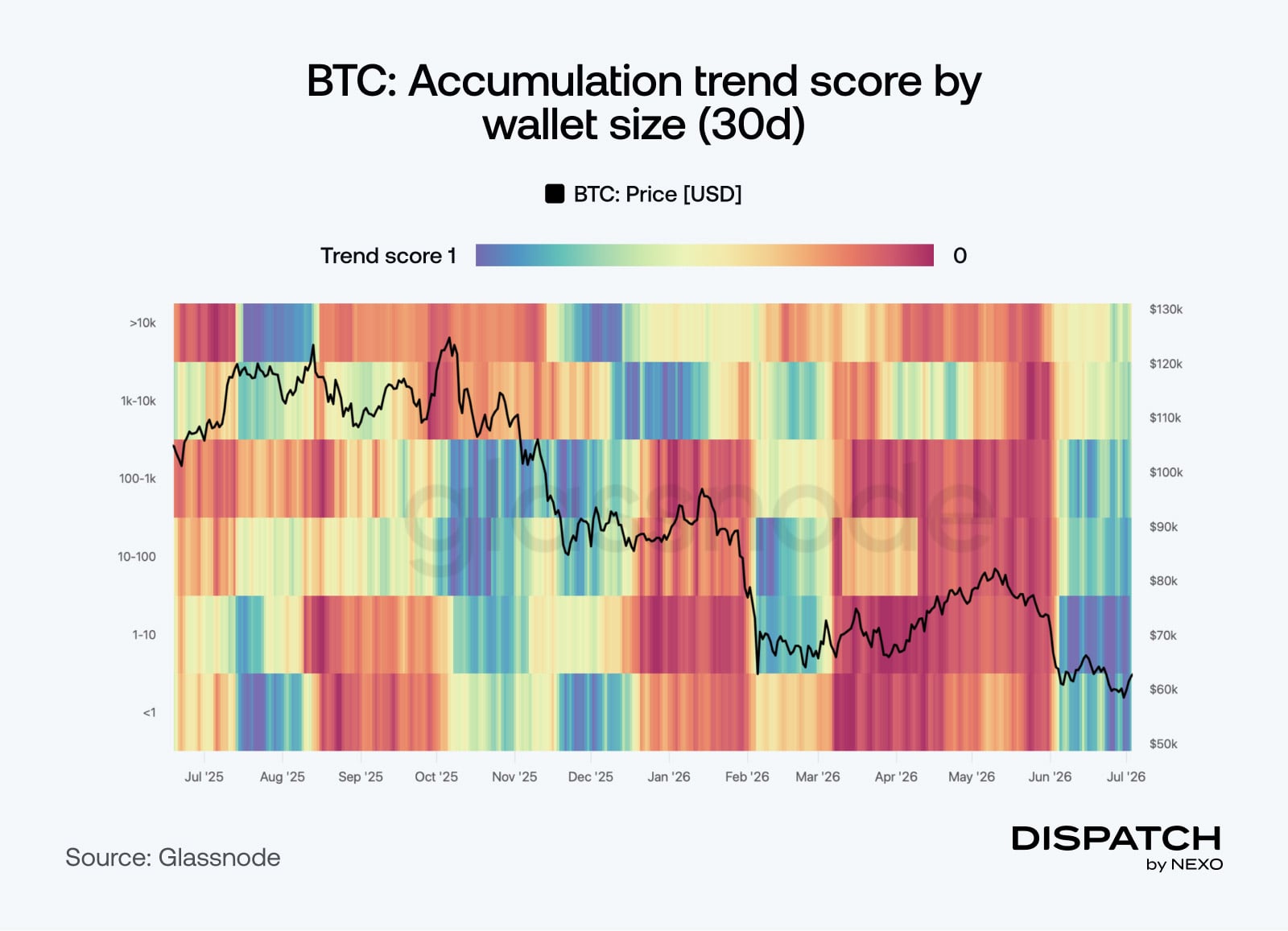
After several months of net distribution, Bitcoin's Accumulation Trend Score has shifted meaningfully higher over the past month, with buying activity becoming increasingly broad-based across the investor spectrum. Smaller holders (under 1 BTC) and mid-size wallets (100–1,000 BTC) are showing the strongest accumulation, both nearing peak trend scores. Larger cohorts, including 1,000–10,000 BTC wallets, have also turned net buyers, though with less intensity than earlier in the cycle.
This synchronized improvement across multiple investor groups suggests confidence is gradually rebuilding, with participants increasingly willing to absorb supply near current levels, according to Glassnode analysts. Periods of broad-based accumulation like this have historically provided a constructive foundation for longer-term recoveries, though sustained buying will be key to confirming the trend.
The numbers
The week’s most interesting numbers
$265 million — U.S. spot Bitcoin ETFs' largest inflow in over a month on Monday, following July 2's break from an outflow streak.
33x — Upside Standard Chartered sees in Morpho by 2030, with a fresh $60 price target.
$1.79 trillion — Record stablecoin transaction volume in June, up 63% from May and 125% year-over-year.
$150,000 – Bernstein's year-end bitcoin price target, held despite the current 54% drawdown from October's peak.
Hot topic
What the community is discussing
A BTC signal from the options markets?
The corporate ETH strategy continues?
The HODLers’ mindset.
Dispatch is a weekly publication by Nexo, designed to help you navigate and take action in the evolving world of digital assets. To share your Dispatch suggestions and comments, email us at [email protected].