Dispatch #282: What can drive Bitcoin’s price into February?
Feb 03•6 min read

In this patch of your weekly Dispatch:
- BTC derivative markets reset
- Altcoin ETFs flows show resilience
- Labour market data sprint
Market cast
BTC: Early signs of stabilization
BTC markets show tentative signs of stabilization, with short-term momentum pressure moderating. On the daily chart, BTC’s Stochastic oscillator—a momentum indicator that measures where the current price is relative to its recent range—is approaching a move out of oversold territory, suggesting that selling pressure may be losing intensity. Other momentum and trend indicators remain cautious, as price continues to trade below major moving averages, while RSI and MACD still reflect subdued conditions. On the weekly timeframe, BTC is trading near the lower Bollinger Band, a volatility measure that often coincides with stretched downside moves, indicating that price is operating near the lower end of its recent range. Structurally, immediate support is clustered in the 77,000–76,000 zone, with a deeper downside reference near last year’s low around 74,500. On the upside, initial resistance sits near 79,000–79,500, followed by a higher resistance level around 84,500, which previously acted as a consolidation area.
The big idea
What can drive Bitcoin’s price into February?
Bitcoin enters February in a consolidation phase, with price stabilising near $76,000 after a thin liquidity weekend pullback. Historically, February has been one of the stronger months for crypto, delivering a median return of ~12% since 2011.
Meanwhile, near-term macro conditions remain mixed. Elevated U.S. real interest rates and ongoing monetary policy uncertainty continue to weigh on risk appetite. While gold demand has found support from central bank buying, Bitcoin has continued to trade largely in line with risk assets, which tend to lose appeal relative to risk-free investments in higher-rate environments. The correlation between BTC and gold is currently slightly negative, suggesting limited co-movement. Over longer horizons, however, the establishment of a U.S. Bitcoin reserve could strengthen Bitcoin’s perceived safe-haven characteristics.
Against this macro backdrop, crypto-specific dynamics show early signs of stabilisation. January’s price weakness coincided with net spot ETF outflows, reflecting a risk-off stance among institutional investors. However, outflows have been materially lower than November’s peak levels, suggesting that de-risking pressures may be moderating rather than accelerating.
Market structure indicators also point to a more balanced setup. Derivatives positioning remains subdued, with muted funding rates indicating limited demand for excess leverage. Bitcoin perpetuals open interest is currently hovering around $26 billion, roughly half of October’s all-time high near $51 billion, reducing the likelihood of leverage-driven dislocations.
On the supply side, long-term holders continue to engage in measured distribution in 2026. Coins have largely rotated toward shorter-term holders rather than moving onto exchanges, suggesting controlled profit-taking and ongoing absorption rather than panic selling.
Finally, while near-term factors may drive short-term price volatility in either direction, Bitcoin remains structurally supported over the longer term by slowing supply growth and rising adoption, together contributing to a tightening supply–demand balance.
February could bring more idiosyncratic support for crypto markets as regulatory clarity and policy expectations come into sharper focus. Progress on U.S. digital asset legislation, particularly around clearer jurisdictional boundaries, could reduce regulatory overhang and support institutional re-engagement. At the same time, markets may be underpricing the implications of Kevin Warsh’s stance on monetary policy, which could ultimately prove less restrictive for risk assets than initially assumed.
Blue chips
Altcoin institutional flows show resilience
Despite the price consolidation, Ethereum’s network fundamentals remain constructive. The share of staked ETH reached a new all-time high over the weekend, while active addresses remain near historical peaks. Ethereum’s investment case as a base layer for tokenised assets remains intact, supported by continued stablecoin market cap growth, which is increasingly decoupling from broader crypto trading volumes. Separately, ETH treasury companies added around 130,000 ETH in January, suggesting dip-buying rather than capitulation.
Ether and major altcoins followed Bitcoin lower into the weekend, with SOL stabilising around $103 and XRP near the $1.60 level early this week. Institutional flows were mixed throughout January. While spot ETH ETFs recorded approximately $358 million in net outflows, SOL and XRP ETFs showed relative resilience, posting modest net inflows of about $105 million and $16 million, respectively. The trend suggests continued accumulation and confidence in the long-term asset outlook.
TradFi trends
Structural shifts in settlement infrastructure
Institutional crypto adoption is increasingly shifting from experimentation to integration. According to PwC, digital assets, particularly stablecoins, are now being embedded in payments, settlement, and treasury operations, making adoption difficult to reverse once integrated into core workflows. Industry participants echo this view, noting that institutions are moving from pilots to production use, reinforcing crypto’s role as financial infrastructure rather than a trading product.
Macroeconomic roundup
U.S. jobs data takes center stage
This week’s macro focus is on the U.S. labour market after last week’s stronger-than-expected U.S. PPI revived concerns that disinflation may be uneven. European data also matters, as the euro’s recent rise against the Dollar to around $1.20, its strongest level since mid-2021, has brought FX dynamics back into focus.
U.S. Labour Data – ADP & Jobless Claims (Wed–Thu):
ADP employment is expected around ~48k (vs 41k prior) and initial jobless claims near ~213k, offering the primary test of whether labour conditions are cooling after last week’s PPI surprise and directly influencing yields, the dollar, and liquidity-sensitive assets.
Eurozone CPI (Wed):
Core CPI is expected near ~2.2% YoY, remaining important as sticky inflation and energy-related pressures potentially complicate the ECB’s monetary policy trajectory.
ECB & BoE Rate Decisions (Thu):
Rates are expected to remain unchanged (ECB deposit rate ~2.00%, BoE Bank Rate ~3.75%), shifting focus to guidance and vote splits as markets assess the durability of the current policy pause, particularly in light of recent euro strength and its potential disinflationary impact.
For a fuller breakdown of this week’s macro events and timings, see our full macro calendar on X.
The week’s most interesting data story
Institutional demand deepens
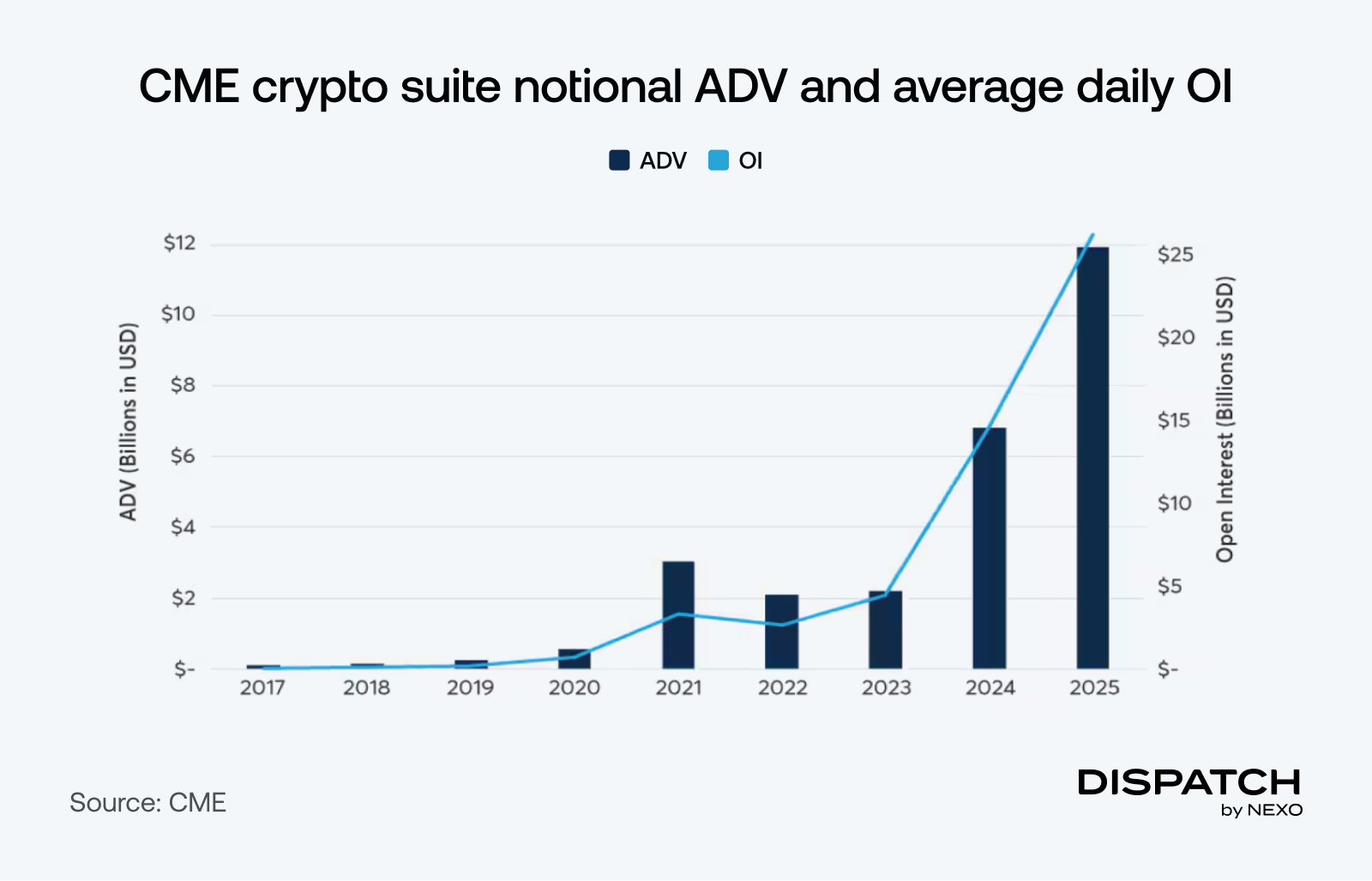
Data published last week shows that CME’s crypto suite processed nearly $3 trillion in notional volume in 2025, an all-time high, with average daily volume around $12 billion and average daily open interest near $26 billion.
Importantly, growth has been driven by a broader base of large participants, not simply higher turnover. The number of Large Open Interest Holders reached a record 1,039 in October, signalling deeper and more diversified institutional engagement. Participation has also expanded beyond Bitcoin into Ether, Solana, and XRP, supported by micro and spot-quoted contracts. Taken together, the data suggest institutional demand is broadening cautiously, with a clear preference for assets offering sufficient liquidity, regulatory clarity, and usable derivatives infrastructure.
The numbers
The week’s most interesting numbers
$3 trillion - Total notional traded across CME crypto futures and options in 2025, highlighting continued institutional engagement.
$37.7 billion- Solana (SOL) CME futures and options trade volumes in Q4, suggesting widening market demand for diversified crypto exposure.
+$2.2 billion - Average monthly net flow of BTC spot ETFs since launch.
36.6 million ETH – Ethereum staking reaches a new record high, with nearly 30.1% of supply locked and exit queues thin, potentially tightening liquid supply.
35,130 BTC - Net increase in Bitcoin held by treasury companies during January, lifting total holdings to an all-time high of ~881.2k BTC, despite ongoing price consolidation.
Hot topic
What the community is discussing
What’s your take on this increase in commodity-based ETF participation?
The market is in a much healthier position.
The U.S. economy is re-accelerating.
Dispatch is a weekly publication by Nexo, designed to help you navigate and take action in the evolving world of digital assets. To share your Dispatch suggestions and comments, email us at [email protected].