Crypto Futures trading: How it works and key strategies
Nov 04, 2025•10 min read
Quick answer
Crypto futures trading means trading contracts that follow the price of cryptocurrencies like Bitcoin or Ethereum, rather than buying the assets themselves. You can profit from prices rising (going long) or falling (going short), and use leverage to amplify your exposure. To trade futures effectively, traders rely on clear strategies — scalping, swing trading, breakout trading, or hedging — that define when to enter, when to exit, and how much to risk.
What is crypto futures trading?
Crypto futures trading means trading contracts, not the cryptocurrency itself.
Instead of buying Bitcoin or Ethereum directly, you trade an agreement that tracks the future price of that asset. You're essentially taking a position on where you think the price will go — up or down — without owning the underlying crypto.
That's the key difference from spot trading:
- Spot trading: you buy and own the asset
- Futures trading: you trade a contract linked to the asset's price
Because of this, futures allow you to profit (or lose) from price movements in either direction.
How crypto futures trading works
At a basic level, crypto futures trading has four core components: positions, margin, leverage, and liquidation.
Positions: going long or short
When you open a futures trade, you choose a direction.
- Going long means you expect the price to rise
- Going short means you expect the price to fall
If the market moves in your favor, your position gains value. If it moves against you, you take a loss.
This ability to trade both upward and downward price movements is one of the main reasons people use futures.
Margin: the amount you put down
To open a futures position, you don't pay the full value of the trade. Instead, you put down a margin — the amount you're willing to put at risk to open the position.
This only works because of leverage. Leverage is what lets you control a larger position than the amount you deposit.
For example:
- You deposit $2,000 as margin
- With 5× leverage, that margin controls a $10,000 position (2,000 × 5)
So the margin is the money you put in. Leverage is the multiplier that increases your exposure.
Leverage: magnifying exposure
Leverage means you're trading with amplified exposure. That can increase gains, but it also increases losses.
For example:
- 5× leverage → a 1% price move becomes ~5% gain or loss on your margin
- 10× leverage → a 1% price move becomes ~10% gain or loss on your margin
That's why futures can move fast — even small price changes can have a big impact.
Liquidation: why it matters
Liquidation is one of the most important concepts to understand before opening a futures position.
Because futures use leverage, platforms set limits on how much loss your position can absorb. If the market moves too far against you and your margin is no longer sufficient, the position may be automatically closed.
This protects the platform — but it means:
- You can lose your margin quickly
- Losses happen faster than in spot trading
Liquidation risk increases with:
- Higher leverage
- Larger position sizes
- More volatile markets
This is why conservative leverage and position sizing matter.
Futures vs. spot trading: what's the difference
In spot trading, you buy or sell the actual asset. In futures trading, you don't own the asset itself — you trade a contract that tracks its price instead.
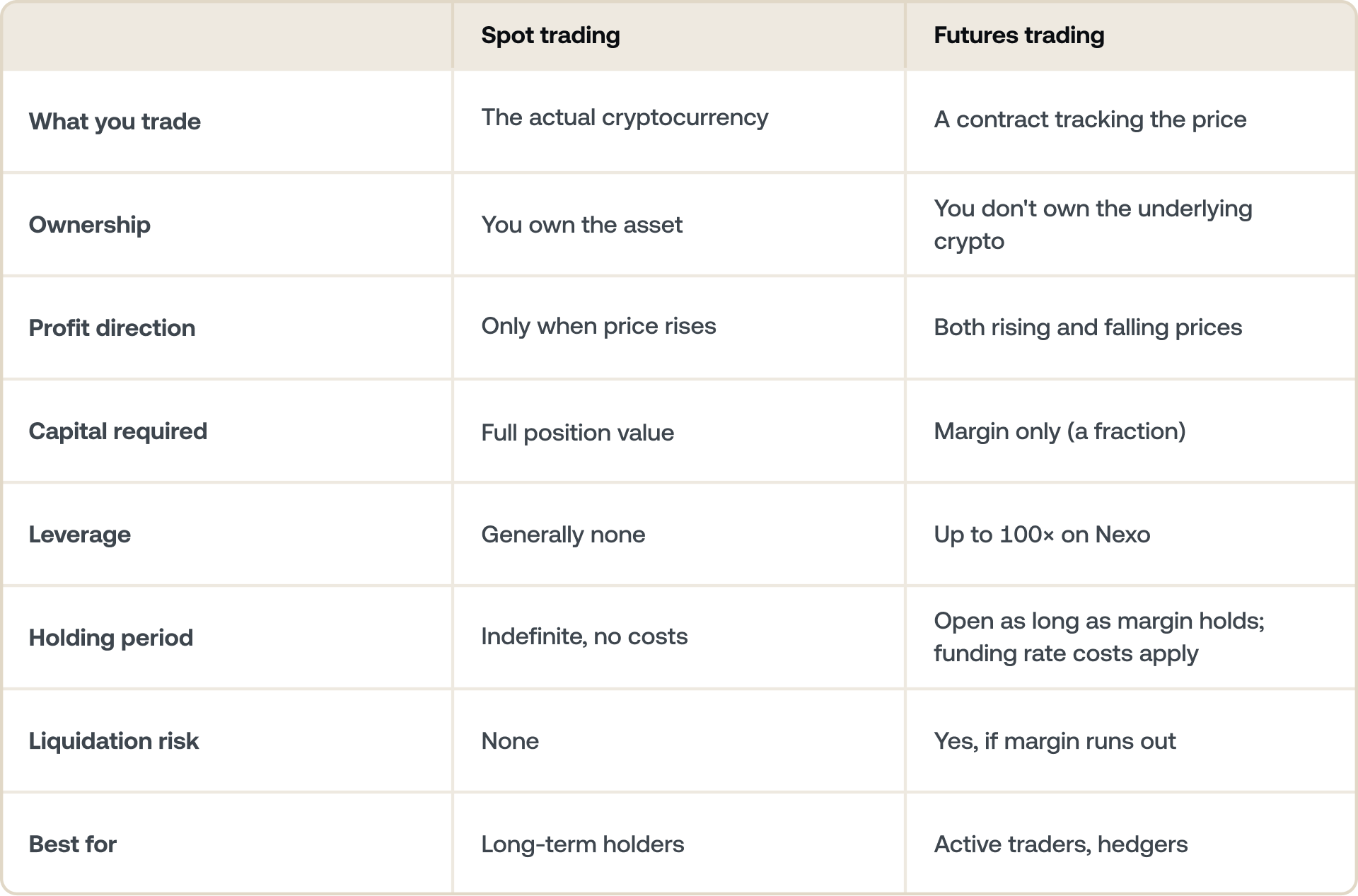
These differences make futures a powerful tool for active traders and risk managers — not just long-term investors.
Why do futures strategies matter?
Futures let you profit from both rising and falling prices. You can go long (if you expect prices to rise) or short (if you expect them to fall). This flexibility is powerful — but without a plan, leverage can magnify losses just as quickly as gains.
That's why professional traders rely on strategies. A futures strategy gives structure to your trades. It defines your time horizon, entry points, and risk level before you even open a position.
Core crypto futures strategies
Let's unpack four futures strategies traders rely on to navigate the market — what they are, how they work, and why they fit the futures markets.
1. Scalping: turning tiny price moves into consistent results
Timeframe: Seconds to minutes
Popular among: High-frequency or experienced traders
Scalping is about taking advantage of micro-movements in price. You open and close many small trades during the day, each targeting a fraction of a percent in profit.
Because futures markets are liquid and continuous, scalpers can react instantly and use leverage to make small swings meaningful.
Example:
If Bitcoin fluctuates between $99,800 and $100,000, a scalper might:
- Go long at $99,800 and close at $100,000 (0.2% gain)
- Use 10× leverage to turn that into roughly 2%
- Repeat this dozens of times across the day
Key point: Scalping isn't a matter of luck. It's math and discipline. You rely on repetition, not prediction.
Risk: High focus is required. One wrong move can erase hours of gains.
Because trades happen so often, small fees and funding costs can eat into profits. Successful scalpers keep trades simple, use small leverage, and stick to strict risk limits.
2. Swing trading: capturing the market's natural rhythms
Timeframe: Days to weeks
Popular among: Intermediate traders
Swing traders try to catch the "swings" — medium-term price waves driven by sentiment or momentum. They hold positions longer than scalpers but shorter than long-term investors.
Futures are ideal for swing trading because you can hold both long and short positions indefinitely (thanks to perpetual contracts) and use moderate leverage to scale exposure.
Example:
ETH breaks above a key resistance at $3,000. A swing trader enters long at $3,050, sets a stop-loss at $2,950, and targets $3,350. That's roughly a 10% move. With 3× leverage, it can return 30% before fees.
Key point: Swing trading is about patience. You're trading trends, not noise.
Risk: Holding overnight exposes you to market gaps or funding rate changes.
Swing traders often use simple chart signals like moving averages or momentum indicators to spot when a trend is starting or slowing down. The goal is to ride the market's rhythm, not chase every move.
3. Breakout trading
Timeframe: Hours to days
Popular among: Momentum traders
Breakout trading focuses on sudden price shifts — moments when the market "breaks out" of a range or key technical level. Traders use stop orders to automatically enter a position when volatility hits.
Example:
Bitcoin trades in a narrow range between $98,000 and $100,000.
You set:
- A long trigger entry at $100,200 to catch an upward breakout
- A short trigger entry at $97,800 to catch a downward one
When one triggers, you cancel the other and let momentum do the rest.
Why it works: Crypto often moves sharply after periods of low volatility, especially around major news or economic events. Futures allow you to plan for both scenarios in advance.
Key point: Breakouts reward preparation, not reaction.
Risk: False breakouts — price moves briefly, then reverses.
Many breakout traders watch for strong trading volume or sharp increases in volatility to confirm that a move has real momentum behind it.
4. Hedging: protecting your long-term holdings
Timeframe: Varies
Popular among: Long-term investors and portfolio managers
Hedging is the opposite of speculation. It's about protection — using a futures position to offset risk in your spot holdings.
Example:
You hold 1 BTC and want to safeguard against short-term drops. You open a short BTC futures position equal to your holdings. If Bitcoin falls 10%, your spot value drops — but your short position gains roughly the same amount.
Why traders use it:
You stay exposed to Bitcoin's long-term upside while limiting short-term downside. No need to sell your BTC or trigger taxes.
Key point: Hedging turns futures into a defensive tool, not just a speculative one.
Risk: If the market rises instead, your hedge limits your upside.
Note: There's another way to hedge — by opening two futures positions in opposite directions.
For example, you could go long and short on BTC at the same time. This setup is like putting both hands on the wheel in a fast-moving market. One position gains if the price goes up, the other cushions you if prices decline.
Traders use this approach to offset short-term risk or pause their exposure without fully closing their positions. Learn more.
Key features of futures strategies
- You can trade in any market direction. Bull or bear, there's always an opportunity.
- You control risk precisely. Futures let you define margin, stops, and exposure.
- You use capital efficiently. Leverage frees up funds for other activities.
- You learn faster. Futures trading exposes patterns in behavior and sentiment that long-term investing often hides.
Futures focuses less on prediction and more on probability — helping traders define their approach with precision and control.
Applying these strategies to Nexo Futures
Once you understand the mechanics, execution becomes simpler. With Nexo Futures, you can:
- Trade perpetual contracts across BTC, ETH, SOL, XRP, and other major assets
- Use collateral like BTC, ETH, XRP, or stablecoins
- Access up to 100× leverage, adjustable per trade, depending on your jurisdiction.
- Automate exits with Take Profit and Stop Loss orders — essential for every strategy above
- Keep positions open as long as needed — no expiry, no rollover pressure
- Practice with Demo Trading, our simulated trading environment that lets you test strategies without risk of actual financial loss
Risks and good habits
- Leverage and liquidation: Lower leverage reduces the risk of liquidation. Understanding how margin requirements change with market volatility is key to managing futures positions responsibly.
- Trading frequency: Futures trading often rewards selectivity. Fewer, well-planned positions tend to be easier to manage than constant trading activity.
- Stop-loss orders: Stop-loss tools help limit potential losses in volatile markets. Setting clear exit points can make trading outcomes more predictable.
- Performance tracking: Reviewing your trading history and results helps identify what works over time. Futures trading benefits from data awareness and consistency.
Is crypto futures trading right for you?
For most newcomers, futures trading is best approached as a learning tool rather than a primary strategy.
It may make sense if:
- You understand leverage and margin
- You can monitor positions actively
- You're comfortable with the possibility of losing your margin
It may not make sense if:
- You're still learning basic crypto concepts
- You prefer long-term holding
- You're uncomfortable with fast-moving risk
There's no single right answer — only what fits your experience and risk tolerance.
Frequently asked questions
1. Do you own crypto when trading futures?
No. You trade contracts linked to the asset's price, not the asset itself.
2. Can beginners trade crypto futures?
Beginners can access futures on many platforms, but futures trading carries higher risk and requires a strong understanding of margin, leverage, and liquidation.
3. Are crypto futures only for advanced traders?
No. They're accessible to everyday traders who take time to learn risk management and start small.
4. Is futures trading the same as margin trading?
They're related but not identical. Futures involve contracts with built-in leverage, while margin trading typically involves borrowing funds to trade spot assets.
5. Can you lose more than you invest?
Depending on platform rules and risk controls, losses are usually limited to your margin — but they can still happen very quickly.
6. Can I lose my entire margin?
Yes. If the market moves far enough against your position, your margin can be fully liquidated. This is why it's often recommended to only trade with amounts you're prepared to lose.
7. What does "perpetual" mean in crypto futures?
Most crypto futures are perpetual contracts, which means they don't have an expiration date. You can keep a position open as long as you maintain enough margin and cover ongoing funding costs. To keep the contract price closely tracking the spot market price, platforms use a mechanism called funding payments, which periodically adjust incentives between long and short traders.
8. Do I need leverage to trade crypto futures?
No, but futures are built around leverage. Even if you choose low leverage (like 2×), you're still using leverage by default. Higher leverage increases both potential gains and potential losses, which is why beginners are often advised to start conservatively, if at all.
9. Can I hold a futures position long term?
Technically, yes — especially with perpetual contracts. Practically, it's risky. Holding leveraged positions over long periods exposes you to ongoing volatility, funding costs, and higher liquidation risk. That's why futures are usually used for short-term strategies, not long-term holding.
10. What are some common futures trading strategies?
Futures traders use a range of approaches, depending on their goals and experience. Common examples include scalping for short-term price moves, swing trading to follow medium-term trends, breakout trading during volatile periods, and hedging to offset risk in other holdings.
These materials are accessible globally, and the availability of this information does not constitute access to the services described, which services may not be available in certain jurisdictions. Rates are subject to change and may vary by region, loyalty tier, and other applicable factors. Always refer to the Nexo app for your applicable rates. These materials are for general information purposes only and not intended as financial, legal, tax, or investment advice, offer, solicitation, recommendation, or endorsement to use any of the Nexo Services and are not personalized, or in any way tailored to reflect particular investment objectives, financial situation, or needs. Digital assets are subject to a high degree of risk, including but not limited to volatile market price dynamics, regulatory changes, and technological advancements. The past performance of digital assets is not a reliable indicator of future results. Digital assets are not money or legal tender, are not backed by the government or by a central bank, and most do not have any underlying assets, revenue stream, or other source of value. Independent judgment based on personal circumstances should be exercised, and consultation with a qualified professional is recommended before making any decision.