Crypto banking explained: crypto-friendly banks vs. crypto banks vs. neobanks vs. non-bank platforms
Sep 03•8 min read

The short version
Crypto banking is the general term for holding, moving, or growing digital assets through a financial provider — whether that's a bank, a fintech app, or a dedicated platform.
A crypto-friendly bank is a licensed, deposit-insured bank. It simply doesn't block transfers to crypto exchanges.
A crypto bank is a licensed banking institution. It’s rare, and usually chartered outside the U.S. and holds crypto as a core part of its balance sheet.
A neobank with crypto features is an app-based bank account built on a partner bank's charter. It bolts on limited buying and selling of crypto.
A non-bank crypto platform holds no banking license at all. It's built specifically to let you hold, earn on, and borrow against crypto. Custody and compliance standards are designed for digital assets, not adapted from traditional banking.
What is crypto banking?
Crypto banking isn't a single regulated category — it's a catch-all for anywhere you can hold or manage digital assets alongside (or instead of) traditional money.
That's why the term gets applied loosely to four genuinely different setups: an ordinary bank that just doesn't block crypto transfers, a licensed institution built around crypto from the ground up, a digital bank account with a crypto feature bolted on, and a dedicated platform with no banking license at all.
The sections below break down what each one is, since the differences determine what happens to your money.
What is a crypto-friendly bank?
A crypto-friendly bank is an ordinary, fully licensed retail or business bank. It has a banking charter, deposit insurance (FDIC in the US, similar schemes elsewhere), and a regulator that examines its books. What sets it apart is simple: it doesn't restrict customers from moving money to and from crypto exchanges. Some banks still flag, delay, or outright block card payments and wire transfers to crypto platforms as a fraud-prevention measure. A crypto-friendly bank doesn't do that.
Beyond not blocking transfers, crypto-friendly banks generally don't offer any crypto-specific products themselves. Your checking account, savings account, and debit card work exactly as they would at any other bank.
The "crypto-friendly" label just means the bank stays out of your way when you want to fund a crypto purchase or cash out to fiat. This is the category most people are actually hunting for when they search "which bank supports crypto." It's worth knowing before you get a declined transaction at the worst possible moment.
What is a crypto bank?
A crypto bank is a licensed banking institution built specifically around digital assets. It holds an actual banking charter, not just a partnership with one, and crypto sits at the center of its business rather than as an add-on.
A small number of these exist globally, mostly under specialized frameworks like Switzerland's banking license for digital-asset firms. Because they're licensed, they can offer things an unlicensed platform legally cannot: regulated custody paired with traditional deposit-taking, or crypto-collateralized accounts that sit inside the banking system itself.
Genuine crypto banks are still uncommon. The term gets misapplied constantly to companies that aren't banks at all. If a platform doesn't disclose an actual banking license from a named regulator, it isn't a crypto bank in the strict sense.
What is a neobank with crypto features?
A neobank is a digital-only bank account, usually mobile-first. It doesn't hold its own banking charter — it issues accounts through a licensed partner bank behind the scenes. Your deposits are typically still covered by that partner bank's deposit insurance. Some neobanks have added crypto features on top of this banking infrastructure: buying a small selection of coins, rounding up spare change into Bitcoin, or viewing a crypto balance alongside your checking account.
The crypto layer on a neobank is usually thin by design. You're generally limited to a handful of major coins. Spreads and fees tend to run higher than on dedicated exchanges. Features like earning yield or borrowing against your crypto are rarely part of the offering. The core product is still the bank account — crypto is a convenience add-on, not the main event.
What is a non-bank crypto platform, and where does Nexo fit?
A non-bank crypto platform holds no banking license at all. It isn't chartered as a bank. It doesn't take deposits in the regulatory sense that a bank does, and it isn't backed by deposit insurance schemes like the FDIC. Instead, it operates under the licenses that actually apply to digital-asset businesses: money transmitter licenses, e-money licenses, or equivalent registrations, depending on the jurisdiction. And it's built end-to-end around crypto — custody, trading, earning, and borrowing against digital assets as the core product, not an add-on.
Nexo is a non-bank crypto platform — a digital wealth platform built for people who already hold crypto and want to put it to work. Rather than operating as a bank, Nexo focuses on the services that matter once you're holding digital assets: earning yield on idle crypto and stablecoin balances, borrowing against crypto holdings without selling them, and trading across a range of assets.
Each of these runs on infrastructure built specifically for digital-asset custody and compliance, designed from the ground up for crypto rather than adapted from a banking system. The one place traditional banking still comes in is funding. Moving money in via bank transfer or card relies on partner banking rails, so that step feels as smooth as any other financial app.
It's this bridge between banking rails and crypto-native infrastructure that lets Nexo connect both worlds, without being a bank itself.
Crypto-friendly banks vs. crypto banks vs. neobanks vs. non-bank platforms: the key differences
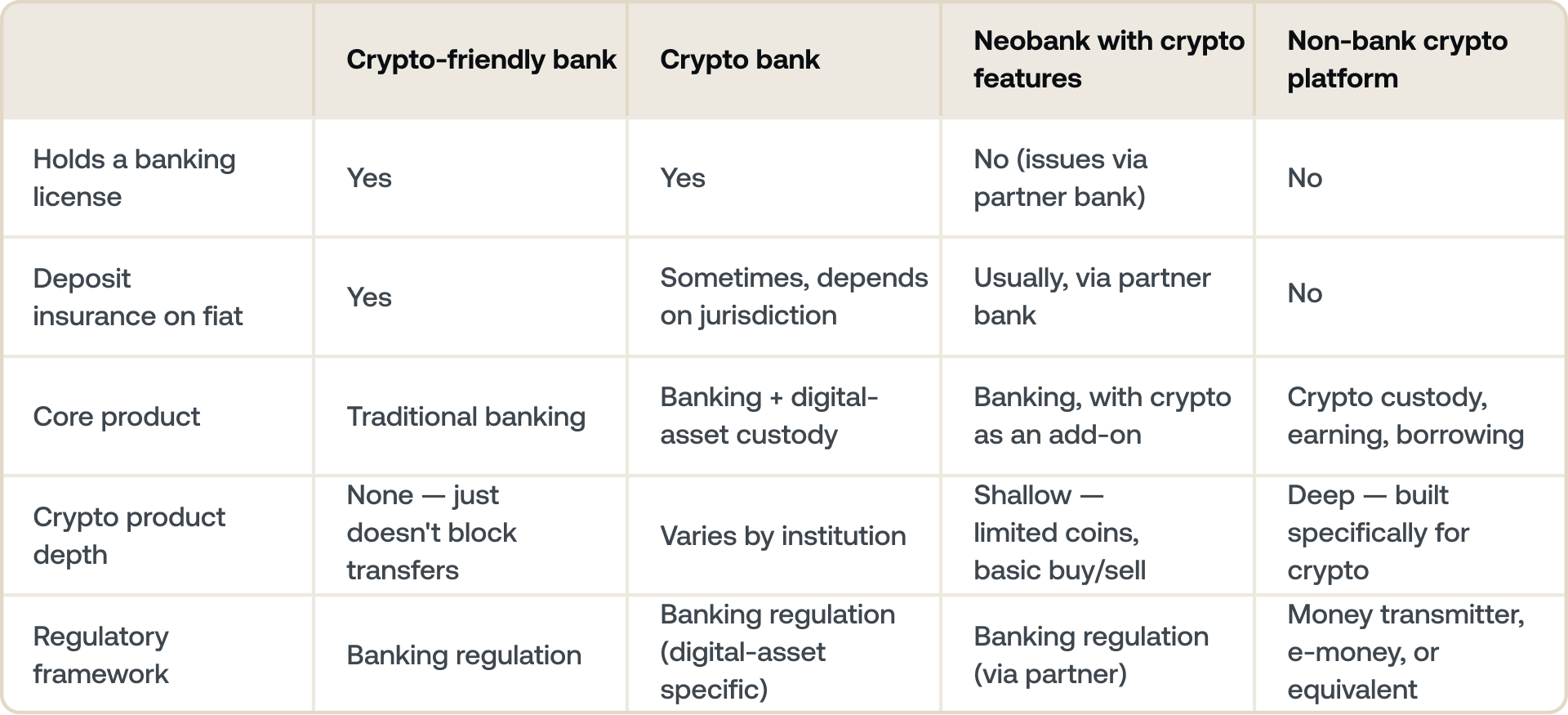
Laid out side by side, the differences come down to three questions. Does the company hold a banking license? Is your balance covered by deposit insurance? And how does the platform actually secure and custody your crypto? The table below answers all three.
How to choose between them
If you just need your paycheck to land somewhere and occasionally fund a crypto purchase without your bank flagging the transfer, a crypto-friendly bank covers that. Nothing more needs to change.
If you want your day-to-day banking and a small crypto balance in one app, a neobank with crypto features is a reasonable middle ground — as long as you're comfortable with the limited coin selection and higher fees that come with the convenience.
If crypto is where you actually want the depth — earning on balances you're not actively trading, unlocking liquidity against holdings without selling them, or trading with more range than a neobank's bolt-on feature allows — that's the gap crypto platforms like Nexo are built to fill.
Is crypto banking safe?
Safety depends entirely on which category you're in, and it's worth being direct about the gaps.
- Crypto-friendly banks and crypto banks: your fiat balance is typically covered by standard deposit insurance — FDIC in the US, or an equivalent scheme elsewhere — the same as any bank account. Crypto holdings themselves are not FDIC-insured anywhere in this landscape; deposit insurance covers cash, not digital assets, regardless of which type of institution is holding them.
- Neobanks with crypto features: the fiat balance is usually insured through the partner bank. The crypto layer generally isn't.
- Non-bank crypto platforms: neither your crypto nor your fiat balance is covered by deposit insurance. Security here comes from the platform's own custody infrastructure, audits, and licensing.
Across every category, the value of the crypto itself can move sharply, and there's no guarantee of return on anything you hold or earn. That's not specific to any one provider — it's true of digital assets generally, no matter who's holding them for you.
The bottom line
These four categories get flattened into "crypto bank" constantly. But the differences are concrete: whether a banking license exists, whether deposit insurance applies, and how deep the crypto functionality actually goes.
Crypto-friendly banks and neobanks solve a fiat-banking problem with light crypto convenience attached. Genuine crypto banks are licensed institutions that remain rare.
Non-bank crypto platforms — Nexo included — are neither, and don't claim to be. They're purpose-built for holding, earning on, and borrowing against digital assets, operating under the licenses that actually govern that activity.
Curious what that looks like in practice? See how earning on crypto and borrowing against your holdings work on a platform built specifically for it.
Frequently asked questions
1. Is Nexo a bank?
No. Nexo is a non-bank crypto platform. It doesn't hold a banking charter and your balance isn't covered by deposit insurance schemes like the FDIC. It operates under money transmitter, e-money, or equivalent digital-asset licenses depending on the jurisdiction, with infrastructure built specifically for crypto custody, earning, and borrowing.
2. What's the real difference between a crypto bank and a crypto-friendly bank?
A crypto bank holds an actual banking charter and puts digital assets at the center of its business. A crypto-friendly bank is an ordinary licensed bank that simply doesn't block your transfers to crypto exchanges — it doesn't offer any crypto products itself.
3. Is cryptocurrency banking regulated the same way as traditional banking?
It depends on which category you're in. Crypto-friendly banks and crypto banks fall under standard banking regulation. Non-bank crypto platforms operate under separate digital-asset frameworks — money transmitter or e-money licenses — which is a different regulatory regime, not a lighter one.
4. Are "crypto banking solutions" the same thing as this?
Not usually. "Crypto banking solutions" most often refers to white-label, business-to-business infrastructure that lets banks or fintechs add crypto capabilities to their own products. This page is about the personal side: how you, as an individual, hold and use crypto day-to-day — whether through a bank, a neobank, or a platform like Nexo.
5. Which specific banks are considered crypto-friendly?
This varies by country and changes as bank policies shift, so we don't maintain a ranked list here. The reliable way to check is to ask your bank directly whether it restricts transfers to crypto exchanges, or to look for banks that explicitly advertise crypto-related transfers as supported.
6. What's a digital wealth platform, and how is it different from a bank?
A digital wealth platform is a non-bank service built around managing and growing what you already hold in digital assets — earning yield, borrowing against holdings, and trading, in one place. It doesn't hold a banking charter and isn't a substitute for one; it's a different category built specifically for crypto, running on custody and compliance infrastructure designed for digital assets rather than adapted from traditional banking. Nexo is an example of this category.