Markets Today - October 29, 2026
Oct 29•5 min read

Daily analysis of crypto markets and the forces shaping them, from the Nexo research desk.
Bitcoin navigates hawkish Fed as us inflation meets forecasts and growth remains resilient
Bitcoin eases to near $80,100 on Thursday after briefly slipping below $80,000, reversing a two-day rebound as a fresh bout of risk aversion hits technology shares after the Fed held rates on Wednesday. U.S. futures are mixed, with the Nasdaq-100 down 1.0%, the S&P 500 down 0.3% and the Dow up 0.5%, as Alphabet falls about 10% premarket on weaker search advertising and a deeper cash burn, while Microsoft gains more than 3% on cloud strength. The Kospi closed down 1.2% after Samsung’s chip profit fell just short of expectations, while the STOXX 600 is up 0.5%. The Fed held at 3.75% to 4.00% in a 10-2 vote, with two policymakers favoring a hike and Chair Kevin Warsh declining to give guidance, so the hold did not close the door on tightening, with a December hike still priced at roughly 80%. Treasury yields steepened after the decision, the 10-year near 5.00%, the dollar index is steady near 102.2, gold is lower at $4,038 and Brent is near $114. Core PCE, the Fed’s preferred inflation gauge, rose 0.3% month-on-month, matching expectations and offering no fresh inflation surprise. Third-quarter GDP grew 3.4% and initial jobless claims fell to 194,000, reinforcing economic resilience, while the ECB held rates at 2.50% as expected. The Bank of Japan decides on Friday. The total crypto market cap sits around $2.7 trillion.
Bitcoin
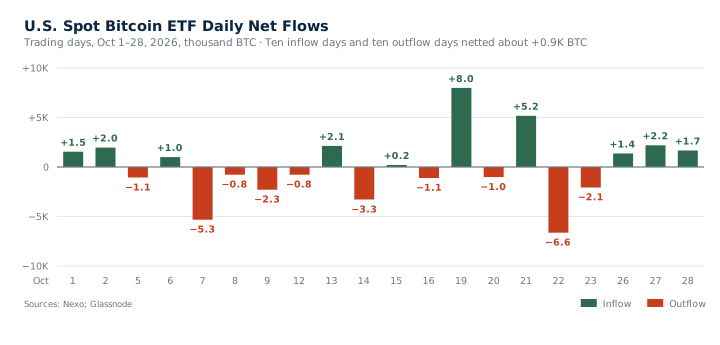
Bitcoin fell from above $81,700 to around $79,800 in Asian trading as Alphabet’s results and Samsung’s chip miss set off renewed selling, with about $356 million of leveraged positions, mostly longs, reset over 24 hours. The hold itself was not the trigger, as Bitcoin had edged up to $81,000 after the Fed’s statement. ETF demand has stayed positive into the dip, with U.S. spot Bitcoin ETFs taking in $137 million on Wednesday, a third straight inflow day this week. The channel to crypto is real yields: a hawkish tone keeps inflation-adjusted yields high and limits flows into speculative assets.
Bitcoin has tracked equities, with a 30-day correlation of 0.64 with the Nasdaq-100, and has moved against oil since the Middle East conflict began, with a correlation of −0.47. WTI is trading in a narrowing range near $102, so a break higher would revive the inflation and yield worries that have weighed on Bitcoin.
Ethereum & Altcoins
Ether trades near $2,320, XRP near $1.29 and Solana near $100, all lower with Bitcoin as the tech selloff spreads. Ether has also seen softer demand through October: U.S. spot Ether ETFs have recorded outflows on 17 of the month’s 20 trading days, about $1.35 billion in total per SoSoValue, the second-largest monthly outflow on record, and the price is down about 13.6% this month, on course for its weakest October since 2018. Long-idle wallets have also moved roughly 56,000 ETH since October 5, with most of the larger transfers going to exchanges, though on-chain data cannot show whether sales followed. Traders will watch whether ETF outflows slow and whether Ether holds above $2,295, with $2,400 the first level to reclaim.
Macro & Institutional
The Fed held at 3.75% to 4.00% in a 10-2 vote, with Governor Lisa Cook and Cleveland Fed President Beth Hammack preferring a quarter-point hike after September’s increase. Chair Kevin Warsh again gave no forward guidance, said the data in the coming period will shape policy, and said politics played no role. He noted that financial conditions have tightened since September and that he is skeptical tighter policy would leave AI investment untouched, since rates reach nearly every part of the economy, which matters because AI companies now fund the buildout in bond and equity markets. He also announced that one of next year’s eight meetings will focus on strategy instead of a rate decision. Markets read the hold as a pause and not an end to tightening: Treasuries steepened, with the 2-year yield down 3.8 basis points to 4.70% and the 10-year up 5 to 5.04%, and Wall Street finished slightly higher.
Tech earnings fed the same debate. Alphabet’s search advertising grew at its slowest pace in five quarters while capital spending rose to $51.4 billion, putting roughly $400 billion of market value at risk premarket, whereas Microsoft’s cloud unit grew 48%.
Core PCE, the Fed’s preferred inflation gauge, rose 0.3% month-on-month, matching both expectations and the previous reading, offering no fresh inflation surprise following Wednesday’s rate decision. The broader economic picture remained resilient, with third-quarter GDP expanding at an annualized 3.4%, above the 3.2% forecast and up from 2.2% in the previous quarter. Initial jobless claims fell to 194,000 from 195,000, below the expected 198,000, pointing to continued labor market strength. Together, the releases suggest that the U.S. economy continues to expand at a healthy pace without an unexpected acceleration in underlying inflation. With the data bringing little reason to reassess the policy outlook, attention remains on the Fed’s December decision.
The ECB held its deposit rate at 2.50%, as expected, warning that rising energy prices pose upside risks to inflation and downside risks to growth. It also noted that underlying price pressures have remained broadly stable while financing conditions have tightened, leaving December’s widely anticipated hike in focus. French stress, with the spread over Bunds near 153 basis points, gives it cover to avoid aggressive tightening. The euro, near $1.11, is down almost 2% this month, with investors holding their largest bets against it in a decade, and President Christine Lagarde confirmed she will leave in February. The Bank of Japan decides on Friday and is expected to hold at 1.25%, with focus on whether Governor Kazuo Ueda opens the door to a December hike.
Looking Ahead
With core PCE delivering no inflation surprise and Thursday’s broader economic data confirming continued growth and labor market resilience, attention shifts to the Bank of Japan’s Friday decision and Governor Ueda’s comments on a possible December hike. Amazon and Intel report after the close, the next read on AI spending. Friday also brings euro-zone third-quarter GDP and national October inflation. U.S. midterm elections follow on November 3 and payrolls on November 6, with the Fed’s next decision on December 9. For Bitcoin, the latest readings offer reassurance on U.S. growth and employment, while the path of real yields, December rate expectations and oil near $102 remain important drivers.
Author: Iliya Kalchev, Analyst at Nexo’s Dispatch
This material is produced by Nexo for informational purposes only and does not constitute financial, investment, legal, or tax advice, or a recommendation to transact in any digital asset. Views are the author's as of the date of publication and may change without notice. Information is from sources believed reliable, but Nexo makes no warranty as to its accuracy and accepts no liability for any loss arising from reliance on this material.