Markets Today - October 15, 2026
Oct 15•5 min read
.png)
Daily analysis of crypto markets and the forces shaping them, from the Nexo research desk.
Bitcoin trades below $81,000 as producer prices jump 1.3%, more than double forecasts, adding to a tech rout
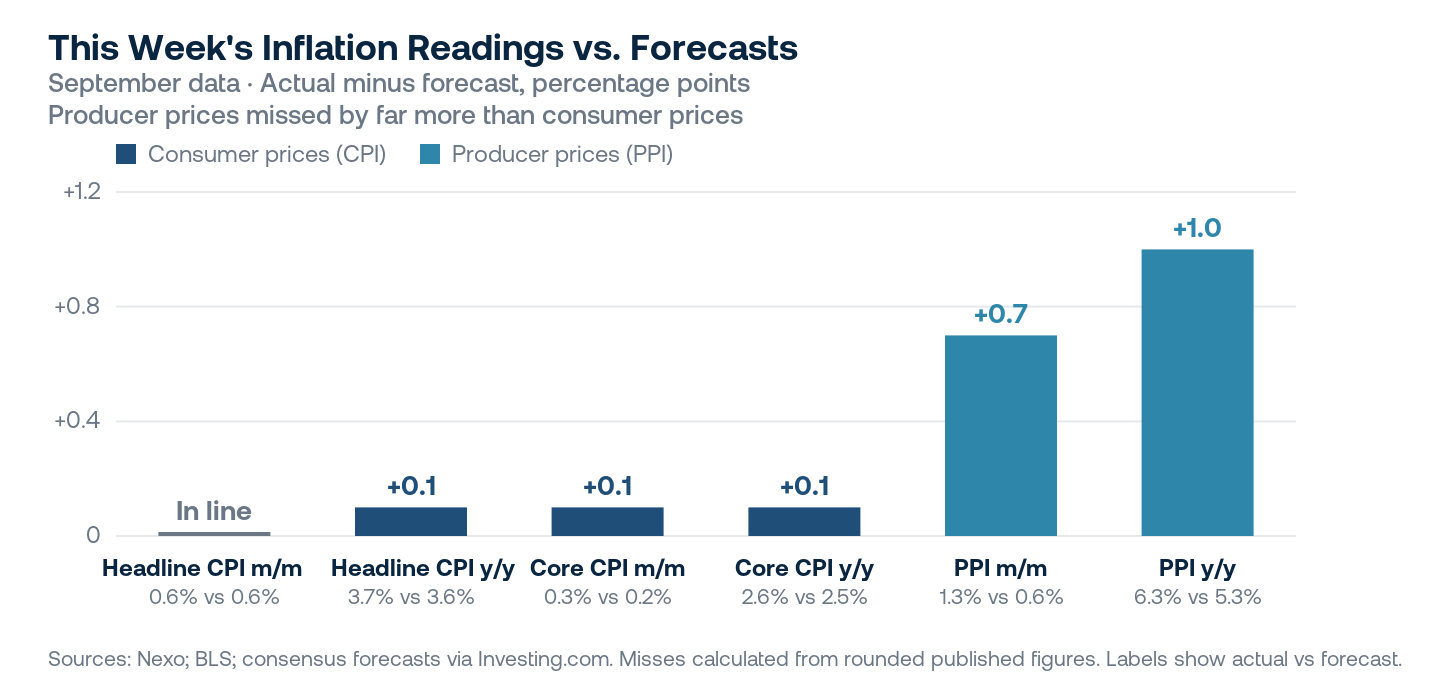
Bitcoin trades just below $81,000 on Thursday as a global technology selloff, led by chipmakers in Asia, meets a U.S. producer price report far hotter than expected: final-demand prices rose 1.3% in September against 0.6% forecast, taking the annual rate to 6.3% from 5.6%, against 5.3% expected. Before the report, U.S. futures pointed lower, with the Nasdaq-100 down 1.4%, the S&P 500 down 0.5% and the Dow up 0.1%, after South Korea’s Kospi fell 8.2% to 5,514.96, triggering a market-wide circuit breaker, and Japan’s Nikkei fell about 5%. Samsung and SK Hynix fell roughly 10% in Seoul, SK Hynix was down 6.7% and Micron 4.1% in premarket trading, and European equities were little changed. Wednesday was the weakest session since July, with the S&P 500 down 1.1% to 7,723.59, the Nasdaq Composite down 1.9% to 26,692.87 and the Dow down 0.1% to 51,622.32. Treasuries had rallied in a flight to safety, with the 10-year yield near 5.1% against a Wednesday high of 5.333%, the dollar index eased to about 102.1 and spot gold rose 1.2% to $4,152.51. The total crypto market cap sits around $2.7 trillion. Before the report, CME FedWatch showed roughly a 71% chance of a Fed hold at the October 28 meeting and a 70.6% chance of a 25 basis point hike in December.
Bitcoin
Bitcoin extended Wednesday’s CPI-driven losses in Asian trading, dipping to just above $80,000 before buyers stepped in near the October 8 low of about $80,300, and it is trading near its weakest level since September 20. The move looks less like a crypto-specific story than a broad exit from risk, with weakness in U.S. tech spilling into both markets. About $950 million of leveraged positions, mostly longs, were reset over 24 hours, up from about $136 million a day earlier, which suggests significant leverage has already been flushed out, and the question now is whether spot demand returns. U.S. spot Bitcoin ETFs saw $261.5 million of outflows on Wednesday, per SoSoValue, after a $175.6 million inflow on Tuesday.
Derivatives show positions being rebuilt into the drop. Bitcoin futures open interest rose about 1.6% in dollar terms while price fell more than 2%, implying contracts rose by roughly 3.7%, and with cumulative volume delta negative, the new money looks more like shorts, per CoinDesk data. Open interest does not show direction, and funding remains positive. Implied volatility held just above 40% for a second day, up from recent lows near 34% but well short of the highs in February and June, and options flow is two-way, with calls at the $90,000 and $86,000 strikes alongside puts among the most traded.
Ethereum & Altcoins
Ether trades near $2,360, falling harder than Bitcoin, with about $200 million of ether long positions liquidated against $115 million in Bitcoin, which points to heavier long leverage in Ether, and puts topping its options volume. Zcash fell the most among the top ten, to about $1,101, and smaller tokens lost more than the majors, with Pump.fun near $0.0043. Open interest in Dogecoin and Near fell far more than their prices, a sign of capital leaving, while silver perpetual futures saw more liquidations than Zcash, a sign of the growing popularity of traditional assets on crypto platforms.
Macro & Institutional
The producer price report adds a second hot inflation reading in two days. Final-demand prices rose 1.3% in September, more than double the 0.6% forecast and up from 0.5% in August, and the annual rate rose to 6.3% from 5.6%, a full percentage point above the 5.3% economists expected. Producer prices are a leading indicator for consumer prices, since higher input costs can feed through to retail prices with a lag, and components of the index can feed into the PCE gauge due October 29, so the report raises the bar for a soft reading there and adds to the risk for the consumer inflation outlook. Initial jobless claims were 199,000, in line with forecasts and up from 198,000 the week before, so a steady labor market leaves inflation, not employment, as the swing factor for the Fed. The report also tests this morning’s flight to safety, in which Treasuries and gold rallied on growth and AI-financing fears.
The Fed was already leaning toward patience on October but not on direction. Fed officials Michelle Bowman and Mary Daly said the central bank can afford to weigh incoming data before acting again, while Chicago Fed President Austan Goolsbee called the inflation figures discouraging and flagged AI infrastructure investment as a possible source of overheating. Core CPI was above the 0.2% consensus for a second consecutive month, with core goods and core services both firming, and UBS now expects hikes in December and March 2027 on top of September’s, calling October a close call while noting that Fed communication favors gradual tightening. Its path is more dovish than markets, which price in nearly five hikes in total.
AI demand looks intact, but its financing is being repriced. TSMC posted a record quarterly profit of NT$763 billion, up 69% from a year ago on revenue up 50%, even as chip and AI-linked stocks sold off on the prospect of higher rates for debt-funded buildouts. CoreWeave fell more than 15% on Wednesday, with some of its bonds at new lows, and Anthropic reportedly told investors its third-quarter revenue rose 45% to $16.8 billion, a cooler pace than in earlier quarters.
Before the producer report, the 30-year yield was near 5.46%, and the euro was posting its largest single-day gain in nearly two months, near $1.121, as the dollar retreated. The yen firmed on renewed intervention warnings from Japan’s finance minister. Oil fell about 2%, with Brent near $104 and WTI near $94, on a report that Washington is weighing easing sanctions on some tankers, offsetting tensions around Hormuz shipping.
Looking Ahead
With CPI and PPI both above forecast and claims steady at 199,000, attention turns to how the Fed weighs them. Friday brings a speech from Fed Chair Kevin Warsh and euro-zone CPI. The October 28 decision comes before core PCE on October 29, which the producer data now makes a bigger test, followed by payrolls on November 6 and the December 9 meeting. For Bitcoin, buyers need to defend the $80,000 area where they stepped in overnight, with ETF flows, which turned to a $261.5 million outflow on Wednesday, the first read on whether demand is returning.
Author: Iliya Kalchev, Analyst at Nexo’s Dispatch
This material is produced by Nexo for informational purposes only and does not constitute financial, investment, legal, or tax advice, or a recommendation to transact in any digital asset. Views are the author's as of the date of publication and may change without notice. Information is from sources believed reliable, but Nexo makes no warranty as to its accuracy and accepts no liability for any loss arising from reliance on this material.