What to know before you get a crypto-backed loan
Oct 15•8 min read
Short answer:
Crypto-backed loans aren’t risk-free, but the risk can be measured and managed. Before you get one, two things matter most: how much you borrow against your collateral (your loan-to-value ratio, or LTV) and how the lender handles falling prices.
Get both right, and a crypto-backed loan can be a practical way to access cash without selling. Get them wrong, and a market drop can cost you part of your holdings.
This guide covers what to know before you get a crypto-backed loan: how it works, the real advantages and risks, and the questions to ask any lender first.
How crypto-backed loans work
A crypto-backed loan lets you borrow against digital assets you already own, such as Bitcoin (BTC), Ether (ETH), or stablecoins. You pledge the crypto as collateral, and the lender provides funds, usually in US dollars via bank transfer or in stablecoins like USDC.
Because the loan is backed by collateral, most lenders don't run a credit check. Instead, they cap how much you can borrow with a loan-to-value (LTV) ratio. LTV is your loan amount divided by the value of your collateral. If you borrow $5,000 against $10,000 of BTC, your LTV is 50%.
Crypto prices can move 10% or more in a day. When your collateral loses value, your LTV rises, even if you haven't borrowed another dollar. Every crypto lender has a threshold where it steps in, usually by selling some of your collateral to repay part of the loan. In the industry, this is called liquidation.
The pros: why people borrow against crypto
You keep your position. Borrowing lets you access funds without selling assets you expect to hold long term. If the price rises while your loan is open, you still benefit from that upside once you repay.
Selling can trigger taxes; borrowing generally doesn't. In the US, selling crypto is usually a taxable event. Taking out a loan against it generally isn't, because you haven't disposed of the asset. Tax rules depend on your situation, so check with a qualified tax professional before relying on this.
No credit check, faster access. Since the collateral backs the loan, approval doesn't depend on your credit score, and funds can arrive much faster than with a bank loan.
Flexible repayment. Many crypto credit products don't have fixed monthly installments. You repay when it suits you, as long as your LTV stays within limits.
The cons behind crypto-backed loans
Price drops can force a sale of your collateral. This is a common way a loan can become harder to manage. If your collateral falls far enough, the lender sells part of it to bring your LTV back down. You lose those coins at a low price, and if the market recovers, you don't get them back.
Fast markets may move faster than you do. Crypto prices can change quickly, including outside market hours. Alerts can help you keep track, but they don’t guarantee you’ll have time to act.
The factor you control most: your LTV
Most crypto lenders let you borrow up to 50% of the value of BTC or ETH.
The LTV you start with determines how large a price drop your loan can absorb before the collateral is sold. Here's a worked example using an automatic repayment threshold of 83.33% LTV, the level Nexo uses when collateral is entirely crypto:
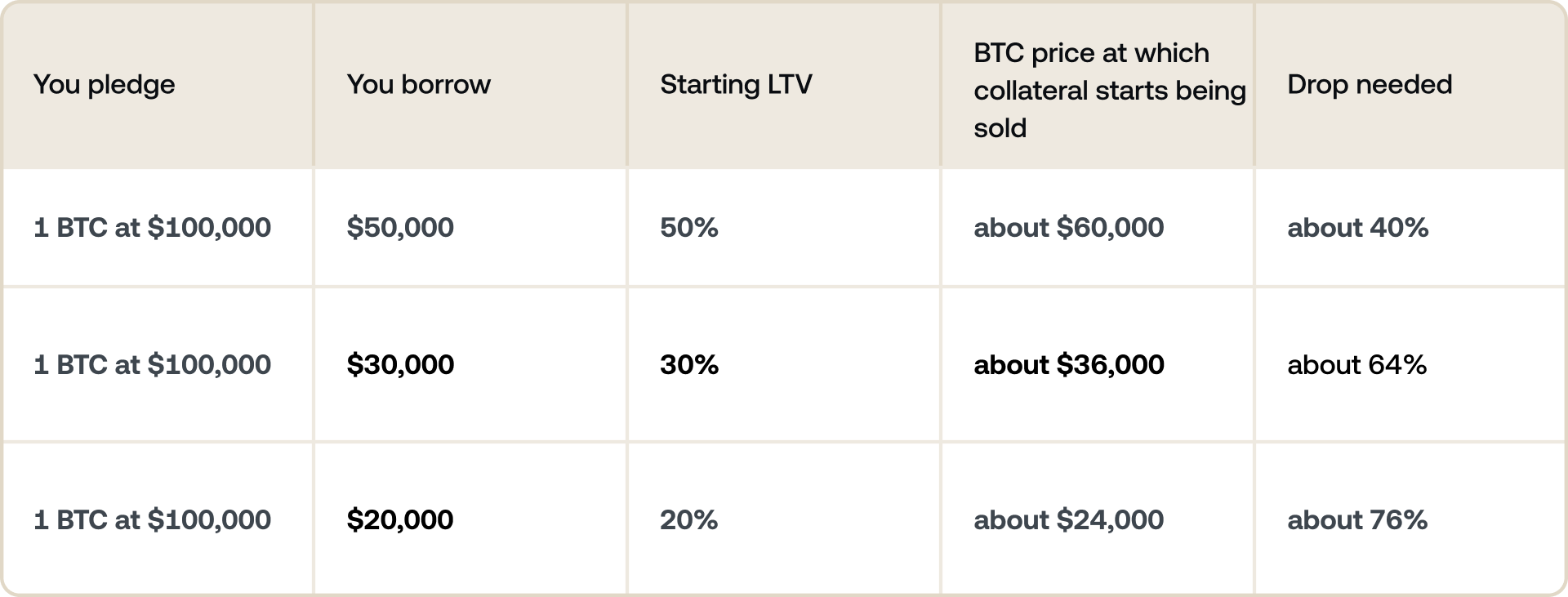
Illustrative figures only. They ignore accrued interest, which raises your LTV over time. Not a forecast of future prices.
Borrowing less than the maximum is the most effective risk control available to any borrower, with any lender. On Nexo, LTV at 20% or less can get you lower interest rates, given you’re part of the Wealth Club loyalty program.
Questions to ask before you borrow
- At what LTV does the lender sell collateral, and how much does it sell? Some lenders sell only enough to restore a healthy LTV. Others close the whole position.
- Will I be warned before that happens? Ask how alerts work, and whether a sale can happen without prior notice.
- What will I really pay? Check how the rate changes with LTV, whether interest compounds, and whether early repayment costs extra.
- How do I repay, and is there a schedule? Check whether you can repay in crypto, stablecoins, or US dollars, and whether minimum payments apply.
- What independent checks has the lender passed? Look for verifiable audits and certifications, not just claims.
How Nexo's Credit Line approaches these risks
Nexo has offered crypto-backed credit since 2018 and has a loan book of over $1.7 billion. In the US, assets used as collateral for Nexo’s Credit Line are held in custody by Bakkt, a publicly listed US company. Here's how the Credit Line answers the checklist above.
Automatic repayments are partial. If your LTV reaches 83.33% (when your collateral is entirely crypto), Nexo automatically sells part of your collateral to bring your LTV back to a healthier level first. If you hold a mix of crypto and stablecoins, the threshold depends on that mix.
You can see the risk building. The Nexo app shows your loan health as Good, Moderate, or Poor. Nexo also sends margin call emails as your LTV approaches the automatic repayment threshold. These alerts are sent on a best-efforts basis. In fast markets, an automatic repayment can happen before you see one.
You can set up an automatic top-up. With Automatic Collateral Transfer turned on, Nexo moves eligible assets from your Savings Wallet into your Credit Wallet to lower your LTV before an automatic repayment is triggered. A related setting can also draw on assets committed in a Fixed-term Yield.
Rates reward lower LTV. Credit Line rates depend on your Wealth Club tier and your LTV. They start at 0.9% per year for Signature-tier clients whose Credit Wallet LTV remains below 20%. Above 20% LTV, the standard rate for the same tier is 7.9% per year. Interest compounds, and you only pay it on the amount you've drawn for the days you use it.
Repayment is flexible. There are no fixed repayment dates and no minimum installments, and you can repay in crypto or stablecoins. However, if you repay within 45 days of your last withdrawal, additional interest at 15.9% per year applies to the repaid amount for the rest of that 45-day period.
Collateral options. You can borrow from $50 (in stablecoins) or $500 (by bank transfer) up to $2 million, against BTC, ETH, and 30+ other assets. Maximum LTV is 50% for BTC and ETH and 90% for USDC and USDT. Nexo doesn't run a credit check.
Independent audits. Nexo holds SOC 2 Type 2 certification and ISO 27001, 27017, and 27018 certifications for information security and data handling.
Is a crypto-backed loan right for you?
A crypto-backed loan may suit you if you plan to hold your crypto long term, need funds for a specific purpose, and can add collateral or repay quickly if prices fall. It's likely a poor fit if you'd be forced to sell in a downturn anyway, if you'd borrow at or near the maximum LTV, or if you plan to use the funds to buy more crypto.
The safest version of a crypto loan is a small one. Borrow well below the maximum, know exactly where your lender's threshold sits, and choose a lender that is transparent about what it costs to borrow.
Frequently asked questions
1. Are crypto-backed loans safe?
They may carry real risks. You can reduce it by borrowing well below the maximum LTV and choosing a lender with clear terms, named asset holders, and independent audits.
2. Can I lose my crypto with a crypto-backed loan?
Yes. If your collateral's value falls far enough, the lender will sell some or all of it to repay the loan. You won't get those assets back, even if prices recover.
3. What happens if I can't repay a crypto loan?
With most crypto credit products, there's no fixed due date, so missing a payment isn't the main risk. The risk is your LTV rising. If it reaches the lender's threshold, collateral is sold to cover the loan.
4. Do crypto-backed loans affect my credit score?
Most crypto lenders, including Nexo, don't run a credit check. Check the lender's terms to confirm whether it reports to credit bureaus.
5. Is borrowing against crypto a taxable event in the US?
Taking out the loan generally isn't, because you haven't sold anything. If collateral is sold to repay the loan, that sale may be taxable. Speak to a qualified tax professional about your situation.
6. What is a safe LTV for a crypto loan?
There's no LTV without risk, but lower is always more resilient. At 20% LTV, BTC would need to fall about 76% before automatic repayment starts at an 83.33% threshold. At 50%, a fall of about 40% is enough.
Borrowing against digital assets involves risk. If collateral value declines, you may be required to add collateral or repay promptly. The platform may execute partial or full automatic repayments or collateral sales to manage loan-to-value thresholds, including during fast-moving markets when notifications may not be timely. Clients are responsible for monitoring their Loan-to-Value ratio. Interest, fees, spreads, and other charges may apply and can change. Rates, product availability, features, and applicable terms may vary based on jurisdiction, eligibility, loyalty tier, and other factors, and are subject to change at any time. When terms such as "up to" or "from" are used to denote limits, achieving these maximum or minimum thresholds may be conditional on additional actions or fulfilment of certain criteria and requirements that may not be attainable by all clients. Any examples are for illustrative purposes only. This information does not constitute tax advice. Please consult a qualified tax professional regarding your specific circumstances. For more information, visit Bakkt Disclosures.
These materials are accessible globally, and the availability of this information does not constitute access to the services described, which services may not be available in certain jurisdictions. These materials are for general information purposes only and not intended as financial, legal, tax, or investment advice, offer, solicitation, recommendation, or endorsement to use any of the Nexo Services and are not personalized, or in any way tailored to reflect particular investment objectives, financial situation or needs. Yield and interest rates are not guaranteed, are subject to change, and may vary by eligibility, selected term, and wealth tier. References to Yield are product names and do not represent rates of return or performance. Nexo products are not bank deposits and are not insured by the FDIC or SIPC. Digital assets are subject to a high degree of risk, including but not limited to volatile market price dynamics, regulatory changes, and technological advancements. The past performance of digital assets is not a reliable indicator of future results. Digital assets are not money or legal tender, are not backed by the government or by a central bank, and most do not have any underlying assets, revenue stream, or other source of value. Independent judgment based on personal circumstances should be exercised, and consultation with a qualified professional is recommended before making any decision.
Services are provided by Bakkt Crypto Solutions, LLC. Digital assets may be held or serviced by third-party custodians, exchanges, lenders, or other service providers. Your ability to access or recover assets depends on the provider’s operational resilience and financial condition. If a provider becomes insolvent or experiences an operational disruption, you may experience delays in access to assets and could lose some or all of your assets. For more information, visit Bakkt Disclosures.