Markets Today - May 22, 2026
May 22•3 min read
Daily analysis of crypto markets and the forces shaping them, from the Nexo research desk.
Bitcoin holds the line through a week of rates volatility
Bitcoin held around $77,000 Friday morning, with total crypto market cap at $2.58 trillion, even as Middle East developments drive volatility in rates and oil. The cross-asset picture flipped sharply mid-week. U.S.–Iran de-escalation headlines pulled Brent from above $110 to $105.7 a barrel, while hawkish April FOMC minutes pinned long-end yields near cycle highs. U.S. equity futures point higher Friday: Dow and S&P 500 contracts up 0.3%, Nasdaq 100 up 0.4%. Focus today turns to Kevin Warsh's swearing-in as Fed Chair, against a backdrop of conflicting signals from Tehran and Washington.
Bitcoin
Despite the ongoing rate volatility, BTC traded in a $76,200–$78,000 range all week as ETF outflows capped upside. Spot ETFs have shed roughly $1.84 billion across the six sessions since the April CPI print on May 13. Immediate resistance continues to sit at $78,000; above that, the short-term holder realized-price band at $80,000–$80,300 is the next material level. Initial support is the $76,200 weekly low; a break exposes $74,200.
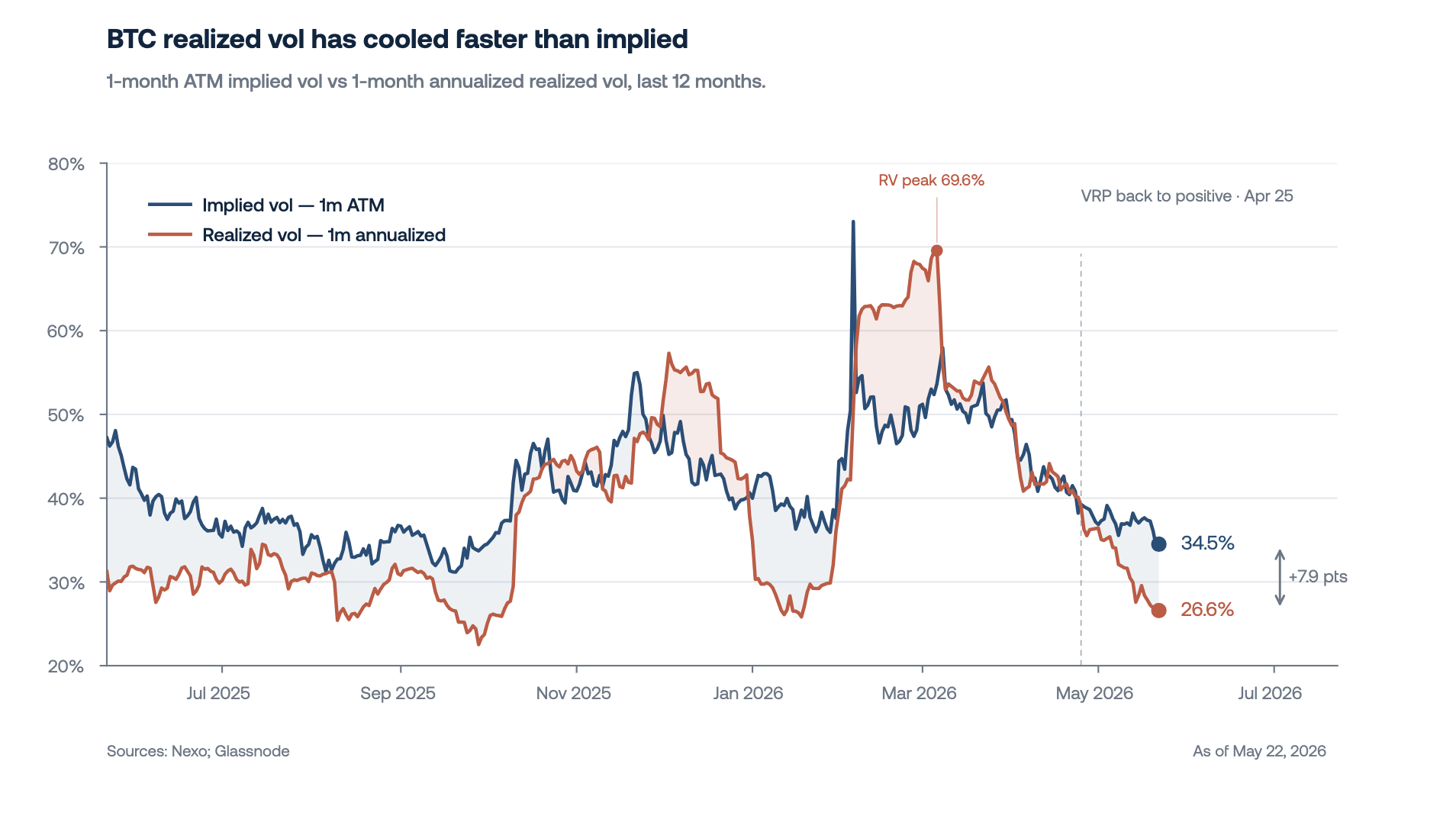
Underneath the flat tape, both realized moves and the cost of protection have collapsed. One-month implied volatility — what options price in for the next 30 days — sits at 34.5%, near a multi-month low. One-month realized volatility — how much the price has actually moved — has fallen from 70% in early March to 27% today. The gap between the two is roughly normal, with sellers of protection earning a small premium for taking risk, as in any insurance market. But a simultaneous compression to the floor in both measures is a setup that has historically preceded sharp directional moves, per Amberdata. May CPI on June 10 and the June FOMC under newly confirmed Chair Warsh are the next tests.
Ethereum & Altcoins
ETH traded at $2,127 Friday morning, down 7.3% in May, the weakest of the majors. The underperformance may reflect asset-specific risk, not macro alone. Eight senior Ethereum Foundation researchers have resigned in 2026, five in May, with all three Protocol Cluster leads now departed. A proposal for a new $1 billion ETH-aligned organization outside the EF surfaced May 19. JPMorgan said the same day that ETH cannot reverse multi-year underperformance against BTC without meaningful improvement in network activity, citing the Dencun upgrade's weakening of the burn mechanism. SOL ($87.26, +4.2% in May) and XRP ($1.37, broadly flat) each absorbed $107 million in ETF inflows over the same window. Institutional positioning remains selective, not broadly de-risking.
Macro & Institutional
Long-end U.S. yields anchored the week's risk-asset complex. The 30-year Treasury touched its highest level since July 2007 on Tuesday before easing modestly on the Iran de-escalation trade. The hawkish read of the April 28–29 FOMC minutes, released Wednesday, confirmed the divide behind the 8-4 vote: many participants would have preferred to drop the easing bias outright, with some discussion that the next move could be a hike rather than a cut. Growth signals weakened on Thursday, with the flash Eurozone composite PMI falling to 47.5 in May, a 31-month low. Iran de-escalation pulled Brent down 5.2% to $105.50 on May 20, well below April's $117 average, yet 10-year yields stayed at a one-year high. The curve is pricing inflation persistence even as the geopolitical risk premium fades. NVIDIA's beat-and-raise removed an idiosyncratic risk for the Magnificent 7 and the AI-capex narrative without lifting the broader index.
Looking Ahead
Today's focus is University of Michigan consumer sentiment. Longer-run inflation expectations are the key read, flagged in the FOMC minutes as a concern. Japan's national CPI tests BoJ hike timing. Fed Governor Waller speaks today. Next week is holiday-shortened, with Memorial Day Monday and the U.K. Spring Bank Holiday likely thinning liquidity through Tuesday. Thursday is the main event: U.S. April core PCE tests whether the May 13 CPI hot-print pattern carries to the Fed's preferred gauge.
Author: Dessislava Ianeva, Analyst at Nexo’s Dispatch
This material is produced by Nexo for informational purposes only and does not constitute financial, investment, legal, or tax advice, or a recommendation to transact in any digital asset. Views are the author's as of the date of publication and may change without notice. Information is from sources believed reliable, but Nexo makes no warranty as to its accuracy and accepts no liability for any loss arising from reliance on this material.