¿Qué es un ETF de Bitcoin y cómo funciona?
Mar 13•8 min read
Respuesta rápida
Un ETF de Bitcoin es un fondo que podés comprar en un exchange de acciones tradicional que sigue el precio del Bitcoin. Obtenés exposición al precio de Bitcoin sin comprar ni mantener la criptomoneda directamente.
Existen dos tipos principales:
• Spot Bitcoin ETF — mantiene Bitcoin real
• ETF de futuros de Bitcoin — mantiene contratos vinculados al precio futuro de Bitcoin
Los ETF spot, aprobados en EE. UU. en enero de 2024, son la opción más directa para la mayoría de los inversores
Seguramente viste el término ETF de Bitcoin en las noticias. Tal vez un titular sobre BlackRock, una cifra récord de ingresos o un banco comprando. Pero, ¿qué significa realmente y te importa a vos?
En esta guía te explicamos todo desde el principio.
¿Qué es un ETF?
ETF son las siglas en inglés de fondo cotizado en un exchange. Es un producto financiero que sigue el precio de un activo —o un grupo de activos— y opera en un exchange de acciones como cualquier acción normal.
Si alguna vez escuchaste hablar de un ETF de oro o de un fondo indexado S&P 500, funciona con el mismo principio. En lugar de salir a comprar lingotes de oro, comprás acciones de un fondo que mantiene el oro por vos. Las acciones suben y bajan con el precio del oro.
Un ETF de Bitcoin funciona de la misma manera, pero con Bitcoin como activo subyacente.
Entonces, ¿qué es exactamente un ETF de Bitcoin?
Un ETF de Bitcoin es un fondo que te da exposición al precio de Bitcoin a través de tu cuenta de corretaje habitual. No necesitás una billetera de criptomonedas, una cuenta en un exchange de criptomonedas ni conocimientos técnicos para mantener uno.
Comprás acciones del fondo. El fondo sigue el precio del Bitcoin. Cuando el Bitcoin sube, el valor de tus acciones sube. Cuando baja, también lo hace el precio de la acción.
La diferencia clave con la compra directa de Bitcoin: nunca sos dueño de ningún Bitcoin. Poseés un producto financiero que sigue su precio.
Spot vs. futuros: ¿cuál es la diferencia?
No todos los ETF de Bitcoin funcionan de la misma manera. Hay dos tipos principales, y la distinción es importante.
ETF de Bitcoin spot
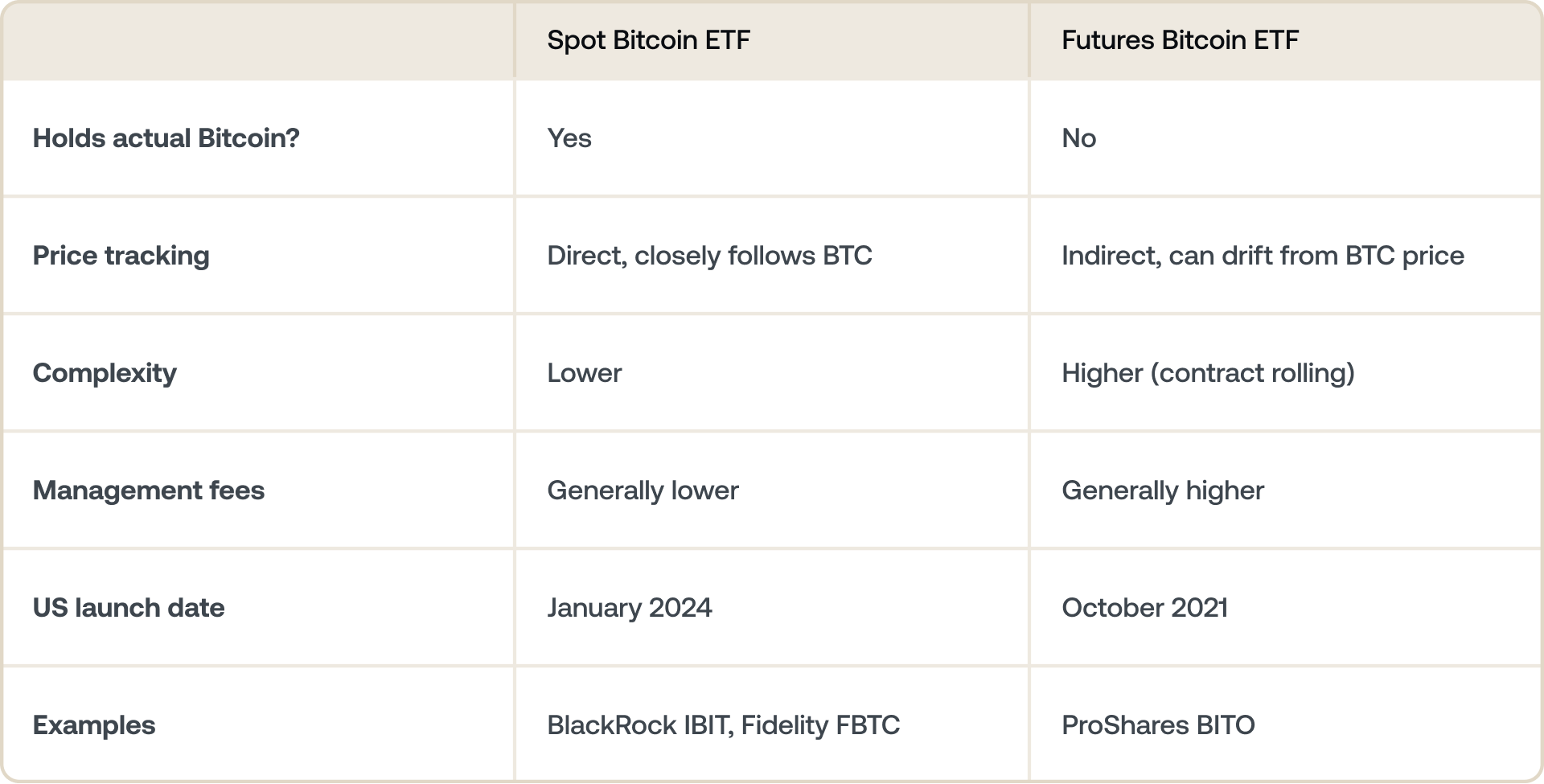
Un ETF spot mantiene Bitcoin real. Cuando los inversores ponen dinero, el fondo sale y compra BTC real. El valor del ETF sigue directamente el precio en vivo de Bitcoin.
Pensalo como un ETF de oro que almacena físicamente lingotes de oro en una bóveda. En este caso, el fondo mantiene Bitcoin en una custodia digital segura.
- Seguimiento directo del precio: el ETF replica fielmente el precio del Bitcoin.
- Estructura más sencilla: sin fechas de vencimiento de contratos ni complejas mecánicas de reinversión.
- Los ETF de Bitcoin spot de EE. UU. se lanzaron en enero de 2024, tras la aprobación de la SEC.
ETF de futuros de Bitcoin
Un ETF de futuros no mantiene Bitcoin. En su lugar, mantiene contratos de futuros: acuerdos para comprar o vender Bitcoin a un precio fijado en una fecha futura.
Esto significa que el rendimiento del ETF puede desviarse del precio real del Bitcoin, especialmente en periodos más largos. Los ETF de futuros también suelen tener comisiones más altas debido a la gestión continua de contratos que implican.
El primer ETF de futuros de Bitcoin en EE. UU. se lanzó en octubre de 2021. Fueron un hito, pero ahora los ETF spot se consideran generalmente la opción más limpia para los inversores que quieren una exposición directa a BTC.
Aquí tenés una comparación rápida:
¿Por qué fue tan importante el ETF de Bitcoin?
Durante años, el Bitcoin existió en gran medida fuera de las finanzas tradicionales. Si querías tener exposición, tenías que abrir una cuenta en un exchange de criptomonedas, gestionar billeteras y resolver la custodia por tu cuenta. La mayoría de los inversores institucionales —fondos de pensión, gestores de activos, bancos— no podían hacerlo fácilmente.
Los ETF de Bitcoin spot cambiaron eso. Crearon una estructura de inversión regulada y familiar que permite a las grandes instituciones asignar fondos a Bitcoin a través de la misma infraestructura que ya utilizan para acciones y bonos.
La aprobación de los ETF de Bitcoin spot en EE. UU. en enero de 2024 fue vista por muchos como un punto de inflexión para la adopción institucional.
¿Quiénes están comprando ETF de Bitcoin hoy en día?
El dinero institucional ha estado fluyendo de manera constante. A principios de 2026, los ETF de Bitcoin spot de EE. UU. han atraído colectivamente más de $55 mil millones en flujos de entrada acumulados desde su lanzamiento.
El iShares Bitcoin Trust (IBIT) de BlackRock lidera el grupo. Ha crecido hasta alcanzar unos $62 mil millones en activos bajo gestión, lo que lo convierte en uno de los productos ETF de más rápido crecimiento de la historia. En un solo día de marzo de 2026, solo el IBIT registró $115 millones en nuevas entradas de capital.
Otros actores importantes son:
El FBTC de Fidelity: sistemáticamente el segundo ETF de Bitcoin más grande por entradas de capital.
El GBTC de Grayscale — el vehículo institucional original de Bitcoin, convertido en un ETF spot en 2024.
ETF de Bitcoin vs. comprar Bitcoin directamente
Ambos te dan exposición al precio de Bitcoin. Pero en la práctica funcionan de forma muy diferente.
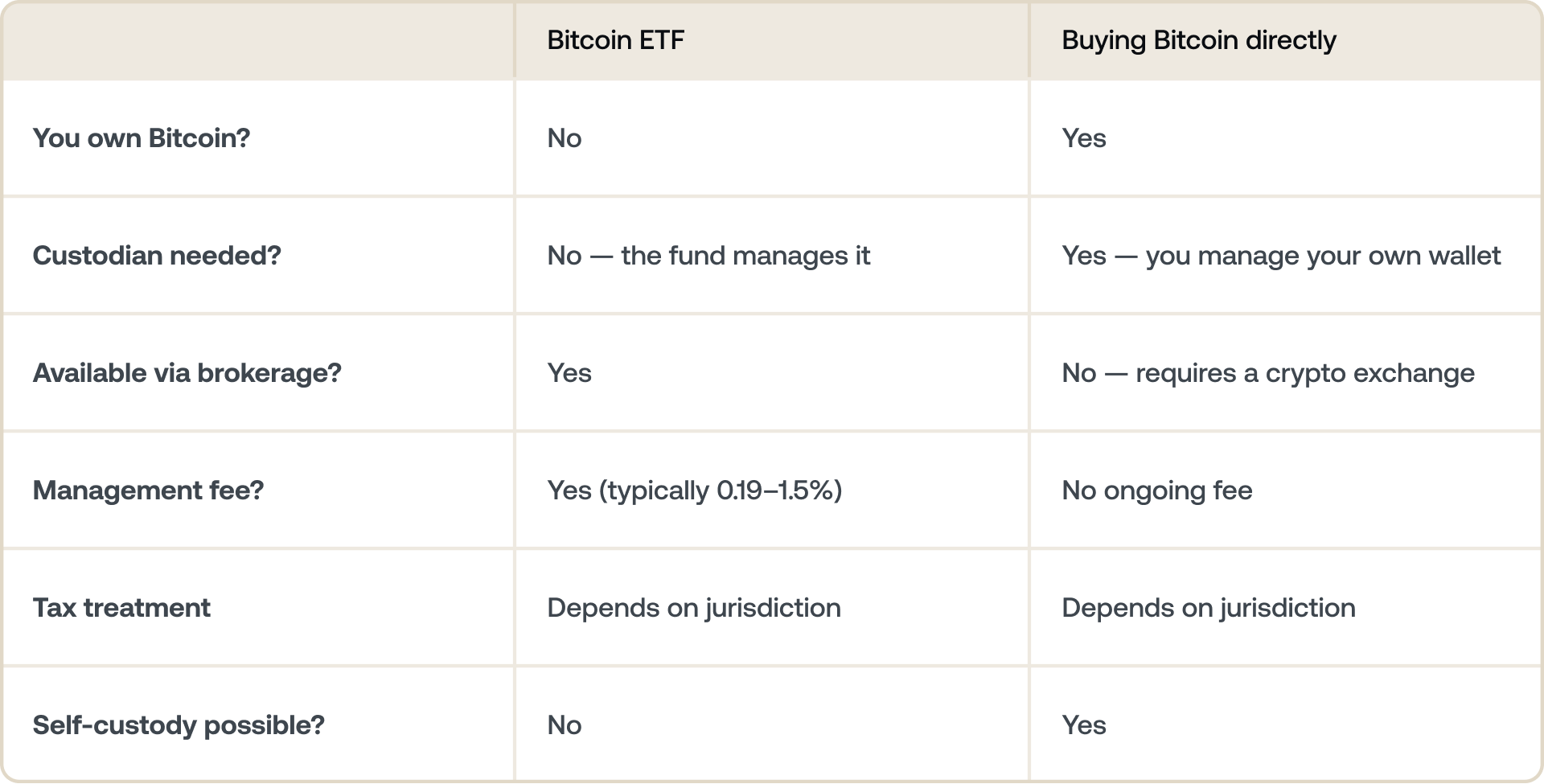
La vía del ETF es más fácil y familiar para los inversores tradicionales. La contrapartida: renunciás a la propiedad directa y a la posibilidad de hacer cosas con tu Bitcoin — como ganar intereses con él o usarlo como garantía.
¿Cuáles son los riesgos?
Los ETF de Bitcoin no eliminan los riesgos subyacentes de Bitcoin. Solo cambian la forma en que accedés a él.
- Volatilidad del precio: el precio de Bitcoin puede moverse bruscamente en cualquier dirección, y tus acciones del ETF se mueven con él.
- Comisiones de gestión — incluso las pequeñas comisiones anuales se capitalizan con el tiempo. Compará las comisiones antes de elegir un producto.
- Sin propiedad de Bitcoin — si el proveedor del ETF tiene problemas, vos mantenés acciones de un fondo, no Bitcoin en sí.
- Error de seguimiento (solo en ETF de futuros): los ETF de futuros pueden no seguir con precisión el precio de Bitcoin durante periodos más largos.
- Cambios normativos: las normas sobre los productos de criptomonedas siguen evolucionando en todo el mundo.
¿Y si querés hacer más con tu Bitcoin?
Un ETF de Bitcoin ofrece principalmente exposición al precio.
Pero si mantenés Bitcoin directamente, esas opciones se abren. En Nexo, por ejemplo, podés:
- Ganá intereses diarios con tu Bitcoin a través de Ahorros Flexibles o a Plazo Fijo.
- Pedí un préstamo con tus BTC como garantía sin venderlos, utilizando una línea de crédito con respaldo en criptomonedas.
- Cambiá, comprá y gestioná activos digitales en un solo lugar.
Que un ETF de Bitcoin o la propiedad directa de Bitcoin sea lo adecuado para vos depende de tus objetivos. Si querés simplicidad y acceso a través de una cuenta de corretaje, un ETF cumple bien esa función. Si querés poner a trabajar tu Bitcoin —ganar, pedir préstamos, construir— mantenerlo directamente te da más opciones.
Preguntas frecuentes
1. ¿Qué es un ETF de Bitcoin?
Un ETF de Bitcoin es un fondo que opera en un exchange de acciones y sigue el precio de Bitcoin. Podés comprar acciones del fondo a través de una cuenta de corretaje normal sin necesidad de poseer o almacenar Bitcoin vos mismo.
2. ¿Cuál es la diferencia entre un ETF de Bitcoin spot y uno de futuros?
Un ETF de Bitcoin spot mantiene Bitcoin real, por lo que su valor refleja fielmente el precio en vivo de BTC. Un ETF de futuros mantiene contratos vinculados al precio futuro de Bitcoin en lugar de la moneda en sí, lo que puede hacer que su rendimiento se desvíe del precio real de Bitcoin con el tiempo.
3. ¿Qué es el ETF de Bitcoin de BlackRock?
El iShares Bitcoin Trust de BlackRock (ticker: IBIT) es el mayor ETF de Bitcoin spot por activos bajo gestión. Se lanzó en enero de 2024 tras la aprobación de la SEC y ha atraído más de $62 mil millones en activos, liderando sistemáticamente las entradas diarias entre todos los productos ETF de Bitcoin de EE. UU.
4. ¿Es un ETF de Bitcoin lo mismo que poseer Bitcoin?
No. Cuando comprás un ETF de Bitcoin, sos dueño de acciones de un fondo — no del Bitcoin en sí. El valor del fondo sigue el precio del BTC, pero no podés retirar Bitcoin, ganar intereses con él ni usarlo como garantía para un préstamo de la forma en que podés hacerlo con el Bitcoin que mantenés directamente.
5. ¿Cómo funciona un ETF de Bitcoin?
Cuando invertís en un ETF de Bitcoin spot, el gestor del fondo utiliza tu dinero para comprar y mantener Bitcoin real en custodia segura. Recibís acciones proporcionales a tu inversión. A medida que el precio de Bitcoin sube o baja, el valor de tus acciones se mueve en consecuencia. Podés comprar y vender esas acciones en un exchange de acciones durante el horario de trading, como cualquier otro fondo.
6. ¿Cuáles son los riesgos de un ETF de Bitcoin?
Los ETF de Bitcoin conllevan la misma volatilidad de precios que el propio Bitcoin. Otros riesgos incluyen las comisiones de gestión que reducen los rendimientos con el tiempo, la falta de propiedad directa (mantenés acciones del fondo, no BTC) y, en el caso de los ETF de futuros, el riesgo de error de seguimiento. Los cambios normativos también podrían afectar al funcionamiento de estos productos en los distintos mercados.
Estos materiales son accesibles globalmente, y la disponibilidad de esta información no constituye acceso a los servicios descritos, los cuales pueden no estar disponibles en ciertas jurisdicciones. Estos materiales son solo para fines de información general y no están destinados a ser asesoramiento financiero, legal, impositivo o de inversión, oferta, solicitud, recomendación o respaldo para usar cualquiera de los Servicios de Nexo, y no son personalizados ni adaptados de ninguna manera para reflejar objetivos de inversión, situación financiera o necesidades particulares. Los activos digitales están sujetos a un alto grado de riesgo, incluyendo, entre otros, la dinámica volátil de los precios de mercado, los cambios regulatorios y los avances tecnológicos. El rendimiento pasado de los activos digitales no es un indicador confiable de resultados futuros. Los activos digitales no son dinero ni moneda de curso legal, no están respaldados por ningún gobierno o banco central y la mayoría de estos no cuenta con activos subyacentes, flujo de ingresos ni otra fuente de valor. Se debe ejercer un criterio independiente basado en las circunstancias personales, y se recomienda consultar con un profesional calificado antes de tomar cualquier decisión.