Proof of Stake vs Proof of Work: ¿Cuál es la diferencia?
Apr 08•6 min read
Cada transacción de cripto debe verificarse antes de registrarse. ¿Pero quién se encarga de verificarlas — y cómo?
Ahí es donde entran en juego el proof of work y el proof of stake. Son los dos métodos dominantes que usan las blockchains para llegar a un acuerdo sobre qué es válido. Bitcoin usa uno. Ethereum cambió al otro en 2022. Y la diferencia entre ellos tiene que ver con energía, seguridad, propiedad y mucho más.
Esto es lo que necesitas saber.
¿Qué es un mecanismo de consenso?
Una blockchain no tiene una autoridad central — ni banco, ni empresa, ni regulador — que decida qué transacciones son legítimas. En cambio, todos los participantes de la red deben ponerse de acuerdo. Las reglas que rigen ese proceso de acuerdo se denominan mecanismo de consenso.
Imagínalo como un sistema de votación, solo que los "votantes" son computadoras de todo el mundo y lo que está en juego es dinero real. El proof of work y el proof of stake son dos respuestas diferentes a la misma pregunta: ¿cómo lograr que miles de desconocidos se pongan de acuerdo — y hacer que hacer trampa sea suficientemente costoso?
¿Qué es el proof of work?
El proof of work es el mecanismo de consenso original. Bitcoin lo usa. También Litecoin y, hasta 2022, Ethereum.
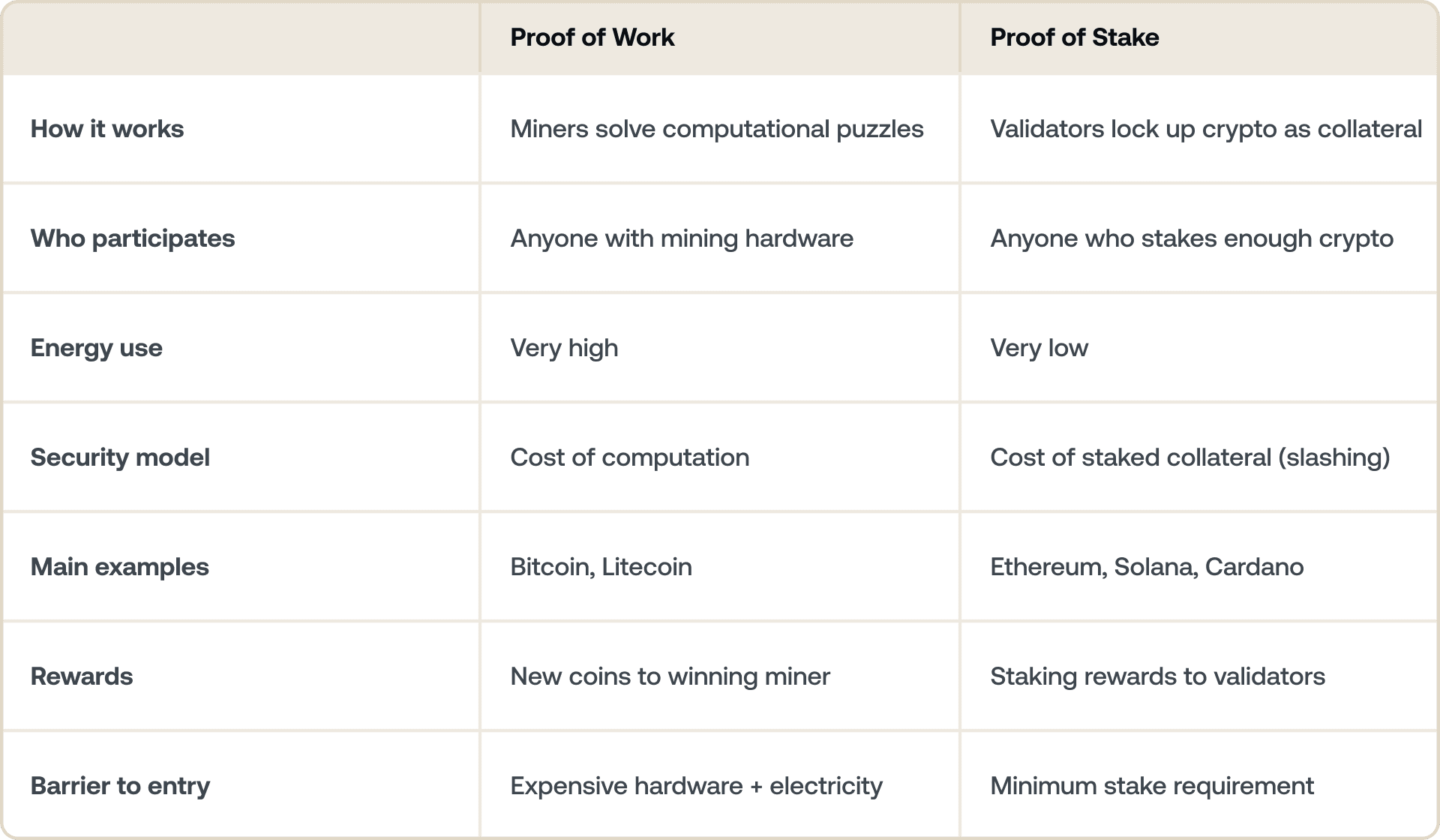
Así es como funciona. Cuando hay un nuevo grupo de transacciones que agregar a la blockchain, computadoras de todo el mundo — llamadas mineros — compiten para resolver un complejo acertijo matemático. El acertijo no tiene atajos. La única forma de resolverlo es con pura potencia computacional, ejecutando billones de intentos por segundo hasta que un minero da con la respuesta correcta.
El ganador agrega el siguiente bloque de transacciones y gana una recompensa en cripto (en el caso de Bitcoin, BTC recién acuñado). Los demás empiezan de nuevo.
El "trabajo" en proof of work es literal. Los mineros invierten recursos reales como hardware potente y electricidad para participar. Esa inversión es lo que hace que hacer trampa sea costoso. Para falsificar una transacción, un atacante tendría que rehacer el trabajo computacional de cada bloque desde el fraudulento, mientras el resto de la red sigue añadiendo nuevos. A la escala de Bitcoin, eso es prácticamente imposible.
¿Qué es el proof of stake?
El proof of stake adopta un enfoque distinto. En lugar de competir mediante cómputo, los participantes llamados validadores bloquean (o "ponen en staking") cierto monto de cripto como garantía. Cuanto más ponen en staking, mayores son sus probabilidades de ser seleccionados para validar el siguiente bloque.
Si un validador actúa con honestidad, gana una recompensa. Si intenta hacer trampa — aprobando transacciones fraudulentas — pierde parte de su cripto en staking. Este mecanismo de penalización se llama slashing.
Ethereum migró al proof of stake en septiembre de 2022 con una actualización conocida como The Merge. Fue una de las transiciones técnicas más grandes en la historia del cripto, y redujo el consumo energético de Ethereum en aproximadamente un 99.95%.
Otras cadenas PoS importantes incluyen Solana, Cardano y Avalanche.
Proof of work vs proof of stake: comparativa lado a lado
¿Cuál es mejor?
Ninguno es universalmente mejor — cada uno resuelve problemas distintos con diferentes compromisos.
El proof of work tiene un historial de quince años. La red de Bitcoin nunca ha sido atacada con éxito, y su modelo de seguridad es bien comprendido. El costo energético es real, pero sus defensores argumentan que ancla la red a la realidad física de una manera difícil de falsificar.
El proof of stake es más eficiente y más accesible. No requiere hardware especializado y permite a los holders comunes ganar recompensas simplemente participando en la seguridad de la red. También es la base del staking — una forma de poner tu cripto a trabajar sin venderlo.
Qué significa esto para ti como holder de cripto
Si mantienes Bitcoin, el proof of work es simplemente la infraestructura de fondo — no es algo en lo que participes directamente a menos que estés minando.
Si mantienes Ethereum, el proof of stake te afecta de forma más directa. Los validadores ponen en staking ETH para ayudar a mantener la red y ganan recompensas a cambio. Sin embargo, no necesitas operar un validador tú mismo para aprovechar los beneficios. La mayoría de las personas ponen su ETH a trabajar a través de plataformas que te permiten ganar intereses sobre tu saldo de cripto sin necesidad de operar un validador.
Si prefieres liquidez sobre recompensas, también puedes pedir un préstamo usando tu saldo de cripto como garantía sin vender — manteniendo tu exposición intacta.
Gana con Ethereum en Nexo
En Nexo, puedes poner tu ETH a trabajar sin operar un validador tú mismo — sin hardware, sin configuración técnica, sin staking mínimo.
- Hasta un 5.5% en ETH con Flexible Savings — sin período de bloqueo, retira cuando quieras
- Hasta un 6.5% en ETH con Fixed-term Savings — comprométete por un periodo determinado y gana una tarifa más alta
- No solo ETH — gana en BTC, USDC, USDT y más desde la misma cuenta
Preguntas frecuentes
1. ¿Cuál es la principal diferencia entre el proof of work y el proof of stake?
El proof of work usa potencia computacional — los mineros consumen energía resolviendo acertijos para validar transacciones. El proof of stake usa cripto en staking — los validadores bloquean fondos como garantía en su lugar. Ambos protegen la blockchain, pero a través de mecanismos muy diferentes.
2. ¿Qué monedas usan proof of work vs proof of stake?
Bitcoin y Litecoin son las redes de proof of work más grandes. Ethereum (desde 2022), Solana, Cardano y Avalanche usan proof of stake.
3. ¿Ethereum cambió de proof of work a proof of stake?
Sí. Ethereum hizo la transición de proof of work a proof of stake en septiembre de 2022, en una actualización conocida como The Merge. El cambio redujo el consumo energético de Ethereum en aproximadamente un 99.95%.
4. ¿Cuáles son las desventajas del proof of stake?
La crítica más común es que puede favorecer a los grandes holders — los validadores con más cripto en staking tienen mayor influencia. Algunos también argumentan que está menos probado en batalla que el proof of work a la misma escala, aunque la red PoS de Ethereum ha operado sin incidentes graves desde The Merge.
5. ¿Puedo ganar recompensas del proof of stake sin operar un validador?
Sí. Muchas plataformas te permiten ganar recompensas basadas en staking en ETH sin necesidad de operar un nodo validador tú mismo.
6. ¿El proof of work o el proof of stake es más seguro?
Ambos se consideran altamente seguros a escala. La seguridad del proof of work proviene del costo de la computación — atacar la red requiere un hardware y una energía enormes. La seguridad del proof of stake proviene del slashing — los validadores que se comportan mal pierden su cripto en staking. El PoW de Bitcoin tiene el historial más largo; el PoS de Ethereum ha funcionado bien desde 2022.
7. ¿Qué significa "staking" en el proof of stake?
El staking consiste en bloquear cripto como garantía para participar en la validación de transacciones. A cambio, los validadores (y, a través de plataformas, los holders comunes) ganan recompensas. Es la forma en que la red compensa a los participantes que ayudan a mantenerla segura.
Este artículo es solo para fines informativos y no constituye asesoramiento financiero ni de inversión. Los criptoactivos implican riesgo, incluida la posible pérdida del capital. Haz siempre tu propia investigación antes de tomar decisiones financieras.