Can CLARITY outweigh macro headwinds?
May 19•6 min read
In this patch of your weekly Dispatch:
- Rising yields pressure risk
- Tokenized MMFs expand
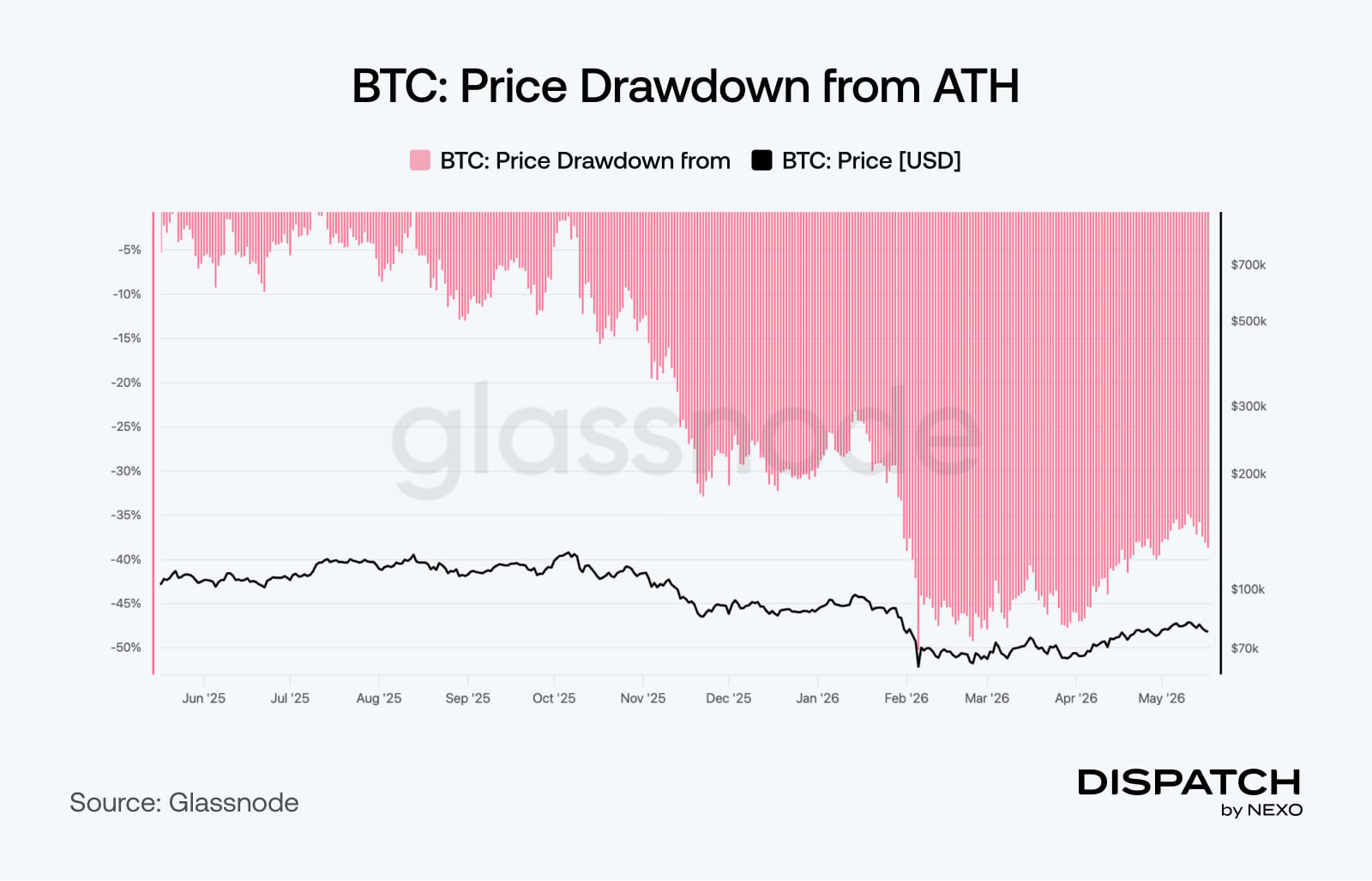
- BTC drawdown shallowest on record
Market cast
BTC tests support after weekly pullback
On the weekly chart, price pulled back but holds above the middle Bollinger Band — the 20-week moving average. The broader uptrend stays in place, and this level is now the first support to watch. Momentum is mixed. RSI gives no clear signal. The Stochastic is approaching overbought, a sign the recent move is getting stretched. The MACD histogram remains above zero, with momentum still net positive. ADX is declining indicating that the trend is losing strength rather than building.
On the daily chart, price has fallen to the lower Bollinger Band. It sits near the 50-day moving average, and both lines act as dynamic support. RSI is neutral. The Stochastic has entered oversold territory. Short-term selling looks stretched. A cross back above the 20 line would mark bearish momentum fading. The MACD histogram is negative, with short-term momentum pointing down. ADX is declining.
Key levels to watch: Key levels to watch. Support sits around $76,000, then in the $74,000–$73,000 zone. The weekly middle Bollinger Band and the daily lower Bollinger Band alongside the 50-day moving average provide additional dynamic support. Resistance runs through $78,000–$79,000, then around $82,000.
The big idea
Regulatory tailwind builds, macro caps the rally
Underneath this week's volatile price action, the U.S. is steadily building the framework institutional capital has waited for. The CLARITY Act cleared the Senate Banking Committee last week, lifting Polymarket's probability of a 2026 signing to more than 60%. That is a genuine milestone, however, Bitcoin briefly rallied above $82,000 on the vote before retracing below $77,000 by Monday morning. Here is why this muted reaction is exactly what history would predict.
The GENIUS Act precedent is instructive here. Bitcoin didn’t rally on the committee, or chamber vote, or even the signing. It rallied in the months that followed, as the infrastructure that the legislation enabled started to take shape. BlackRock and JPMorgan recently filing prospectuses for tokenized money market funds on Ethereum, covered in the TradFi section below, is that kind of downstream effect. The framework precedes the flows.
The CLARITY Act, if it reaches the president's desk, sets the same process in motion for the broader market structure.
What’s holding back prices in the meantime is real as macro continues to dominate. Back-to-back U.S. inflation surprises last week repriced the December 2026 rate-hike probability to 38%, up from 1% a month earlier. The two-year Treasury yield reached 4.05%, the highest level since June 2025, when Bitcoin traded at $104,000, and the dollar firmed. That yield level, not the regulatory calendar, is setting the price now.
Furthermore, ETF flows have accelerated the transmission of these signals and have been volatile since early May, ranging from $630 million of inflows to $635 million of outflows in single sessions. May 14 logged $131 million of inflows after May 13's $635 million withdrawal, the largest single-day outflow since mid-February. With the "Sell in May and go away" window now open, a sustainable rally may have to wait for seasonality to turn.
Finally, two further overhangs are worth mentioning. There are growing expectations that Michael Saylor's Strategy could be about to sell some of its Bitcoin, adding a supply-side question mark.
And then there's the Fed leadership transition which was formalized last week and passed almost unnoticed under the weight of the inflation prints. Markets may be underpricing the regime shift still ahead. Chair Warsh has committed to overhauling Fed communication and has signaled far less appetite for balance-sheet expansion.
So while short-term price action stays in the hands of yields, oil, and the FOMC, the longer game is being built in Washington and last week it moved way forward
Ethereum
Is corporate accumulation slowing down?
The corporate bid has anchored Bitcoin and Ether prices this year, even as ETF flows turned volatile and Bitcoin miners flipped to net sellers in May, per Glassnode. Strategy added 146,372 BTC year-to-date, worth roughly $11 billion, much of it bought below its $75,540 blended cost basis. Holdings now stand at 3.9% of Bitcoin's 21 million cap, and JPMorgan projects an annualized pace of $30 billion in 2026 if accumulation holds. BitMine Immersion Technologies, the largest corporate ETH holder, added over 1 million ETH year-to-date and now holds 5.2 million ETH, or 4.31% of supply.
Both firms have since flagged a change in tempo. BitMine Chairman Tom Lee said last week the firm will slow weekly purchases. Strategy's latest filing floated selling some Bitcoin to fund dividend payments, an evolution from pure accumulator to active treasury manager. The slowdown signals have weighed on prices, but for now this is sentiment recalibration, not a change in flows.
TradFi trends
Institutions position for stablecoin growth
BlackRock and JPMorgan Asset Management have both filed prospectuses to launch tokenized money market funds on Ethereum, structured as reserve-eligible assets under the GENIUS Act. The Act, enacted last summer, allows stablecoin issuers to hold tokenized MMFs as reserves and requires implementing rules by July 18 -- roughly two months away. BlackRock's offering adds a new on-chain share class to its $7 billion Select Treasury Based Liquidity Fund. The institutional footprint is broadening from direct crypto exposure into the infrastructure that lets stablecoins scale inside traditional finance.
Macroeconomic roundup
Yields climb as cuts get priced out
The sell-off in U.S. Treasuries was the defining macro story of the week. Yields rose across the curve, with the long end leading. The 10-year closed at 4.59%, its highest since February 2025, and the 2-year reached 4.05%, a level last seen in June 2025. The dollar firmed 1.4% on the week to 99.24, recovering its 99 handle for the first time since early April, and the probability of a December rate hike more than doubled relative to early May.
The driver was April's U.S. inflation prints, which came in well above consensus on both sides of the pipeline last week. Producer prices climbed 1.4% on the month — the largest gain since March 2022 and nearly three times the 0.5% consensus. Headline CPI rose 0.6%, with import prices up a sharper 1.9%, direct confirmation that the imported channel is open.
The easing path has been priced out and the right-tail risk of a hike is now live. This Wednesday's April 28–29 FOMC minutes, from the most divided Fed vote since October 1992, will be parsed for the hawkish dissenters' reasoning on the easing bias.
The week's most interesting data story
The shallowest drawdown on record
Bitcoin trades 38.7% below its October 2025 peak, narrowing from a 50.2% drawdown in February. Even at the current level, this is the narrowest drawdown at the same stage of any cycle in BTC's history, Glassnode data shows. The cycle is structurally shallower and shorter than its predecessors. The last three bear legs each exceeded -75% and took 12 to 13 months to bottom; the current cycle's low of -50.2% was reached after 4 months. The change is structural rather than cyclical. Spot ETF inflows and corporate balance-sheet allocation absorb selling pressure that prior cycles had no infrastructure to absorb.
The numbers
The week’s most interesting numbers
+28%- Bitcoin's gain from the February 5, 2026 cycle low of $62,840, a 98-day recovery that has narrowed the drawdown from −50% to −36%.
+54.3%Y0Y - U.S. fuel oil prices in April, direct evidence of the Iran/Hormuz disruption feeding through to household costs.
$30 billion — JPMorgan's estimate of Strategy's annualized 2026 Bitcoin purchases if the current pace hold.
3.7 million — Stand With Crypto advocates, the grassroots base behind the CLARITY Act's bipartisan Senate momentum and the political infrastructure prior crypto bills lacked.
309 pages — Length of the CLARITY Act, as reported out of the Senate Banking Committee.
Hot topic
What the community is discussing
https://twitter.com/jameslavish/status/2055105312768868779
U.S. bond yields move to a multi-month higher.
https://twitter.com/JSeyff/status/2055258141189976079
ETH ETFs have lagged behind Bitcoin.
https://twitter.com/Jamie1Coutts/status/2055253822214472115
Tokenization is about to have a stablecoin moment.
Dispatch is a weekly publication by Nexo, designed to help you navigate and take action in the evolving world of digital assets. To share your Dispatch suggestions and comments, email us at [email protected].