Dispatch #288: Can Bitcoin beat inflation and traditional assets?
Mar 17•6 min read

In this patch of your weekly Dispatch:
- Bitcoin as a hedge
- ETH’s latest rise
- Central bank decisions
Market cast
Are BTC bulls taking over?
A fresh wave of ETF inflows has put Bitcoin back on the front foot, lifting it above $74,000 and potentially opening the path toward $76,000. On the weekly timeframe, bearish momentum appears to be fading as bulls regain control of price action. While RSI and Stochastic remain in neutral territory, both are rising steadily, and the MACD histogram continues to trend upward toward the zero line – an early sign of strengthening momentum.
The daily chart shows even stronger bullish signals. BTC has moved decisively above the 50-day SMA and is hovering near the upper Bollinger Band, pointing to sustained buying pressure. Momentum remains firm: the RSI signal line is approaching the overbought zone, Stochastic has crossed above the 80 threshold, and the MACD histogram remains deep in positive territory.
Key levels to watch: Immediate support sits at $73,000, followed by $71,000 as previous resistance turned support, while resistance levels stand at $76,000 and then $79,000. Momentum is strengthening across timeframes, but the move will likely depend on whether inflows continue to support prices above the $73,000–$74,000 range.
The big idea
How will Bitcoin react to the Fed?
Bitcoin is beginning to diverge from traditional assets, gaining ground even as gold and U.S. equities drift lower – a shift that puts macro positioning back in focus ahead of the Federal Reserve decision.
The divergence becomes even more notable when viewed over a longer window. Since the start of the Middle East conflict roughly two weeks ago, Bitcoin has gained over 10%, outperforming both traditional risk assets and safe havens. On a monthly basis, the asset is also up roughly 8% so far in March, which would mark its first positive month since September after five consecutive months of declines that saw Bitcoin fall as much as 50% from its October all-time high.
Institutional demand appears to be gradually returning as well. U.S. spot Bitcoin ETFs have recorded roughly $1.3 billion in net inflows so far in March, putting them on track for their first month of positive flows since October. At the same time, broader market sentiment remains cautious, suggesting the recent rebound may reflect a shift in how investors view Bitcoin — not purely as a speculative risk asset, but increasingly as a macro-sensitive one. That context makes this week’s Federal Reserve meeting a key moment for the market. This suggests the current move may be increasingly flow-driven, with ETF demand playing a central role in shaping near-term price action.
Policymakers are widely expected to keep the federal funds rate unchanged within the 3.50%–3.75% range. The decision itself, however, may not be the primary market catalyst. Investors will instead focus on the Federal Reserve’s updated economic projections, Chair Jerome Powell’s remarks, and the tone of the FOMC press conference, all of which could provide clues about how policymakers view inflation risks and the future path of interest rates.
For Bitcoin, the implications could develop along two different macro paths.
If inflation pressures remain elevated and interest rates stay higher for longer, Bitcoin’s “digital gold” narrative could strengthen as investors seek protection from inflation and monetary instability. In that environment, the asset may increasingly behave as a hedge against macroeconomic uncertainty.
If the Fed instead signals that rate cuts could approach later in the year, improving liquidity conditions and a return of risk appetite could also support Bitcoin. Historically, periods of easier monetary policy have provided a favorable backdrop for digital assets as capital flows back into risk markets.
In other words, the Fed’s message this week may influence Bitcoin in more than one way: higher rates could reinforce its role as a macro hedge, while lower rates could boost its appeal as a risk asset. Either way, Powell’s remarks may prove just as important as the rate decision itself in shaping Bitcoin’s next move. The key question, then, is whether Bitcoin continues to trade as a macro hedge or reverts to behaving more like a liquidity-sensitive risk asset. The next phase of the move will likely depend on whether institutional inflows remain consistent and how markets interpret the Fed’s forward guidance.
Ethereum
Ethereum is building momentum
Ethereum’s recent rebound alongside Bitcoin may be setting up a larger move higher.
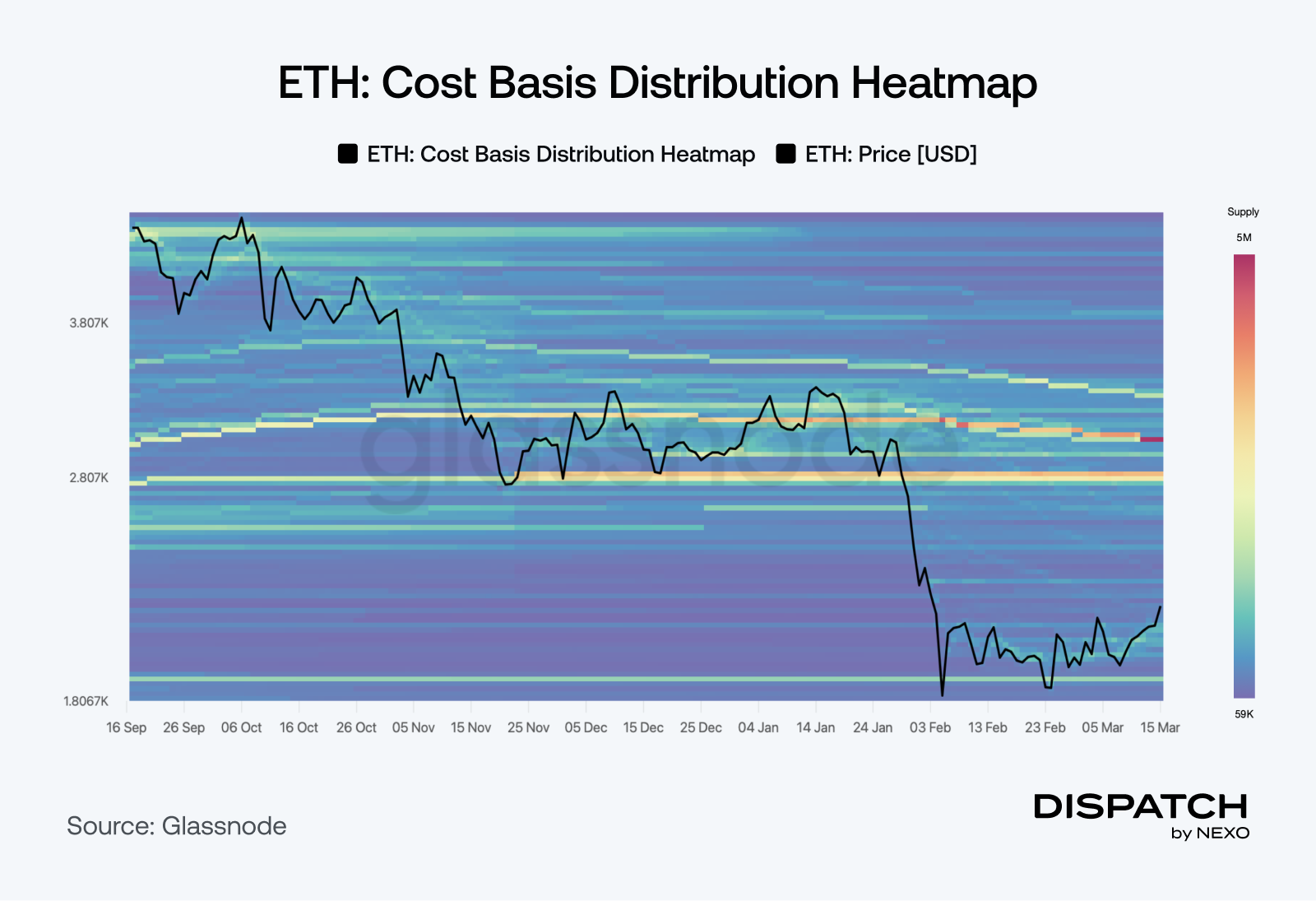
On-chain data shows a major accumulation cluster near $2,800, where more than 3 million ETH were previously purchased. With relatively little historical supply between current prices and that level, a breakout from the present range could allow the asset to move more freely toward that zone. This positioning suggests relatively limited resistance between current levels and that cluster, making the $2,800 area a key test of continuation.
The technical setup aligns with a broader institutional narrative. Standard Chartered still sees Ether reaching around $4,000, citing Ethereum’s growing role in the tokenisation of financial assets. Institutional conviction was reinforced this week as BlackRock launched the iShares Staked Ethereum Trust ETF (ETHB). The fund debuted with about $100 million in assets and roughly $16 million in first-day trading volume, offering investors Ether exposure alongside staking yield. Together, positioning and institutional activity point to a setup where momentum may build if current levels hold.
Macroeconomic roundup
A global central bank week
With Bitcoin hovering above $70,000 after a strong rebound, markets now face one of the most policy-heavy weeks of the year. Seven major central banks — including the Federal Reserve — will announce rate decisions as rising energy prices and persistent inflation complicate the outlook for interest rate cuts.
Eurozone CPI & U.S. PPI (Wed): Inflation readings from Europe and U.S. wholesale prices will shape expectations for the Fed and ECB. Softer prints support easing bets and risk assets; persistent inflation reinforces the “higher-for-longer” rate outlook.
Federal Reserve decision & projections (Wed): Markets expect rates to remain in the 3.50–3.75% range. Investors will focus on updated economic projections and Chair Jerome Powell’s remarks for clues about how policymakers view inflation risks and the path of future rate cuts.
Global central bank decisions (Tue–Thu): The Reserve Bank of Australia, Bank of Canada, Bank of Japan, Swiss National Bank, Bank of England, and European Central Bank all deliver policy decisions this week. Broadly cautious messaging could keep financial conditions tight, while dovish signals may support risk assets.
Initial Jobless Claims (Thu): Forecast near 215,000. A move higher would reinforce signs of labor market cooling, while continued stability may temper expectations for near-term policy easing.
For full timings, see our macro calendar on X.
The week's most interesting data story
The next key level for Ethereum
Ether’s cost-basis distribution highlights a key level to watch above the current range. Data from Glassnode shows a large accumulation cluster near $2,800, where more than 3 million ETH were previously purchased. Cost-basis clusters represent the price zones where large groups of investors have established positions, often acting as magnets during upward moves as holders defend their entry points or add exposure. With Ether now trading around $2,300, there is relatively limited historical supply concentration between current levels and the $2,800 cluster — suggesting that a sustained breakout from the present range could allow price to move more freely toward that zone.
The numbers
The week’s most interesting numbers
$1.06 billion – Digital asset investment products logged a third straight week of inflows, including $793 million into Bitcoin funds.
$79 billion – USDC’s market cap hit a record high, rising 8% in a month as institutional payments and on-chain settlement grow.
22,337 BTC – Strategy bought another $1.57 billion in Bitcoin, lifting its holdings to 761,000 BTC.
122,000 ETH – BitMine’s $280M ETH buy in two weeks underscores rising corporate demand.
$255 million – Metaplanet adds firepower for Bitcoin accumulation, signaling continued corporate demand.
Hot topic
What the community is discussing
Is that a (bullish) signal?
Is gold becoming a risk asset?
Is Bitcoin attraction getting stronger?
Dispatch is a weekly publication by Nexo, designed to help you navigate and take action in the evolving world of digital assets. To share your Dispatch suggestions and comments, email us at [email protected].