Dispatch #287: Bitcoin’s market (re)balancing
Mar 10•5 min read

In this patch of your weekly Dispatch:
- Bitcoin tests key levels
- Inflation in focus
- The new stablecoins record
How does crypto fit into your financial life?
Dear Dispatch readers,
We’re inviting you to complete a short, anonymous survey. It takes just a few minutes and helps us better understand crypto adoption trends. Thank you for being part of the conversation.
Take the survey
Market cast
The signals at 20 million BTC mined
As Bitcoin surpasses 20 million coins mined, the market is beginning to feel the effects of tightening supply. Renewed inflows into Bitcoin ETFs, alongside ongoing investor interest in Gold, suggest capital may be rotating back toward crypto.
Technically, BTC shows early signs of bullish momentum. On the weekly chart, price action suggests a potential bottom has formed. Momentum indicators – the Relative Strength Index (RSI) and Stochastic Oscillator, are rising from oversold territory, while the MACD histogram, a trend-following momentum indicator, is trending higher toward zero, signaling fading downside pressure. On the daily chart, price is advancing toward the upper Bollinger Band, a volatility indicator, with the 50-day SMA, a trend indicator, nearby. The RSI remains neutral but trending upward, Stochastic signal lines move toward overbought, and the MACD histogram remains positive, together reinforcing a short-term bullish bias.
Key levels to watch include support at $68,500, with deeper support at $66,500 if the market pulls back. On the upside, $71,000 is immediate resistance, followed by $73,000–$74,000, where selling pressure may intensify.
The big idea
Bitcoin: Working through supply
Over the last few weeks we’ve focused heavily on Bitcoin, but such is the dynamism of this asset that there is always something new to factor in if one is to stay ahead of it. Bitcoin’s pullback to the mid-$60,000s followed a brief rally toward $73,500, as a spike in oil prices and renewed geopolitical tension pushed markets into risk-off mode. The move is a reminder that macro shocks can drive short-term volatility – but they do not define the structure.
Even as price action remained constrained, institutional flows quietly improved. U.S. spot Bitcoin ETFs posted their first back-to-back weekly inflows in five months, reversing a $3.8 billion outflow streak. Yet the return of capital has not translated into sustained upside – a divergence that points less to weak demand than to overhead supply still being absorbed. Bitcoin is moving through a transition in which forced selling has eased, but structural inventory continues to cap progress. Markets do not shift from correction to expansion in a straight line – they compress before they expand.
What analysts are signaling: Across research desks, the tone is cautious – but increasingly constructive.
K33 describes Bitcoin as sitting at “one of its most oversold weekly levels on record” with derivatives markets reflecting “extreme bearish positioning.” Historically, such crowding tends to form nearer exhaustion than expansion, and the firm sees “no compelling reason” to sell at current levels.
CryptoQuant frames the rebound as “a relief rally” within a broader corrective regime. Yet spot demand contraction has narrowed sharply, long-term holder selling has slowed materially, and U.S.-led bid activity has strengthened – signs of stabilization rather than renewed breakdown.
Glassnode adds structural depth. Buy-side momentum has weakened since early February, and the short-term holder cost basis near $70,000 defines a “significant overhead distribution zone.” In fragile regimes, rallies often stall as recent entrants approach breakeven and distribute supply.
At the same time, spot sell pressure is easing, ETF flows are stabilizing, leverage is being flushed from derivatives, and options positioning is rotating toward calls. The $75,000 strike has emerged as a key negative gamma concentration point, suggesting positioning dynamics could draw price higher if acceptance above $70,000 is secured. Taken together, this shows that the aggressive de-risking phase appears largely complete and demand is rebuilding beneath visible resistance.
The Miner layer: Mining economics suggest supply dynamics are stabilizing. Many large U.S. miners can now cover electricity costs, limiting the risk of forced operational selling. While broader profitability thresholds remain higher – encouraging disciplined distribution during rebounds, miner-driven supply is becoming increasingly price-sensitive rather than destabilizing.
The Big idea: Bitcoin is not lacking participation; it is working through prior distribution. The stabilization in flows, positioning, and leverage suggests the sharpest phase of de-risking has passed. What remains is the gradual thinning of overhead supply. In transitional regimes, markets compress before they expand. Acceptance above resistance will signal not acceleration, but absorption – the quiet condition that precedes sustainable upside.
TradFi trends
Crypto’s ongoing integration
Institutional integration continues across regulation, product expansion, and sovereign balance sheets, reinforcing the gradual normalization of digital assets within traditional finance – here is how TradFi meets crypto:
The Federal Reserve clarified that tokenized securities will be treated the same as traditional securities for capital purposes, reinforcing a “technology-neutral” regulatory stance as banks expand blockchain experimentation.
Florida passed the first state-level stablecoin regulatory framework, aligning with federal rules while introducing licensing, consumer protection, and oversight standards for payment stablecoin issuers.
The first U.S. spot Polkadot ETF began trading on Nasdaq, extending the expansion of exchange-traded crypto products beyond Bitcoin and Ethereum into broader altcoin exposure.
Kazakhstan’s central bank allocated up to $350 million from its reserves to invest in crypto-linked assets and infrastructure, signaling growing sovereign-level engagement with the digital asset ecosystem.
Macroeconomic roundup
A most important inflation report
With Bitcoin near $70,000 after February’s shock -92,000 NFP print and unemployment rising to 4.4%, this week’s inflation stack could define near-term direction.
Consumer Price Index (Wed): Consensus near 2.5% headline and 3.0% core. A softer print supports rate-cut bets; a hotter reading reinforces “higher for longer.”
Initial Jobless Claims (Thu): Seen near 215,000. A move above 220,000 would confirm labor softening; continued stability tempers easing expectations.
Core PCE (Fri): Expected around 2.9% year-over-year. A downside surprise could support risk assets; sticky inflation complicates the Fed path.
JOLTS Job openings (Fri): Consensus near 6.8 million. Continued cooling reinforces soft-landing hopes; a sharp drop intensifies recession concerns.
For full timings, see our macro calendar on X.
The week's most interesting data story
Crypto’s latest accolade
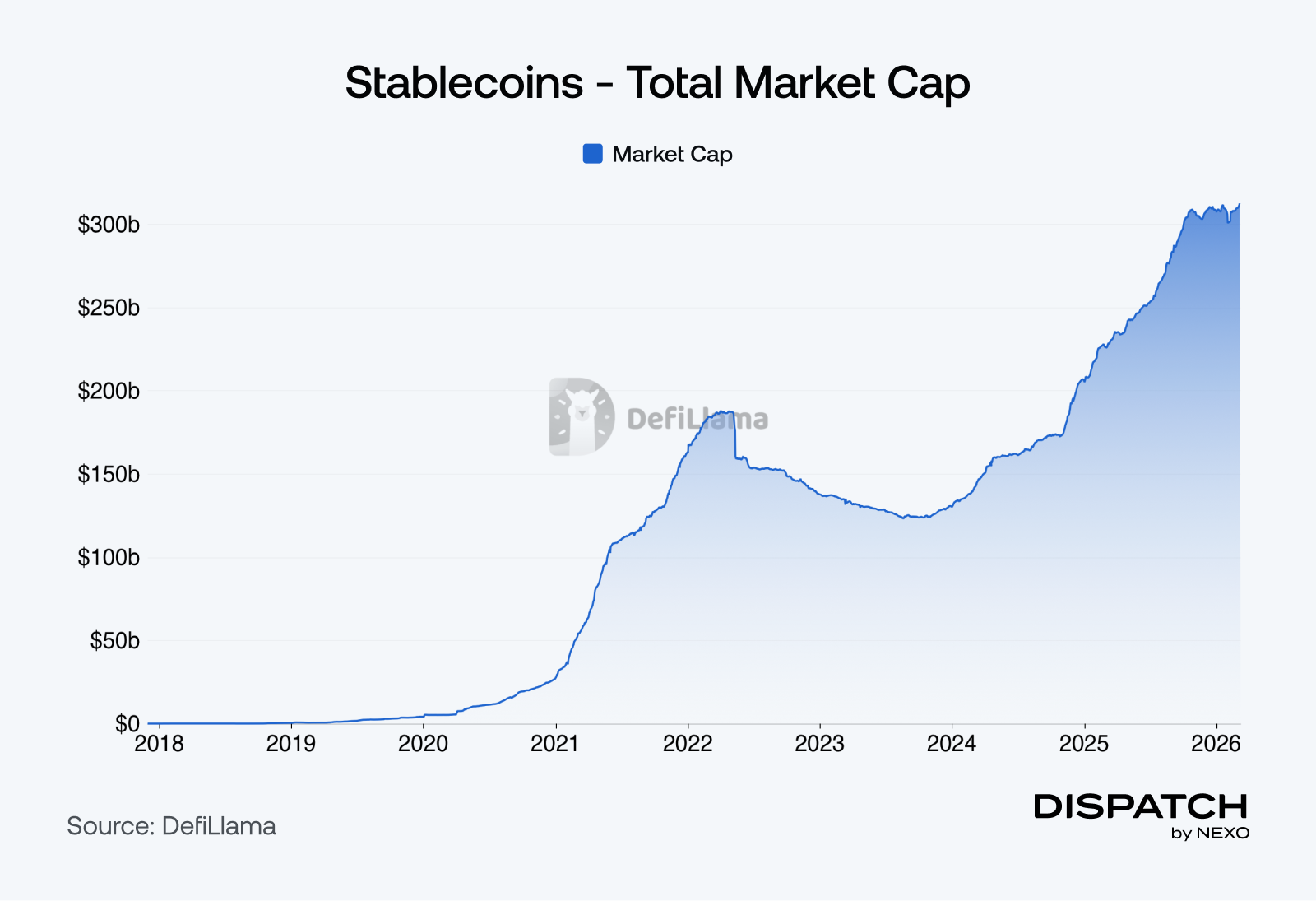
Stablecoin market capitalization has climbed to a record $313 billion, underscoring continued liquidity growth across the digital asset ecosystem. Often described as “dry powder” for crypto markets, stablecoins represent capital that can be quickly deployed into digital assets when sentiment improves. At the same time, their expanding use in cross-border payments, business settlement, and emerging financial infrastructure signals that adoption is broadening beyond pure trading activity. In that sense, the new all-time high reflects not just speculative positioning, but a deeper and more durable expansion of digital dollar liquidity within the crypto economy.
The numbers
The week’s most interesting numbers
$1.8 trillion – Stablecoin monthly transfer volume hit an all-time high, with USDC accounting for roughly 70% of activity.
$619 million – Global crypto investment products recorded their second consecutive week of net inflows.
35% – U.S. crude posted its largest weekly gain on record, pushing oil back above $100.
20 million BTC – Bitcoin’s mined supply surpassed 20 million BTC, leaving less than 1 million coins to be issued.
Hot topic
What the community is discussing
A true whale sighting.
There is still a long way to go.
Here comes ETH’s major whale.
Dispatch is a weekly publication by Nexo, designed to help you navigate and take action in the evolving world of digital assets. To share your Dispatch suggestions and comments, email us at [email protected].