Is Bitcoin ready for takeoff?
Apr 21•6 min read

In this patch of your weekly Dispatch:
- Bitcoin hunts higher
- Markets await macro
- Institutional appetite grows
Market cast
Are BTC bulls back in charge?
The week has opened on a promising note, with corporate acquisitions making headlines and ETFs recording a solid $238 million inflow on Monday. A sign that institutional appetite remains intact, and one that lends weight to what the charts are suggesting.
On the weekly chart, price is testing the 20-period Simple Moving Average, a trend indicator that smooths price action over a set number of periods. The RSI and Stochastic, both momentum oscillators, sit in neutral territory but are trending higher, and the MACD histogram, a trend-following momentum indicator, holds slightly above the zero line – a subtle but encouraging signal for bulls.
On the daily chart, price oscillates between the 100-period Simple Moving Average and the upper Bollinger Band, a volatility indicator that expands and contracts based on market conditions. The RSI and Stochastic are approaching overbought territory, with the MACD continuing to hold above zero.
Key levels to watch: support at the $74,000–$73,000 zone, followed by $71,000. To the upside, $77,000 is the immediate resistance, with $79,000 beyond that and the weekly 20-period Simple Moving Average in play as a dynamic resistance level.
The big idea
Bitcoin at a crossroads
Last week felt like a turning point. Bitcoin surged to multi-month highs, ETF inflows hit their strongest weekly reading since January, as markets priced in the ceasefire in the U.S.-Iran conflict. Then, over the weekend, a U.S. Navy seizure of an Iranian vessel unraveled it all within hours. It is a pattern that has defined Bitcoin's price action for weeks now – headline up, price up; headline down, price down, leaving traders less focused on charts and more glued to news feeds. Bitcoin is at $75,000, and the question the market is now asking is simple: was last week a preview of what's coming, or a false dawn?
What could push Bitcoin lower? The biggest risk is the one expiring Wednesday. The U.S.-Iran ceasefire deadline is the single most important event of the week, and the weekend showed how little it takes to flip sentiment. Oil jumped nearly 6%, stock futures fell, and Bitcoin gave back gains in a matter of hours. If tensions escalate further, the same dynamic that weighed on crypto all through Q1 – rising oil, sticky inflation, and a Fed that can't cut – comes back. Markets are already pricing a 38–40% chance of zero interest rate cuts this year, and a fresh spike in energy prices only makes that worse.
Under the surface, the rally also has cracks. Most of the recent buying has come from retail and offshore traders, while larger institutional players are re-engaging slowly and cautiously. Meanwhile, many investors who bought during the dip are already sitting on thin profits and looking for the exit. This pattern has historically capped recoveries before they gain real momentum.
What could drive Bitcoin higher? The demand side of the equation looks better than it has all year. Over $996 million flowed into U.S. Bitcoin ETFs last week alone, and long-term holders, the market's most patient and conviction-driven buyers, have been quietly adding to their positions throughout the recent pullback. Importantly, the proportion of recent buyers sitting on profits is still well below the level where selling typically accelerates, which means there is room for the rally to continue before it runs into serious resistance from profit-taking.
The bigger picture is also shifting structurally. Morgan Stanley launched a Bitcoin ETF that crossed $100 million in its first week. Goldman Sachs filed for one. Charles Schwab opened direct crypto trading to 39 million retail clients. Institutional buyers are now absorbing more Bitcoin than miners produce every day. If the ceasefire holds and geopolitical noise fades, all of that demand has a clear runway and the gap between where Bitcoin is trading today and where it was heading last Friday starts to look very closeable.
The bottom line: For most of this cycle, Bitcoin has danced to the Fed's tune. Rate expectations up, crypto down. Pivot hopes alive, crypto up. But this week feels different. The dominant variable is not an inflation print or a Powell speech but whether two countries step back from the brink or push further in. That is a new kind of uncertainty for crypto markets, one that models and historical correlations are poorly equipped to handle. Bitcoin has shown surprising resilience in the face of geopolitical stress, absorbing headlines that sent oil and equities sharply lower. Does that resilience reflect a maturing asset finding its footing as a store of value or simply a market that hasn't fully priced the downside yet? That is the question this week will likely answer.
Macroeconomic roundup
Global macro challenges
Last week ended with the best risk rally in months. Equities hit record highs, oil fell sharply, and for a brief moment it looked like the Middle East was stepping back from the edge. This week, markets get to find out if any of that was real.
- The IMF cut its 2026 global growth forecast to 3.1%, blaming the Middle East conflict, and warned a sustained energy shock could drag growth to 2.5% while pushing inflation above 5%. Oil jumped nearly 8% Monday after Iran closed the Strait of Hormuz again, making Wednesday's ceasefire deadline the most important macro event of the week.
- Gold slipped 0.8% to $4,792, stuck in a $4,700–$4,900 range as oil-driven inflation fears kept rate-cut hopes at bay. The metal won't find direction until the geopolitical picture clears.
- Tuesday's Warsh confirmation hearing and Thursday's flash PMI are the other key events to watch, with Fed cuts now unlikely in 2026. Warsh's testimony will be scrutinized for rate path signals, while the PMI will show how rising prices are hitting business activity on the ground.
For the full macro calendar this week, follow us on X.
TradFi trends
Institutions and crypto: Not if, but how
A new Nomura survey of 500+ investment professionals tells a simple story: institutional crypto sentiment is improving fast. Positive outlook on crypto jumped from 25% to 31% in a year, with 79% of those considering exposure planning to act within three years. The more telling detail is where allocations are heading. Institutions are moving beyond simply owning crypto and stablecoins are emerging as a particular area of interest, with 63% identifying use cases ranging from treasury management to cross-border payments. The seat at the table is no longer up for debate. The conversation has moved to how much, and what for.
The week's most interesting data story
The gap Bitcoin needs to fill
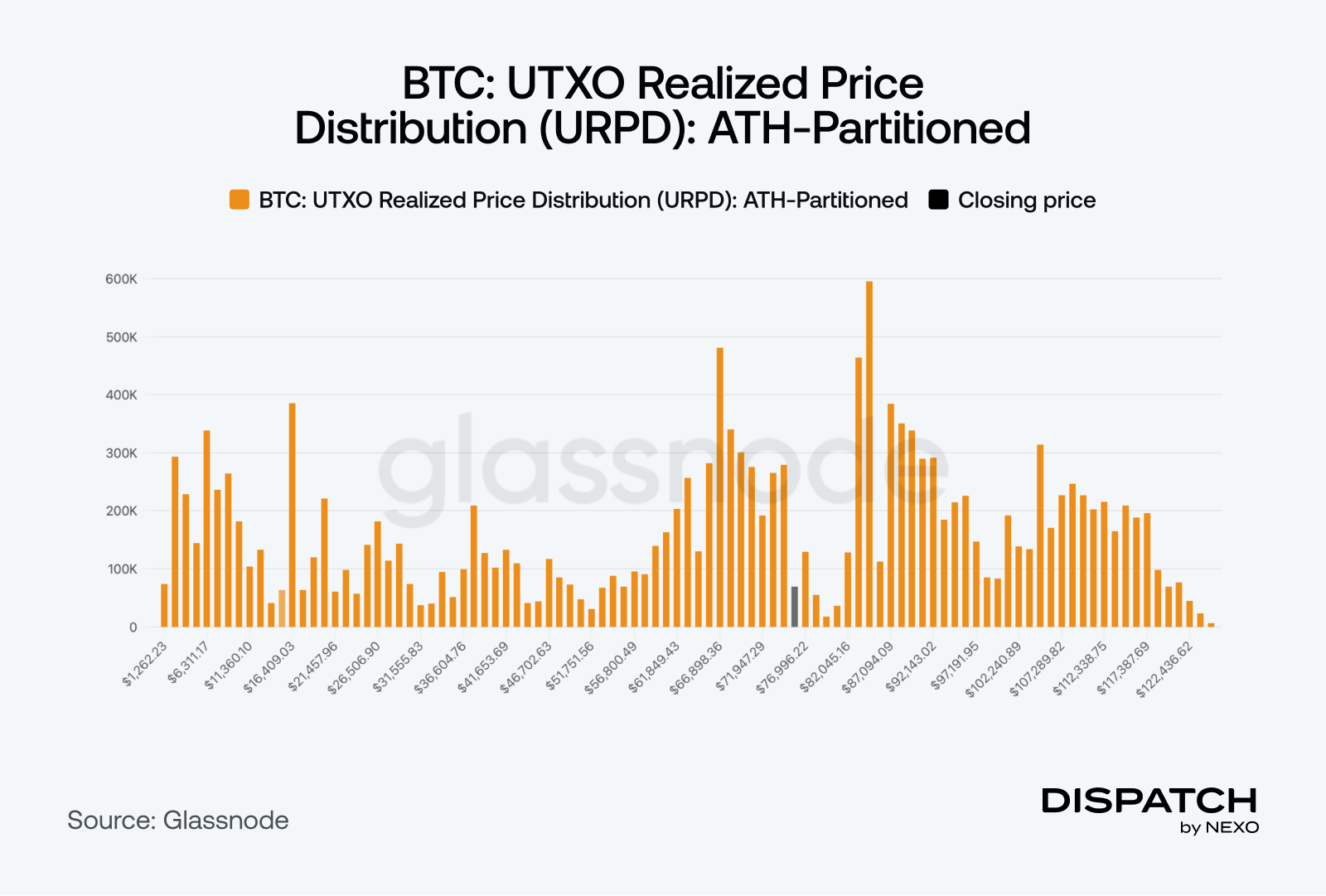
An analysis of where Bitcoin's current supply was last acquired reveals a notably sparse accumulation zone between $75,000 and $82,000. This price range has seen relatively little buying activity, leaving the market without a firm cost basis to support price in that band. This structural gap suggests that any move into this range will likely face limited natural support. Above $85,000, supply distribution thickens considerably, reflecting more meaningful accumulation at higher levels. Reclaiming and holding the $75,000–$82,000 range with fresh demand would be a necessary step before a sustained move toward that zone becomes viable.
The numbers
The week’s most interesting numbers
0.89 — ETH's 7-day correlation to BTC is the highest in over a year. ETH is not trading on its own fundamentals, but is moving as a leveraged Bitcoin proxy.
$100 million — Inflows into Morgan Stanley's MSBT in its first week, making it the firm's most successful ETF launch to date.
$996.4 million — U.S. spot Bitcoin ETFs posted their largest weekly inflows since mid-January,
4,976,485 ETH — Bitmine added 101,627 ETH in a single week, bringing its total treasury to $11.45 billion and making it the largest corporate ETH holder in the world.
$1.1 trillion — Solana recorded over $1 trillion in total economic activity in Q1 2026, a first for the network.
Hot topic
What the community is discussing
Some thoughts on BTC price movements.
The institutional whale that doesn’t hold back.
Is it wait-and-see mode for Bitcoin?
Dispatch is a weekly publication by Nexo, designed to help you navigate and take action in the evolving world of digital assets. To share your Dispatch suggestions and comments, email us at [email protected].