What is Solana? How SOL works and what it's used for in 2026
Mar 06•7 min read
The blockchain built for speed
Bitcoin was the first. Ethereum added programmability. Solana was built to go faster than both.
Launched in 2020, Solana is a high-performance blockchain designed from the ground up to handle the demands of real-world finance, payments, and consumer applications — at a speed and cost that older networks simply cannot match.
If you've been hearing about Solana and want to understand what it actually is, how it works, and why it matters, this article is for you.
What is Solana?
Solana is a Layer 1 blockchain — meaning it's a standalone network, not built on top of another chain. It's designed to process transactions at high speed with fees that are a fraction of a cent.
SOL is its native cryptocurrency. You use it to pay transaction fees, participate in staking, and interact with applications built on the network.
The easiest way to think about it: if Bitcoin is digital gold and Ethereum is a programmable computer, Solana is a high-speed payment and application network — built to handle the kind of transaction volume that banks and internet companies deal with every day.
What makes Solana different?
Three things set Solana apart from older blockchains: speed, cost, and scale.
Speed: Solana processes thousands of transactions per second in real-world conditions, with a theoretical capacity of up to 65,000 TPS. Block confirmation times average around 400 milliseconds — under half a second. The Alpenglow upgrade, expected in 2026, targets 150-millisecond finality, which would make Solana one of the fastest blockchains ever built. Ethereum's base layer, by comparison, handles 15–30 TPS.
Cost: The average transaction fee on Solana is around $0.005 — less than a cent. This makes things like micropayments, frequent trading, and high-volume applications economically viable in a way that's impossible on more expensive networks.
Scale on the base layer: Unlike Ethereum, which relies on a network of Layer 2 solutions to scale, Solana scales directly on its main chain. This keeps liquidity unified and the user experience simple — one network, one set of rules, no bridging between layers.
How does Solana work?
Solana's speed comes from a novel mechanism called Proof of History (PoH) — a kind of cryptographic clock built into the network.
On most blockchains, validators need to communicate with each other to agree on the order and timing of transactions. That back-and-forth takes time. Proof of History solves this by creating a verifiable record of when each event occurred before validators even process it. Because the timeline is already established, validators can process transactions in parallel rather than waiting in sequence.
Think of it like this: instead of every node in the network asking "what time did this happen?" and waiting for agreement, Proof of History lets each node check a shared timestamp that's already been cryptographically proven. The result is dramatically faster processing with far less overhead.
Solana also uses Proof of Stake on top of Proof of History, meaning validators stake SOL to participate in securing the network and earn rewards in return. For holders who don't want the technical complexity of running a validator, platforms like Nexo offer a simpler way to earn up to 7% daily interest on SOL without locking it up or managing infrastructure.
What is Solana used for?
Solana's speed and low fees have made it the network of choice for a specific set of high-throughput use cases.
Decentralized finance (DeFi): Solana hosts a $9 billion+ DeFi ecosystem, including decentralized exchanges, lending protocols, and yield products. Jupiter Exchange and Raydium are among the largest DEXes by volume globally — both built on Solana. The network regularly handles over 50% of global DEX trading volume. For those who want exposure to Solana's ecosystem without navigating DeFi directly, Nexo lets you buy SOL and earn interest on it in a few taps.
Payments and stablecoins: Visa processes approximately $3.5 billion in annualized USDC settlement volume on Solana. Western Union announced plans to launch a stablecoin on Solana in the first half of 2026. JPMorgan executed a $50 million commercial paper trade on Solana. The network's speed and near-zero fees make it a natural infrastructure for payment applications.
Consumer apps and gaming: Solana's low fees make micropayments practical — things like paying fractions of a cent per in-game action, or streaming micro-payments for content. This unlocks consumer app models that are cost-prohibitive on slower chains.
NFTs and digital collectibles: Solana has been a leading NFT platform, with over $1.2 billion in NFT trading volume in Q1 2025. The compressed NFT standard (cNFTs) allows creators to mint millions of assets at near-zero cost — something technically impossible on Ethereum's base layer.
Real-world assets (RWA): Tokenized real-world assets on Solana crossed $2 billion in early 2026, up 70% in 30 days. State Street announced plans for a tokenized money market fund on the network.
Mobile Web3: Solana Mobile — with its Solana Mobile Stack for Android hardware manufacturers — is building the infrastructure for native mobile crypto applications that work without the friction of bridging between apps and wallets.
AI agents: As the AI agent economy grows, Solana is emerging as one of the preferred rails for autonomous transactions. Its sub-cent fees and near-instant finality make it suitable for machine-to-machine payments where traditional networks would be too slow and too expensive.
Solana vs. Ethereum: understanding the difference
The Solana vs. Ethereum question comes up constantly. The honest answer is that they're optimized for different things.
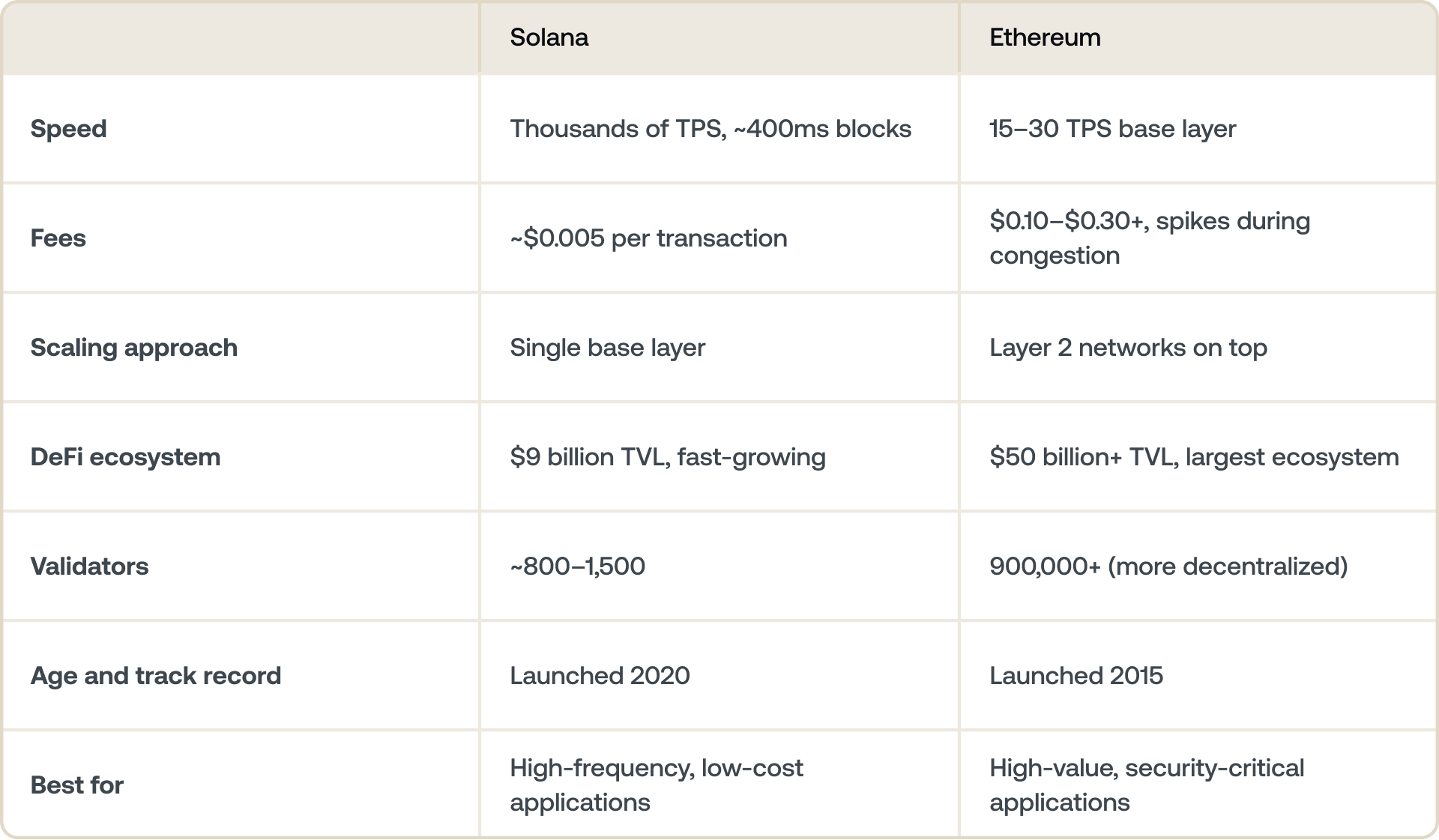
Neither is objectively better — they serve different needs. Ethereum is the gold standard for security and institutional trust. Solana is the performance leader for speed and consumer-facing applications. Many investors hold both.
The risks worth knowing
Solana's performance advantages may come with trade-offs.
Past outages: The network experienced several outages between 2021 and 2023. Since then, stability has improved substantially — uptime has exceeded 99.9% through 2024 and 2025, and the network successfully withstood a week-long DDoS attack in December 2025 without going down.
Centralization concerns: Running a Solana validator requires powerful, expensive hardware. This means fewer people can participate compared to Ethereum, where hardware requirements are lower.
Competition: Ethereum's Layer 2 ecosystem — networks like Arbitrum and Base — is also offering fast, cheap transactions, narrowing Solana's speed advantage for some use cases.
Put your Solana to work
Most SOL sits idle in wallets — earning nothing, doing nothing. That's a missed opportunity. On Nexo, your SOL can work for you from day one.
- Earn interest on your SOL through Flexible and Fixed-term Savings — so your position grows even during quieter market phases.
- Borrow against your SOL via the Nexo Credit Line, accessing funds without selling your position.
- Buy and exchange SOL alongside 100+ other digital assets, 24/7.
Solana was built on the principle that idle capacity is wasted capacity. The same applies to how you hold it.
Frequently asked questions
1. What is Solana?
Solana is a high-performance Layer 1 blockchain known for its speed and low fees. It processes thousands of transactions per second at a fraction of a cent per transaction, making it one of the most widely used blockchains for DeFi, payments, NFTs, and consumer applications.
2. What is SOL used for?
SOL is Solana's native token. It's used to pay transaction fees on the network, stake to help secure the chain and earn rewards, and interact with applications built on Solana.
3. How is Solana different from Bitcoin and Ethereum?
Bitcoin is primarily a store of value. Ethereum is a programmable network optimized for security and decentralization. Solana is optimized for speed and low cost — it processes thousands of transactions per second at near-zero fees, making it better suited for high-frequency applications and payments.
4. What is Proof of History?
Proof of History is Solana's core innovation — a cryptographic clock that timestamps transactions before validators process them. This means validators don't need to communicate back and forth to agree on timing, which is why Solana can process transactions so much faster than older blockchains.
5. Is Solana better than Ethereum?
They're optimized for different things. Solana is faster and cheaper per transaction. Ethereum has a larger, more established ecosystem and is more decentralized. Most serious investors hold both rather than choosing one.
6. Can you earn interest on Solana?
Yes. Platforms like Nexo offer daily interest on SOL holdings through Flexible and Fixed-term Savings. Rates vary by asset, Loyalty Tier, and jurisdiction.
7. What happened with Solana's outages?
Solana experienced several significant outages between 2021 and 2023, primarily due to spam attacks overwhelming the network. Since then, the team introduced fee markets, anti-spam systems, and the Firedancer validator client. Uptime has exceeded 99.9% through 2024 and 2025, though the history remains a consideration for risk-conscious investors.
These materials are accessible globally, and the availability of this information does not constitute access to the services described, which services may not be available in certain jurisdictions. Rates are subject to change and may vary by region, loyalty tier, and other applicable factors. Always refer to the Nexo app for your applicable rates. These materials are for general information purposes only and not intended as financial, legal, tax, or investment advice, offer, solicitation, recommendation, or endorsement to use any of the Nexo Services and are not personalized, or in any way tailored to reflect particular investment objectives, financial situation, or needs. Digital assets are subject to a high degree of risk, including but not limited to volatile market price dynamics, regulatory changes, and technological advancements. The past performance of digital assets is not a reliable indicator of future results. Digital assets are not money or legal tender, are not backed by the government or by a central bank, and most do not have any underlying assets, revenue stream, or other source of value. Independent judgment based on personal circumstances should be exercised, and consultation with a qualified professional is recommended before making any decision.