How interest on crypto works in the U.S.: A practical guide
Oct 15•7 min read
If you hold digital assets in the U.S., you may have seen platforms advertise interest on crypto. Rates can look appealing, but how payouts are produced, who holds your assets, and what happens under stress differ widely from one format to the next.
This guide walks you through what interest on crypto means, how the main formats work, who offers them, and what to review before you allocate assets.
What does generating interest on crypto mean?
It means holding eligible digital assets with a provider that pays a stated annual rate for doing so. The provider may use the assets for lending, network validation, or other activities and pass part of the result to you, usually in the same asset.
For example, if you hold an eligible asset with a flexible product, interest accrues on your balance each day at the stated rate and is added to your account. With a fixed-term product, you agree to a period up front, and the interest is paid at the end of it.
Three points frame everything below. A rate is a stated rate, not a promise of an outcome. Payouts depend on the provider's activity and financial condition. And your asset keeps its own price risk, so a price fall can outweigh the interest you receive.
Where does the interest come from?
Before you compare rates, identify the source of interest. Common sources include:
- Network rewards. Proof-of-stake blockchains issue new tokens to participants who help validate transactions.
- Trading and treasury activity. Some providers generate income through exchange fees, spreads, or treasury strategies.
- Promotional incentives. Some advertised rates include temporary token incentives that can end at any time.
- Borrower interest. Some providers pass part of the interest paid by borrowers to the clients who hold assets with them
How Nexo’s Yield payouts are generated
Our Yield products rest on a utility-driven business model with three sources: interest-rate spreads on our collateralized Credit Lines, transaction fees from our Exchange and payment services, and market-neutral treasury strategies. Payouts are supported by this revenue, though rates remain variable and returns are not guaranteed.
The main formats, and how each one works
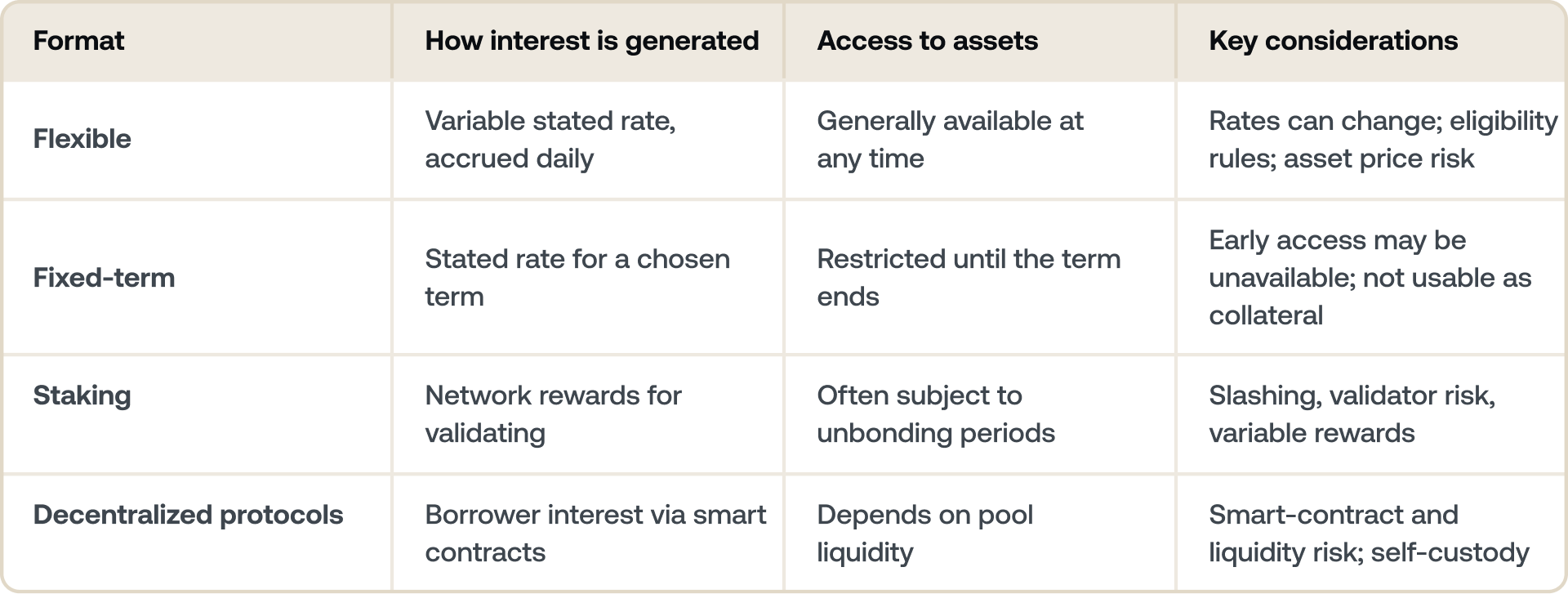
Flexible
Your assets stay available and can be withdrawn or traded at any time, and interest typically accrues daily. Nexo’s Flexible Yield product works this way for eligible U.S. clients: interest accrues daily and compounds, with no lock-ups. Eligibility applies, including opting in and a portfolio balance above $5,000, and rates depend on the asset and your Wealth Club tier. Our Help Center article on Flexible Yield sets out the rules.
Fixed-term
You commit assets for a set period in exchange for a higher stated rate than a flexible product. With Fixed-term Yield, you choose a 1, 3, 6, or 12-month term with stated rates of up to 16% annually, subject to asset, term, and tier. Interest is paid in a single payout at the end, and locked assets cannot serve as collateral. See our Fixed-term Yield Help Center article.
Staking
Staking locks tokens to help a proof-of-stake network validate transactions, in return for newly issued tokens. Rewards vary and can be affected by unbonding periods, validator performance, and penalties known as slashing. Nexo’s Yield products work differently and are not staking.
Decentralized lending protocols
Smart contracts match suppliers and borrowers without a company. You keep control of your wallet but take on smart-contract, price-feed, and liquidity risks.
Who provides these services in the U.S.?
U.S. residents can find yield-generating products at exchanges that run rewards programs, platforms built around interest and credit products, and decentralized protocols. They differ in custody, eligibility, supported assets, and rate structure, so compare them against the checklist below rather than by headline rate.
For our U.S. clients, we work with Bakkt, a publicly listed U.S. digital asset platform that is the custodian for U.S. client assets. Flexible Yield offers annual rates of up to 14% annually on 20 supported assets, and Fixed-term Yield up to 16%. These are maximum interest rates, subject to asset, term, eligibility, and tier, and they are variable and not guaranteed.
Nexo’s Wealth Club page explains tiers, and our Security page describes how we approach custody and compliance.
What to review before you allocate assets
Generating interest on crypto carries risk of loss, and returns are not guaranteed. With any provider, we suggest reviewing the following.
Custody terms
Find out who holds the assets, whether they are held separately from the provider's own, and whether the provider can lend or reuse them. The terms of use set out your rights in different situations, including if a provider’s circumstances change. Nexo partners with Bakkt, a publicly listed U.S.-based digital asset platform purpose-built to support institutional risk management and compliance, and our regulated custodian.
Withdrawal rules
Lock-ups, notice periods, withdrawal limits, and fees can differ between products, and may apply differently when demand is high. A product described as flexible can still include conditions, so it helps to read them in full.
Provider track record
Providers differ in how long they have operated, how openly they describe their risks, and which partners they work with. Some platforms have paused withdrawals in the past, so a provider’s history and disclosures add useful context.
Price movement
Interest is paid on assets whose prices can move significantly, up or down. For illustration only, a stated 7% annual interest rate on an asset worth $10,000 produces about $700 over a year, while a 30% price change in either direction changes its value by about $3,000 over the same period.
Fees
Spreads, network charges, and withdrawal fees reduce the net outcome, so review the fee schedule as well as the rate.
Tax obligations
Interest or rewards may be taxable for U.S. taxpayers, and the rules are complex, so consult a qualified tax professional. Our crypto tax guide gives an overview, and our tax reporting tools, built with Koinly, can help you keep records.
Frequently asked questions
1. How do Flexible Yield and Fixed-term Yield differ?
Flexible Yield keeps your assets available and pays variable interest daily. Fixed-term Yield commits your assets for a term of up to 12 months, with a higher stated annual rate. See Flexible Yield and Fixed-term Yield.
2. Can the rate change after I start?
Yes. On Nexo, stated interest rates are variable and may change at any time, and the rate you see depends on the asset, your eligibility, and your Wealth Club tier. Fixed-term Yield sets the stated rate for your chosen term when you commit.
3. Is staking and generating yield the same thing on Nexo?
No. Staking rewards come from a blockchain network and depend on the network's rules. Our Yield products are separate products with their own stated rates and terms, which you can review on our product pages.
4. I'm new to buying crypto. Where do I start?
Start with the platform choice. Our guide on how to choose a crypto exchange as a beginner covers platform types, selection criteria, and a first purchase for U.S. clients.
Yield / Fixed-term Yield: Rates are variable and may change at any time. Returns are not guaranteed. You may lose some or all of your principal. Certain products lock assets for a fixed term and may not permit early withdrawal. When terms such as “up to” or “from” are used to denote limits, achieving these maximum or minimum thresholds may be conditional on additional actions or fulfilment of certain criteria and requirements that may not be attainable by all clients. References to Yield refer to product names and do not represent rates of return or performance.
These materials are accessible globally, and the availability of this information does not constitute access to the services described, which services may not be available in certain jurisdictions. These materials are for general information purposes only and not intended as financial, legal, tax or investment advice, offer, solicitation, recommendation, or endorsement to use any of the Nexo Services and are not personalized, or in any way tailored to reflect particular investment objectives, financial situation or needs. Digital assets are subject to a high degree of risk, including but not limited to volatile market price dynamics, regulatory changes, and technological advancements. The past performance of digital assets is not a reliable indicator of future results. Digital assets are not money or legal tender, are not backed by the government or by a central bank, and most do not have any underlying assets, revenue stream, or another source of value. Independent judgment based on personal circumstances should be exercised, and consultation with a qualified professional is recommended before making any decision.
Digital asset services involve substantial risk. Digital asset prices are volatile and you may lose some or all of your principal. Rates, product availability, features, and applicable terms may vary based on jurisdiction, eligibility, loyalty tier, and other factors, and are subject to change at any time. Returns are not guaranteed. Digital assets may be held or serviced by third-party custodians, exchanges, lenders, or other service providers. Your ability to access or recover assets depends on the provider's operational resilience and financial condition. If a provider becomes insolvent or experiences an operational disruption, you may experience delays in access to assets and could lose some or all of your assets. Digital asset accounts are not bank accounts and are not insured by the FDIC, SIPC, or any other governmental or private deposit insurance program. Tax treatment of digital assets and related transactions is complex and may change. This information is not tax advice. Consult a qualified tax professional regarding your specific circumstances. Services are provided by Bakkt Crypto Solutions, LLC. For more information, visit Bakkt Disclosures.