Dispatch #285: Bitcoin stays solid under pressure
Feb 24•6 min read

In this patch of your weekly Dispatch:
- Bitcoin’s headwinds explained
- Stablecoins’ new challenge
- A diverse macro week
How does crypto fit into your financial life?
Dear Dispatch readers,
We’re inviting you to complete a short, anonymous survey. It takes just a few minutes and helps us better understand crypto adoption trends. Thank you for being part of the conversation.
Take the survey
Market cast
BTC: Testing key support amid soft momentum
Bitcoin is trading under cautious conditions across higher timeframes, with both trend-following and momentum indicators leaning to the downside. On the weekly chart, price action remains subdued following the break below key support levels. BTC is hovering near the lower Bollinger Band, while momentum indicators such as the RSI and Stochastic are in oversold territory. The MACD histogram continues to print below the zero line, reinforcing the softer tone, while the ADX (a trend-strength indicator) holds above 30, suggesting the broader trend structure remains well established.
The daily chart reflects a similar configuration. BTC is trading below its major moving averages and near the lower Bollinger Band, indicating continued pressure. Momentum gauges, including the RSI and Stochastic, remain in oversold territory, while the MACD histogram is still slightly above the zero line, pointing to moderating but not yet clearly shifting momentum.
Immediate support is seen at $63,000, followed by the $61,000–$60,000 zone. On the upside, $66,000 marks initial resistance, with $68,000 as the next level to watch. The daily middle Bollinger Band – currently positioned near the $66,000 area, may also act as dynamic resistance in the near term.
The big idea
Bitcoin holds in a period of pressure
At Nexo Dispatch we always aim to assess the current tail- and headwinds in the digital assets sector. And there is hardly getting away from this – there have been some less-than-optimal developments from crypto in this past week, resulting in Bitcoin’s timid price action. In true Dispatch style, we unpack it all. The pressure is not coming from one direction. It is building across macro, flows, and positioning.
A Fed that is no longer in a hurry: The January FOMC minutes revealed a divided Federal Reserve. While cuts remain possible later this year, several officials signaled that holding rates steady for longer may be appropriate. Some even floated the possibility that additional easing may not resume until inflation clearly returns toward target. Markets are now pricing the next cut around mid-year. For Bitcoin, this matters. Elevated real yields and policy hesitation restrain liquidity momentum. Crypto does not require aggressive easing to function, but it rarely accelerates when monetary direction is fragmented and forward guidance uncertain. Liquidity is not contracting sharply ,but it is not expanding either.
Tariffs and macro friction: President Trump’s decision to raise the global tariff rate to 15% reintroduces a familiar source of volatility. Previous tariff announcements triggered sharp cross-asset drawdowns earlier in the year. This time, markets reacted with relative composure. Bitcoin held near the $68,000 region and broader crypto benchmarks showed limited immediate disruption. That resilience is notable. But trade policy remains a macro variable capable of influencing inflation expectations and financial conditions indirectly. The uncertainty itself keeps risk appetite cautious.
ETF fatigue: U.S. spot Bitcoin ETFs have now recorded five consecutive weeks of net outflows, removing roughly $3.8 billion since late January. The streak matches the duration of early-2025’s tariff-driven episode, though the magnitude has been more moderate in recent weeks. Importantly, cumulative net inflows since launch still stand near $54 billion, with total assets around $85 billion. This is not structural abandonment, but it does signal that institutional demand is no longer acting as a consistent marginal bid. In short, we have fatigue rather than panic on our hands. Read on this week’s data story to see which addresses are in-play.
Structurally defensive, not disorderly: On-chain structure reinforces the idea of compression rather than collapse. Bitcoin has slipped below its True Market Mean near $79,000, while the Realized Price around $54,900 defines the deeper structural boundary. In the absence of a macro catalyst, this corridor is likely to frame the mid-term environment. The $60,000–$69,000 demand cluster formed during H1 2024 continues to absorb sell pressure, with medium-term holders defending breakeven levels and moderating downside momentum. Accumulation has shifted from outright distribution toward a fragile equilibrium, but conviction-driven large-entity buying has yet to re-emerge.
A quiet structural shift: While short-term flows remain hesitant, longer-term adoption continues to advance. In Missouri, lawmakers revived a Bitcoin strategic reserve bill that would allow the state treasurer to purchase and hold BTC with public funds under a five-year framework, and potentially accept approved cryptocurrencies for certain state payments. The proposal still faces legislative hurdles, but its return underscores a key point: price weakness has not halted policy experimentation. These initiatives are not immediate demand catalysts, yet they reflect Bitcoin’s gradual normalization within public finance. This is a process that moves slowly, then compounds.
What would shift the tone: Bitcoin remains well below its October highs and key cost-basis anchors – a defensive, but not disorderly, regime. A constructive turn would likely require clearer monetary direction, stabilized ETF flows, or renewed large-entity accumulation alongside rebuilding liquidity. Bottom line: clarity is forming but it’s sideways action until there is a clear macro catalyst to shift sentiment.
TradFi trends
Stablecoins: From liquidity to funding
Stablecoins may soon do more than settle crypto trades – they could help finance the U.S. government. According to Standard Chartered, stablecoin market capitalization could reach $2 trillion by 2028, generating $0.8–$1 trillion in incremental demand for short-dated Treasury bills. Under frameworks like the GENIUS Act, regulated issuers are required to hold high-quality liquid assets, concentrating demand in the 0–3 month sector.
Combined with Federal Reserve front-end purchases, bill demand could outpace projected supply, potentially prompting adjustments in Treasury issuance strategy. In Standard Chartered’s view, stablecoins are evolving into a structural bid at the front end of the yield curve – a shift with implications well beyond crypto markets.
Macroeconomic roundup
Focus shifts back to Fed tone and inflation signals
With Bitcoin trading on fragile footing, macro remains in control. After moderating PCE inflation and resilient jobless claims last week, markets are still divided on the timing of rate cuts ahead of the March 17–18 Fed meeting. This week’s Fed commentary and inflation data will test whether disinflation is progressing – or stalling.
Fed Speakers (Mon–Wed): Remarks from Governors Waller and Cook, alongside regional presidents including Bostic and Goolsbee, could shift rate expectations. A hawkish tone would likely lift yields and the dollar; a softer stance could ease pressure on risk assets.
U.S. Consumer Confidence (Tue): Following January’s weak print, sentiment will signal whether growth resilience holds. Strength may delay cut expectations; weakness could revive easing bets.
Initial Jobless Claims (Thu): Labor market tightness remains central to Fed caution. Further strength supports a patient Fed; cooling claims would strengthen the case for earlier easing.
U.S. PPI (Fri): As a key upstream inflation gauge, producer prices will help determine whether price pressures are reaccelerating or continuing to soften — with direct implications for rate expectations. For a full breakdown of this week’s macro events and timings, see our macro calendar on X.
The week's most interesting data story
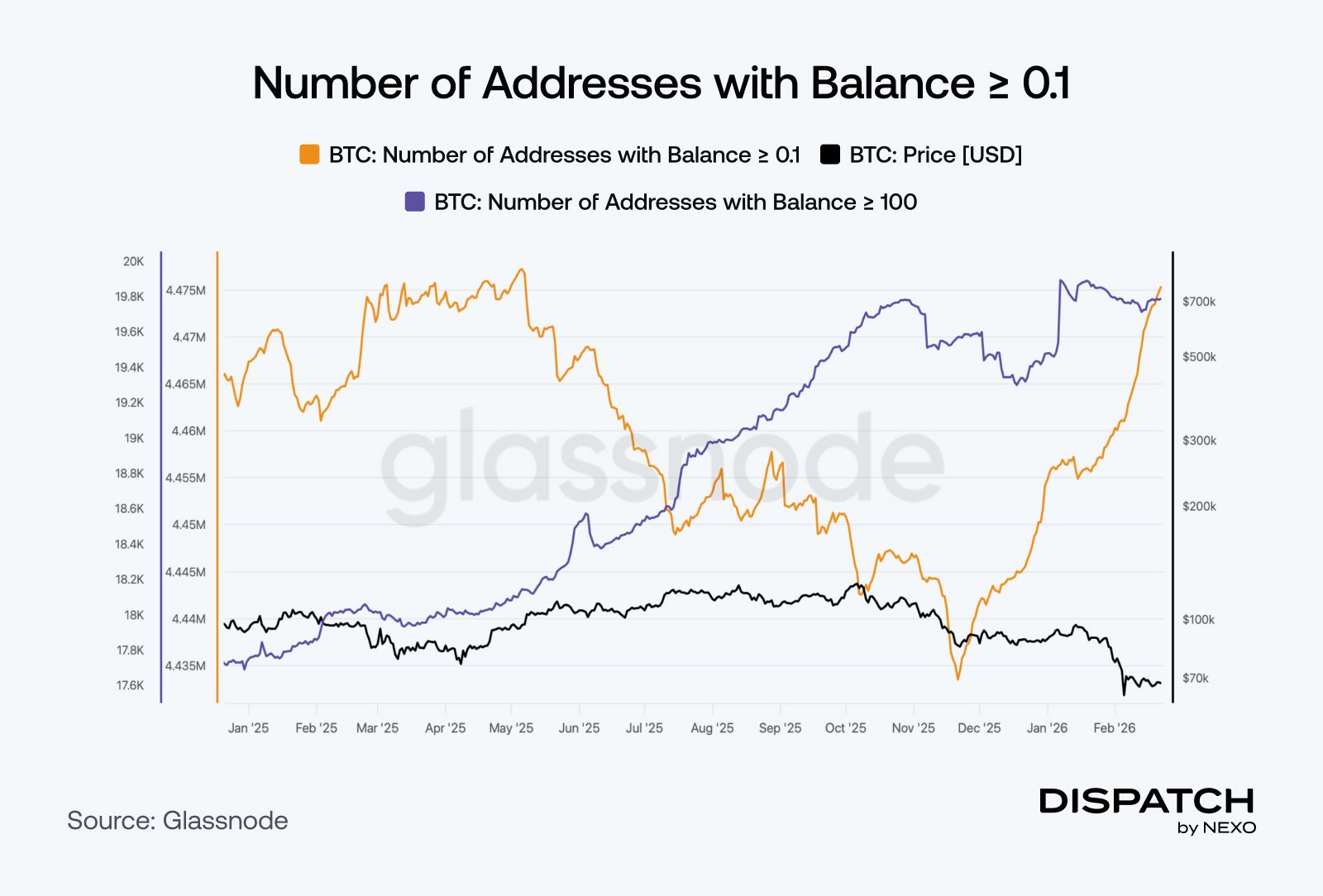
Bitcoin: Steady hands beneath the surface
On-chain trends suggest that not all cohorts are reacting to recent volatility in the same way. Smaller holders with more than 0.01 BTC and larger long-term holders controlling over 100 BTC appear to be maintaining their positions, indicating continued conviction across both ends of the ownership spectrum. Exchange inflows have moderated significantly since the early-February spike, declining roughly 60% from peak levels – a sign that immediate selling pressure has eased. Stablecoin inflows have also slowed, reflecting a pause in aggressive positioning rather than broad liquidation. Taken together, the data points to stabilization beneath the surface, even as price action remains range-bound.
The numbers
The week’s most interesting numbers
6,782 BTC – UAE Royal Group holdings worth roughly $450 million, highlighting sovereign-scale accumulation.
867,798 ETH – Sharplink’s total Ethereum holdings (~$1.68B), reinforcing treasury-style accumulation despite market volatility.
$17 billion – First-day trading volume for ProShares’ GENIUS Money Market ETF, the first fund tailored to U.S. stablecoin reserve rules.
20 days – Bitcoin stuck in “extreme fear” even as macro liquidity growth suggests it is trading at a relative discount.
$436 million — A mystery investor’s disclosed stake in BlackRock’s Bitcoin ETF, with beneficial ownership remaining private.
Hot topic
What the community is discussing
Here is one whale buying.
So when will recovery start?
Is Bitcoin undervalued?
Dispatch is a weekly publication by Nexo, designed to help you navigate and take action in the evolving world of digital assets. To share your Dispatch suggestions and comments, email us at [email protected].