Dispatch #280: Can Bitcoin sustain the rebound?
Jan 20•6 min read

In this patch of your weekly Dispatch:
- BTC’s bullish signals
- ETH transactions surge
- Labour market data sprint
Market cast
BTC: Pause before stronger recovery?
Bitcoin’s recovery has slowed in recent sessions, with geopolitical headlines adding a note of caution to an otherwise stabilising technical setup.
On the weekly chart, price is hovering around the $91,000 support level, which previously acted as resistance and is now being tested as a potential base. Momentum indicators such as RSI and the Stochastic Oscillator remain in neutral territory, while the trend-following MACD is sitting close to the zero line, signalling a lack of strong directional momentum.
On the daily timeframe, short-term momentum has weakened. A bearish crossover in the MACD points to near-term pressure, while RSI is trending lower but remains well above oversold levels. The Stochastic Oscillator is approaching oversold territory, suggesting downside momentum may be fading rather than accelerating. The 50-day simple moving average is the next key area to watch, as it could act as dynamic support if selling continues.
For now, support sits in the $90,000–$91,000 zone, followed by $88,000, while resistance remains around $94,000 and $98,000. Overall, the setup points to consolidation rather than a broader trend breakdown.
The big idea
Can Bitcoin’s recovery turn into a sustainable rally?
Bitcoin’s rebound has been fast enough to draw attention – but not yet decisive enough to settle the debate. With the technical picture established, the focus now shifts from price levels to market quality. Bitcoin’s recent rebound leaves it at an inflection point, where improving structural signals meet lingering macro uncertainty.
The real question isn’t whether Bitcoin has bounced, but whether this phase has the foundations to become more durable. Sustainable rallies tend to reveal themselves not through speed, but through structure: how price behaves under pressure, how leverage resets, and whether demand emerges without being forced.
ETF demand is providing a stabilizing base: One of the clearest constructive signals has been the return of U.S. spot Bitcoin ETF inflows. Last week saw roughly $1.4 billion in net inflows – the strongest weekly total since early October, suggesting renewed institutional engagement despite elevated volatility. That matters less as a price catalyst and more as a structural one. ETF flows represent relatively patient, price-insensitive demand, helping absorb supply during pullbacks and reducing the market’s reliance on leveraged positioning to sustain upside. While inflows alone don’t define a rally, their re-emergence lowers the fragility of recent price action.
Price dipped – leverage adjusted: Crucially, the recent pullback has been accompanied by moderate deleveraging rather than panic-driven repositioning. Despite the sharp spot move, derivatives indicators point to contained risk reduction. Funding rates briefly dipped negative before stabilizing near neutral to slightly positive across major venues, suggesting leverage cooled without flipping decisively bearish. Bitcoin futures open interest declined modestly with a roughly 1.1% drop over a short window, before stabilizing and partially recovering, consistent with measured de-risking rather than forced exits.
Positioning metrics reinforce that view. The long/short account ratio has risen gradually from 0.9 to 1.3, remaining close to neutral and well below levels typically associated with crowded positioning or squeeze risk. Compared with prior drawdowns marked by persistent negative funding and sharp open-interest collapses, the market now appears structurally healthier, with leverage already reset to more sustainable levels.
Regulatory clarity is becoming a tailwind: Momentum around the U.S. CLARITY Act suggests a gradual shift toward a more defined regulatory environment, helping move the market conversation from uncertainty toward structure. While this evolution is unlikely to influence short-term price action, it plays a meaningful role in long-term resilience by encouraging broader institutional participation. Regulation isn’t driving the recovery, but it is quietly changing the character of participation — reinforcing Bitcoin’s ability to sustain gains rather than chase them.
The macro signal, briefly: Outside crypto, early-cycle signals are quietly aligning. Gold and copper have moved higher even as central banks maintain cautious policy rhetoric – a pattern that historically reflects markets repricing liquidity conditions ahead of formal easing. Bitcoin has often lagged that adjustment, responding later once real-yield compression becomes more persistent.
For now, Bitcoin remains range-bound rather than responsive – a familiar position in the early stages of past liquidity shifts.
The bigger picture: Bitcoin doesn’t tend to move first – it tends to move hardest once conditions are in place. The recent recovery hasn’t yet proven itself as a full-fledged rally. But it also doesn’t resemble a hollow bounce driven purely by leverage or narrative momentum. Instead, it looks like a market in transition: absorbing supply, cooling excesses, and waiting for a clearer liquidity signal to tip the balance. Sustainable rallies rarely announce themselves at the highs. They’re built quietly, in periods where price holds together better than expected – and where structure improves before sentiment does. Bitcoin may still be in that phase.
Macroeconomic roundup
Policy signals take centre stage
This week’s macro focus shifts to U.S. policy signals and global central bank dynamics, with markets navigating fragile rate-cut expectations amid elevated geopolitical uncertainty. Bitcoin has remained resilient near key psychological levels, but upcoming data and decisions will test risk appetite as investors reassess the outlook for monetary easing and global liquidity.
U.S. President Trump Speaks (Wednesday): Comments from Davos may shape market sentiment for risk assets. Hawkish trade or tariff commentary would likely support the dollar and pressure crypto, while more constructive signals could improve risk sentiment.
Initial Jobless Claims (Thursday): Claims are expected around 203,000. A stronger print could reinforce “higher-for-longer” rate expectations and cap risk appetite, while softer data would support easing hopes and bolster Bitcoin via lower yield pressure.
Core PCE Inflation (Thursday): The Fed’s preferred inflation gauge is forecast at 0.2% MoM. Higher-than-expected inflation could delay rate cuts and weigh on risk assets, while cooler readings would ease real-yield pressure and support risk sentiment.
Bank of Japan Interest Rate Decision (Friday): Markets will watch for any change to the BoJ’s policy stance, with the rate at 0.75% after a December hike to the highest level in decades. Continued stability would maintain the external liquidity backdrop, while hints of further tightening could tighten global financial conditions.
For a fuller breakdown of this week’s macro events and timings, see our full macro calendar on X.
Nexo
Nexo becomes official partner of Audi Revolut F1 Team
After a year marked by major sports partnerships and pivotal crypto market moves, Nexo continues to make statements on the global stage. The company has entered a multi-year strategic partnership with the Audi Revolut F1 Team, becoming the team’s inaugural official digital asset partner as Audi prepares for its landmark entry into Formula 1 in 2026.
The alliance brings Nexo onto one of the world’s most elite sporting platforms, uniting two organisations defined by precision, disciplined innovation, and performance at the highest level. Reflecting on the partnership, Nexo co-founder Antoni Trenchev described it as a statement about the future — “instant, self-directed, and always on” — and about delivering meaningful utility and premium experiences to a global audience.
The year’s most interesting data story
Ethereum’s fundamentals strengthen
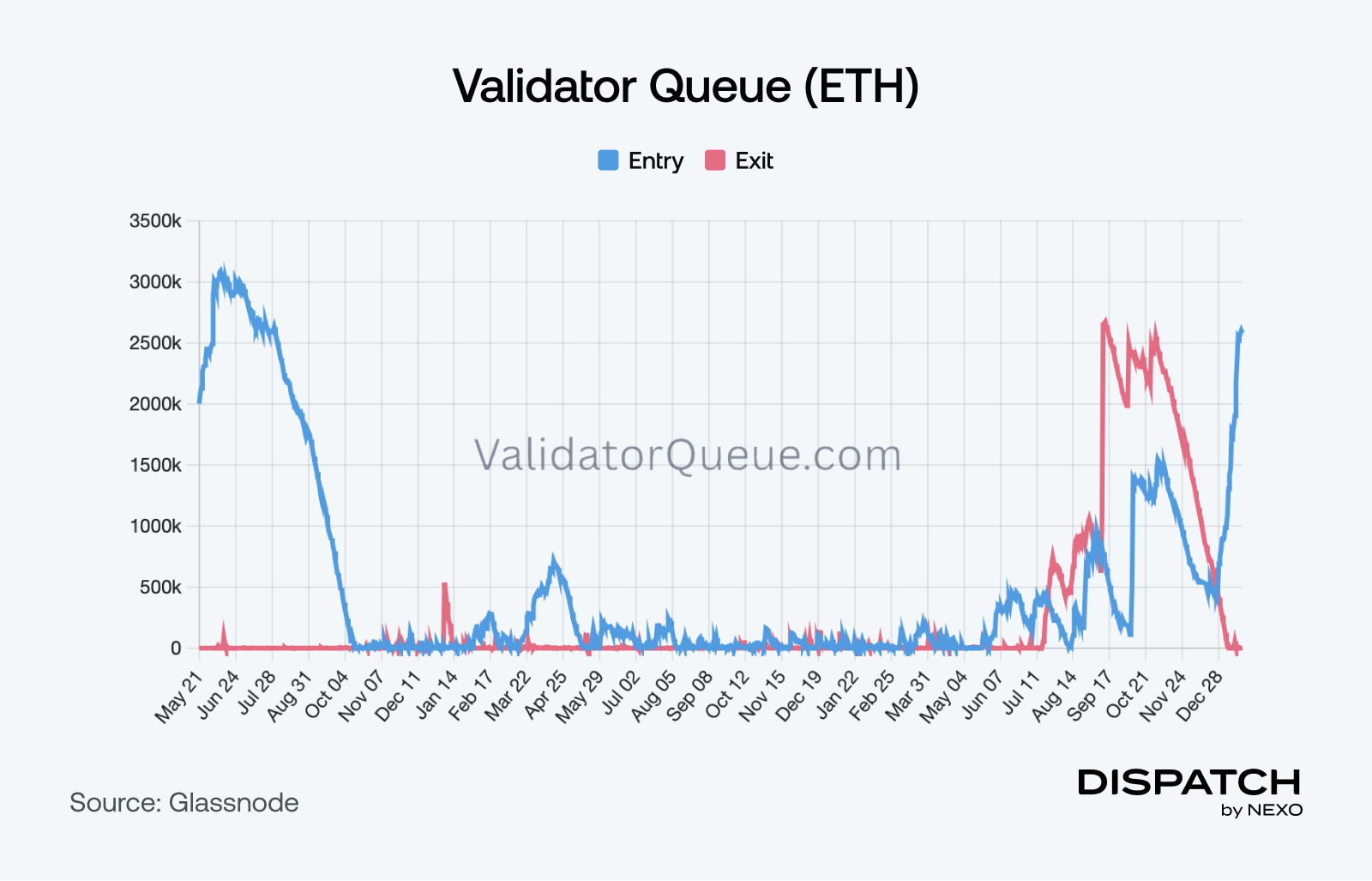
Ethereum’s staking flows are sending a clear signal. The validator exit queue has fallen to near zero, down from roughly 2–2.5 million ETH in late 2025, pointing to a potential sharp decline in near-term sell pressure. At the same time, the entry queue is rebuilding, suggesting more ETH is being locked away rather than positioned for sale.
This shift is showing up in price behavior. ETH has outperformed year-to-date, the share of supply in profit has climbed to its highest level since November, and network activity continues to push toward record levels, all while transaction fees remain compressed. Together, the data point to a tightening supply backdrop that supports more resilient price action rather than reflexive volatility.
The numbers
The week’s most interesting numbers
$66 billion – Bitcoin futures open interest hits an 8-week high, signalling a gradual return of risk appetite after months of deleveraging.
$479 million – Spot Ether ETFs record their strongest weekly inflows since early October, signalling renewed institutional demand for ETH.
$2.17 billion – Global crypto investment products post their strongest weekly inflows since October 2025, despite late-week macro headwinds.
36 million ETH – Ethereum staking reaches a new high, with nearly 30% of supply locked and exit queues thin, tightening liquid supply.
$4,675/oz – Gold hits a fresh all-time high as policy uncertainty and tariff headlines provide support.
Hot topic
What the community is discussing
When will Bitcoin make its decisive move?
Is it time for a NEXO breakout move?
Some deep thoughts on Ethereum.
Dispatch is a weekly publication by Nexo, designed to help you navigate and take action in the evolving world of digital assets. To share your Dispatch suggestions and comments, email us at [email protected].