Crypto vs. ações: como pensar em ambos como investimentos
Apr 09•8 min read
Pergunte à maioria dos investidores se preferem crypto ou ações, e você vai ouvir uma opinião bem firme. O que você raramente vai encontrar, na maioria das vezes, é uma estrutura realmente útil.
O debate entre crypto e ações costuma ser apresentado como uma competição — como se escolher um significasse abrir mão do outro. Mas a pergunta mais útil é qual papel cada um desempenha em um portfólio, e o que você realmente precisa entender sobre cada um antes de investir.
Este guia aborda as diferenças reais entre os dois, como os perfis de risco e retorno se comparam, e como pensar em ter ambos.
São tipos diferentes de ativos
O mais importante a entender sobre crypto e ações é que eles representam coisas fundamentalmente diferentes.
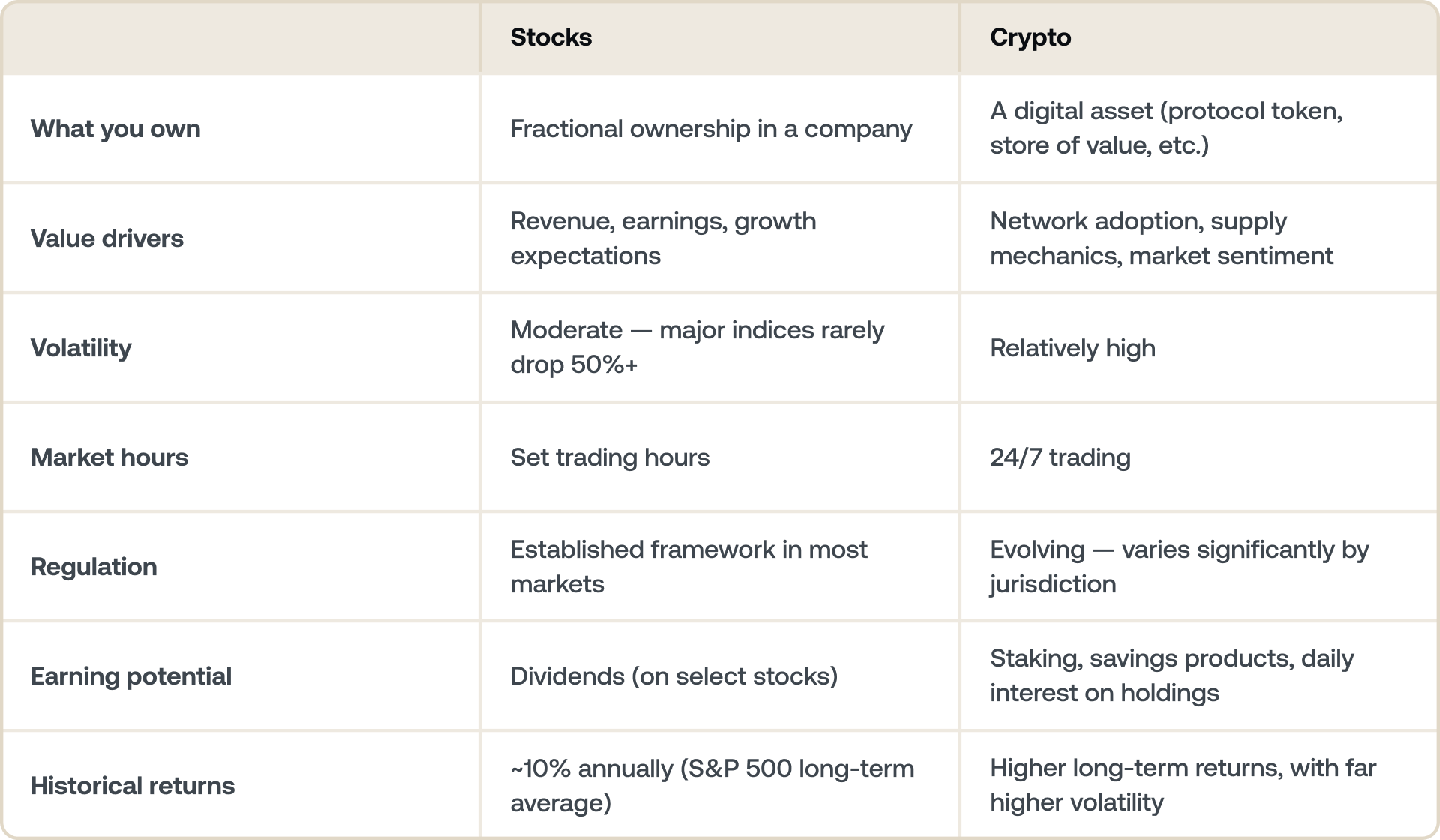
Ações são uma titularidade fracionada de uma empresa. Quando você compra uma ação da Apple ou um fundo que rastreia o S&P 500, você possui uma pequena parte de um negócio com receitas, lucros, funcionários e ativos. O valor de uma ação está, em última análise, ligado ao desempenho da empresa subjacente — lucros atuais, expectativas de crescimento futuro e a economia em geral.
Criptomoedas são ativos digitais. Bitcoin não é uma ação de uma empresa — é uma reserva de valor descentralizada com um limite fixo de oferta de 21 milhões de moedas. Ethereum é uma blockchain programável cujo valor do token está ligado à demanda pela rede. Diferentes criptomoedas têm fatores de valor completamente distintos: adoção de rede, tokenomics, utilidade e sentimento do mercado desempenham um papel que não tem analogia direta nos mercados de renda variável.
Isso importa porque os fatores que movem os preços das ações e os que movem os preços das criptomoedas costumam ser diferentes, o que é tanto uma fonte de risco quanto um argumento para ter ambos.
Como os perfis de risco se comparam
Nenhuma classe de ativo é inerentemente "segura" ou "arriscada" em termos absolutos. Mas a natureza do risco é diferente.
Volatilidade. O crypto tende a ser mais volátil do que a maioria das ações. O Bitcoin passou por várias quedas significativas desde 2011 — e se recuperou de cada uma delas. O S&P 500 historicamente apresentou perdas menores de pico a vale, com recuperações que tendem a seguir padrões mais previsíveis. As altcoins também podem sofrer quedas acentuadas durante mercados de baixa. Se o seu horizonte de tempo é mais curto ou você tem menor tolerância a quedas, isso vale a pena considerar ao tomar suas decisões.
Liquidez e horário de mercado. Os mercados de crypto operam 24 horas por dia, sete dias por semana, incluindo feriados. Os mercados de ações fecham. Para a maioria dos investidores de longo prazo, isso é irrelevante, mas significa que os preços de cripto podem se mover significativamente enquanto você dorme — e você sempre pode encerrar uma posição instantaneamente.
Regulamentação. As ações operam dentro de um arcabouço regulatório bem estabelecido. As empresas devem apresentar demonstrações auditadas; as corretoras devem cumprir requisitos de capital; os investidores têm certas proteções legais. A regulamentação de crypto ainda está evoluindo na maioria das jurisdições, o que gera incerteza — mas também cria janelas de oportunidade à medida que as regras ficam mais claras.
O que o quadro de retornos realmente mostra
Se você tivesse investido $1.000 em Bitcoin em janeiro de 2015, esse investimento valeria significativamente mais hoje — frequentemente citado como um retorno de 100x ou mais nesse período. Os mesmos $1.000 no S&P 500 valeriam aproximadamente $2.500–3.000, incluindo dividendos reinvestidos.
Essa comparação é real — mas também é a visão mais otimista possível. Os retornos do crypto dependem muito de quando você comprou e de quando você mede. Investidores que compraram no pico de 2021 e venderam em 2022 tiveram perdas significativas. Investidores que compraram durante os mercados de baixa de 2018 ou 2022 e mantiveram até a recuperação tiveram resultados excelentes.
A visão honesta: o crypto historicamente superou a maioria das principais classes de ativos no longo prazo, mas com muito mais volatilidade e períodos de queda mais severos do que as ações. Esses retornos não são gratuitos — eles vêm com a experiência de ver seu portfólio cair 60% antes de se recuperar.
Resultados passados não são um indicador confiável de resultados futuros. Todos os valores de retorno são ilustrativos e baseados em dados históricos.
Os retornos das ações são mais previsíveis ao longo de horizontes de tempo longos. O S&P 500 retornou aproximadamente 10% ao ano em média ao longo do último século, com recuperação de todas as grandes quedas. O contraponto é um potencial de alta menor.
O índice de 10% é uma média histórica de longo prazo para o mercado dos EUA. Os anos individuais variam significativamente, e o desempenho passado de um índice não garante retornos futuros.
O crypto pode fazer algo que as ações geralmente não conseguem
Uma dimensão que a maioria das comparações entre crypto e ações ignora completamente: o crypto pode gerar retorno enquanto você o mantém, além da valorização do preço.
Algumas ações pagam dividendos — uma parcela dos lucros da empresa distribuída aos acionistas. Mas a maioria do crypto, parado em uma carteira ou em uma exchange, não gera nada por padrão.
Isso muda quando você o coloca para trabalhar. Moedas de proof-of-stake como ETH podem ser colocadas em staking para ganhar recompensas em nível de protocolo.
Além de simplesmente manter, algumas plataformas de crypto permitem que você coloque ativos como Bitcoin ou stablecoins como USDC para trabalhar — ganhando juros sobre seus ativos mantidos, muitas vezes pagos diariamente.
Isso significa que uma alocação em crypto pode funcionar mais como um ativo gerador de rendimento do que puramente especulativo, dependendo de como você o gerencia. Um titular de Bitcoin que ganha um retorno sobre seus ativos mantidos enquanto aguarda a valorização do preço está em uma posição diferente de quem simplesmente mantém e espera passivamente.
O argumento para ter ambos
Crypto e ações não são mutuamente exclusivos. A maioria dos investidores que mantém crypto o trata como uma alocação dentro de um portfólio mais amplo — não como substituto para ações.
Nos primeiros anos do crypto, o Bitcoin tinha baixa correlação com os mercados de ações e se movia de forma bastante independente. Mais recentemente, especialmente durante eventos de estresse macroeconômico, crypto e ações tenderam a cair juntos — a correlação aumentou à medida que investidores institucionais começaram a ter ambos. Dito isso, a correlação não é consistente, e o crypto também pode se valorizar durante períodos de estagnação das ações.
Uma forma prática de pensar: o crypto adiciona potencial de alta assimétrico e diferentes fatores de risco a um portfólio que, de outra forma, é impulsionado pelos lucros das empresas e pelos ciclos macroeconômicos.
Frameworks comuns de alocação de portfólio entre investidores individuais variam de 5% a 20% em crypto, com o restante em ações, títulos e outros ativos. O número certo depende inteiramente da sua situação pessoal: seu horizonte de tempo, a estabilidade da sua renda e sua capacidade de aguentar uma queda significativa sem tomar decisões reativas.
Estes são frameworks gerais apenas para fins ilustrativos e não constituem aconselhamento financeiro ou de investimento. Sua alocação adequada dependerá das suas circunstâncias individuais. Consulte um assessor financeiro qualificado antes de tomar decisões de investimento.
Crypto vs. ações: visão geral
Fazendo seu crypto trabalhar mais
Se você já mantém crypto como parte do seu portfólio, a próxima pergunta é o quanto você quer gerenciá-lo ativamente.
Os produtos de ganhos da Nexo permitem que você coloque seus ativos mantidos para trabalhar.
Flexible Savings paga juros diários em mais de 40 ativos — incluindo Bitcoin, Ethereum, USDC e USDT — sem período de bloqueio.
Para titulares que desejam uma taxa mais alta e estão confortáveis em se comprometer por um período definido, Fixed-term Savings a uma taxa fixa oferecem retornos mais altos em troca de um prazo definido.
Nota: As taxas de juros são variáveis, sujeitas a alterações, e podem variar com base na sua localização, Nível de Fidelidade e ativo mantido
Conclusão
Crypto e ações são instrumentos diferentes, com perfis de risco diferentes, históricos de retorno diferentes e papéis distintos em um portfólio. A questão não é qual vence — é como cada um se encaixa nos seus objetivos, no seu horizonte de tempo e na sua capacidade de gerenciar risco.
Os investidores que tendem a ter melhores resultados com crypto são aqueles que o tratam como uma alocação deliberada, não como uma aposta: dimensionada adequadamente, compreendida com clareza e, idealmente, gerando algum retorno enquanto aguardam.
Perguntas frequentes
1. O crypto é melhor do que as ações?
Nenhum é objetivamente melhor — eles cumprem funções diferentes em um portfólio. O crypto entregou retornos de longo prazo mais altos do que a maioria dos índices de renda variável, mas com muito mais volatilidade e quedas mais profundas. As ações oferecem retornos mais previsíveis ao longo de horizontes longos. A maioria dos investidores que mantém crypto o trata como uma alocação dentro de um portfólio mais amplo, não como substituto para ações.
2. Quais são as principais diferenças entre crypto e ações?
As ações representam titularidade fracionada em uma empresa; o crypto é um ativo digital com seus próprios fatores de valor. As principais diferenças incluem: as ações têm arcabouços regulatórios estabelecidos, enquanto a regulamentação do crypto ainda está evoluindo; os mercados de ações têm horários de trading definidos, enquanto o crypto opera 24/7; o crypto é mais volátil; e os ativos mantidos em crypto podem gerar rendimento por meio de staking ou produtos de poupança, enquanto apenas algumas ações pagam dividendos.
3. Crypto e ações podem ser mantidos juntos?
Sim, e muitos investidores fazem isso. A correlação entre crypto e os mercados tradicionais aumentou nos últimos anos, mas eles ainda se movem de forma diferente o suficiente para oferecer algum benefício de diversificação. Combiná-los também gera exposição a diferentes fatores de retorno — lucros das empresas no lado das ações, e adoção de rede e dinâmicas de oferta no lado do crypto.
4. O crypto paga dividendos como as ações?
Não no sentido tradicional. Mas os ativos mantidos em crypto podem gerar rendimento por meio de staking (em redes de proof-of-stake como Ethereum) ou por meio de produtos de poupança que pagam juros diários sobre os ativos depositados.
Estes materiais são acessíveis globalmente, e a disponibilidade destas informações não constitui acesso aos serviços descritos, que podem não estar disponíveis em determinadas jurisdições. Estes materiais têm caráter meramente informativo e não constituem aconselhamento financeiro, jurídico, tributário ou de investimentos, nem oferta, solicitação, recomendação ou endosso para usar quaisquer Serviços da Nexo, e não são personalizados nem de qualquer forma adaptados para refletir objetivos de investimento, situação financeira ou necessidades específicas. Os ativos digitais estão sujeitos a um alto grau de risco, incluindo, mas não se limitando a, dinâmicas voláteis de preço de mercado, mudanças regulatórias e avanços tecnológicos. O desempenho passado de ativos digitais não é um indicador confiável de resultados futuros. Os ativos digitais não são dinheiro nem moeda de curso legal, não são respaldados pelo governo ou por um banco central, e a maioria não possui ativos subjacentes, fluxo de receita ou outra fonte de valor. O julgamento independente baseado nas circunstâncias pessoais deve ser exercido, e recomenda-se consultar um profissional qualificado antes de tomar qualquer decisão.