Markets Today - August 20, 2026
Aug 20•6 min read
.png)
Daily analysis of crypto markets and the forces shaping them, from the Nexo research desk.
Bitcoin steady amid geopolitical deadlock
Crypto markets are extending a powerful rally on Thursday, with Bitcoin trading above $71,000 after the U.S. Treasury's surprise move to double its buyback operations for long-dated bonds triggered a sharp reversal in global yields and a broad return of risk appetite. Ether trades above $2,250, and the total crypto market cap has climbed past $2.41 trillion — a level last seen in March of this year. The rally is notable for what it wasn't built on: the Federal Reserve's own July meeting minutes, released the same day, revealed a committee genuinely closer to hiking rates than its formal vote suggested. Equities managed only modest gains, with chip stocks lagging even as healthcare shares surged on a blockbuster cancer-trial result, while oil holds firm near $92 a barrel amid a still-unresolved Strait of Hormuz situation, and gold holds near $4,500 after its own sharp Wednesday advance.
Bitcoin
Bitcoin trades above $71,000, up sharply over the past 24 hours and finally clearing the $64,000–$66,500 range that has held since the start of June. The catalyst is unusual: not a dovish Fed, but a technical intervention in the bond market. The U.S. Treasury announced Wednesday it would at least double its liquidity-support buyback operations for 10-to-30-year debt, from $2 billion to $4 billion per operation starting September 9 — a move that sent the 30-year Treasury yield tumbling from a 19-year high above 5.3% to around 5.18%, and weakened the dollar to a three-month low in the process. That combination of falling yields and a softer dollar is precisely the mechanical backdrop that tends to lift risk assets, and Bitcoin responded more forcefully than almost anything else in markets.
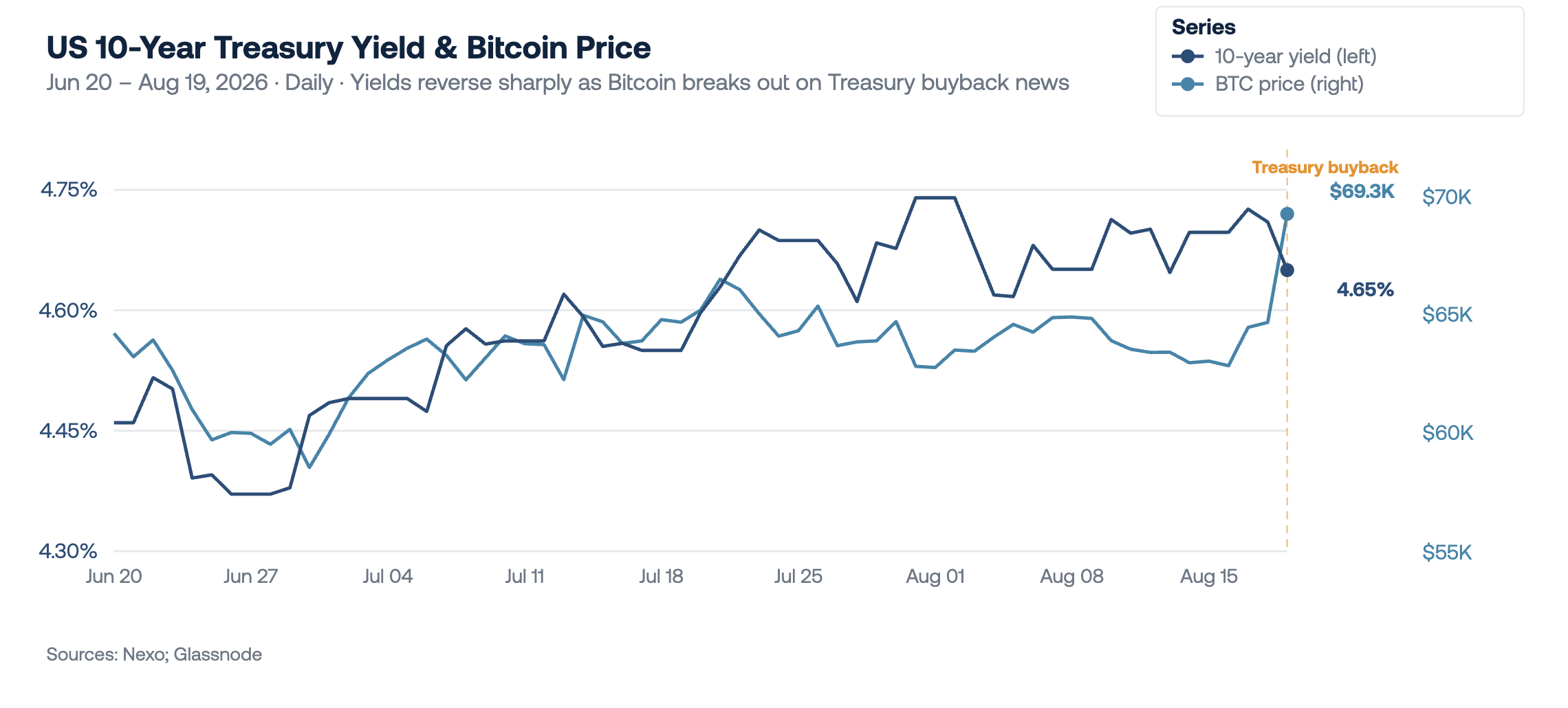
The move overran a market that had grown crowded on the wrong side. Total liquidations approached $2 billion over 24 hours, the bulk of it short positions caught out as Bitcoin broke decisively out of a range many had stopped expecting to resolve upward. Institutional flows moved just as fast: spot Bitcoin ETFs took in roughly $517 million on Wednesday, the largest single-day figure since early May, with the bulk of that demand read by market participants as longer-horizon institutional buying rather than short-term retail speculation. That is the more important story than the price spike itself — a single day of inflows confirms a breakout, but it takes a second or third day at similar scale to confirm the sustained institutional bid that has been largely absent since spring. That combination of a leverage flush and a decisively broken range effectively resets the positioning slate — the crowded bets and the overhead resistance that had defined the market for two and a half months are both gone in a single session, even if what gets built on that cleaner footing remains to be seen.
Whether this move holds will likely hinge on two things worth watching closely — whether ETF inflows extend into further sessions, and whether the 30-year yield stays capped or begins creeping back up, which some market participants think could happen within weeks rather than months.
Ethereum & Altcoins
Ether trades above $2,250, reclaiming a level it has not held since May and touching its highest price in well over a year — and notably, outperforming Bitcoin in this latest leg of the rally. XRP and Solana both advanced sharply, and Cardano and BNB posted firmer, if more modest, gains. Spot Ether ETFs took in roughly $189 million on Wednesday, their largest daily haul since October of last year — a bigger proportional jump than Bitcoin's own ETF flows, and a signal that institutional rotation into the sector is broadening rather than concentrating in Bitcoin alone. That Ether is leading rather than following in this bounce is itself a shift worth noting after a year in which it has mostly traded as Bitcoin's higher-beta shadow.
The sharpest individual mover was Hyperliquid's HYPE, which surged after President Trump publicly stated that the Commodity Futures Trading Commission is working to bring the perpetuals-trading platform onto U.S. soil in a fully compliant fashion — a direct regulatory catalyst rather than a beta move, and a reminder that idiosyncratic news is still driving some of the sharpest individual token moves even within a broad-based rally.
Macro & Institutional
The Treasury's buyback expansion is the day's central story, and its mechanics are worth understanding precisely: it is not quantitative easing, since it does not expand the Federal Reserve's balance sheet, but by shifting more government borrowing toward short-term bills while buying back longer-dated debt, it directly eases the term premium investors have been demanding. The effect was immediate and global — Japanese 10-year yields posted their steepest single-day drop since mid-July, German Bund yields pulled back from a 15-year high, and French yields eased for the first time in five sessions. Notably, the relief was confined to the long end: short-dated European yields kept climbing, with Germany's 2-year yield extending its longest rising streak in a year on expectations the European Central Bank will still need to hike next month given inflation running near 3% — a reminder that the global tightening cycle hasn't actually reversed, even where long-end yields have.
That distinction matters for reading the Fed's own minutes released the same day. Despite only three of twelve voting members formally dissenting in favor of a hike at July's meeting, the minutes revealed a considerably more hawkish committee than that vote implied — many of the Fed's nineteen total members, voting and non-voting alike, said further tightening would likely be needed if inflation fails to recede, and most saw inflation risks skewed firmly to the upside. The practical read: Wednesday's rally in risk assets happened despite a more hawkish Fed, not because of one — it was a bond-market liquidity fix, not a change in the Fed's own reaction function, and markets are still pricing meaningfully better than one-in-three odds of a September hike. That tension — a central bank leaning hawkish while the Treasury quietly does some of the market's easing for it — is arguably the more important story for where yields, and risk assets, head from here.
Energy markets remain a mild source of caution. Tanker traffic through the Strait of Hormuz remains below normal levels, and talks between Washington and Tehran have not resumed, keeping Brent firm near $92 a barrel after a run of gains — a modest inflation risk worth watching, though not one that has derailed the broader risk-on tone this week. On the regulatory side, the SEC's newly proposed "Regulation Crypto Assets" framework — offering streamlined capital-raising exemptions for crypto issuers — moved forward independently of Congress, even as President Trump used a White House meeting with industry executives to again push lawmakers to pass comprehensive crypto legislation that has stalled for months.
Looking Ahead
Today brings a data-dense session: Walmart's earnings offer the clearest near-term read on U.S. consumer health, with its advertising business increasingly relied upon to offset softer discretionary spending, while the Philadelphia Fed manufacturing index and weekly initial and continuing jobless claims round out a lighter but still relevant check on the health of the broader economy. Friday brings the S&P Global manufacturing and services PMIs for a further gauge of activity. Beyond the calendar, the more consequential questions are whether this week's ETF inflows extend into further sessions — the clearest test of whether Wednesday's move reflects a durable institutional shift or a one-off reaction to a single policy announcement — and whether the Treasury's buyback holds long yields down or the recent creep higher resumes within weeks. For Bitcoin, the test is straightforward: a second or third consecutive day of strong ETF demand would begin to validate today's breakout as a genuine shift rather than another false start, while a quick reversal would put the $64,000 level back in play as support.
Author: Iliya Kalchev, Analyst at Nexo’s Dispatch
This material is produced by Nexo for informational purposes only and does not constitute financial, investment, legal, or tax advice, or a recommendation to transact in any digital asset. Views are the author's as of the date of publication and may change without notice. Information is from sources believed reliable, but Nexo makes no warranty as to its accuracy and accepts no liability for any loss arising from reliance on this material.