Bitcoin and gold: It's complicated and about to be tested
Sep 09•6 min read
In this patch of your weekly Dispatch:
- The BTC-gold correlation
- G20 crypto regulation
- CPI before FOMC
Market cast
BTC: Momentum cools as weekly resistance holds
Bitcoin's weekly chart remains capped below the 50-period SMA, which continues to prove a strong resistance on the way up. The RSI, a momentum oscillator, is neutral, and the Stochastic, another momentum oscillator, sits in overbought territory, with the coming weeks likely to show whether that momentum is starting to fade. The MACD, a trend and momentum indicator, keeps its histogram deep in positive territory.
The daily chart has entered a brief consolidation, trading range-bound with price sitting on the middle Bollinger Band, a volatility-based indicator, which now acts as dynamic support. Both the RSI and Stochastic are falling, and the MACD histogram has slipped slightly below the zero line, a sign momentum is turning more cautious on this timeframe.
Key levels to watch: on the downside, immediate support sits around $77,000, with the next level near $75,000 — the daily middle Bollinger Band also lends dynamic support in this zone. To the upside, resistance comes in around $80,000, followed by $82,000, with the weekly 50-period SMA also acting as dynamic resistance along the way.
The big idea
Is Bitcoin becoming the higher-beta gold trade?
Bitcoin is beginning to trade on the forces that move gold – a $40 trillion debt load, dollar weakness, currency debasement – without inheriting gold's sensitivity to interest rates.If that holds, this dynamic gives market watchers two lenses on the same macro thesis: gold as the slower-moving anchor, Bitcoin as the higher-beta expression of it.
The upside is a function of scale. Gold's market is worth roughly $31 trillion; Bitcoin's is closer to $1.6 trillion. A modest shift in how investors divide their scarce-asset exposure lands far more forcefully on the smaller asset. August offered the clearest evidence yet, and every catalyst behind it was domestic. Washington tests the thesis next week.
The fiscal arithmetic that started it: Federal debt crossed $40 trillion in August, five months after passing $39 trillion. Net interest reached $628 billion in the first seven months of FY2026, more than the $588 billion spent on Medicare and more than defense. As long-dated yields climbed, with the 30-year above 5.2%, Treasury Secretary Scott Bessent stepped up purchases of longer-dated debt. Markets read that as a signal about how a $40 trillion obligation eventually gets carried. The dollar weakened. Gold added roughly 5% over the following week; Bitcoin added 22.4%, its largest weekly gain since March 2024, as US equities fell.
The BTC-Gold correlation says something specific: Bitcoin's 90-day correlation with gold sits near 0.59, its highest since 2020, while its correlation with the Nasdaq 100 has dropped to roughly 0.33 from above 0.60 in January. The more telling figure: gold's 90-day correlation with the US 10-year yield is -0.41, while Bitcoin's is barely negative at all. For an asset that has spent most of its life trading like duration-sensitive technology exposure, that is the consequential finding. BlackRock's Robbie Mitchnick has framed the same rally as Bitcoin's risk-off narrative reasserting itself – a fiscal hedge rather than risk appetite.
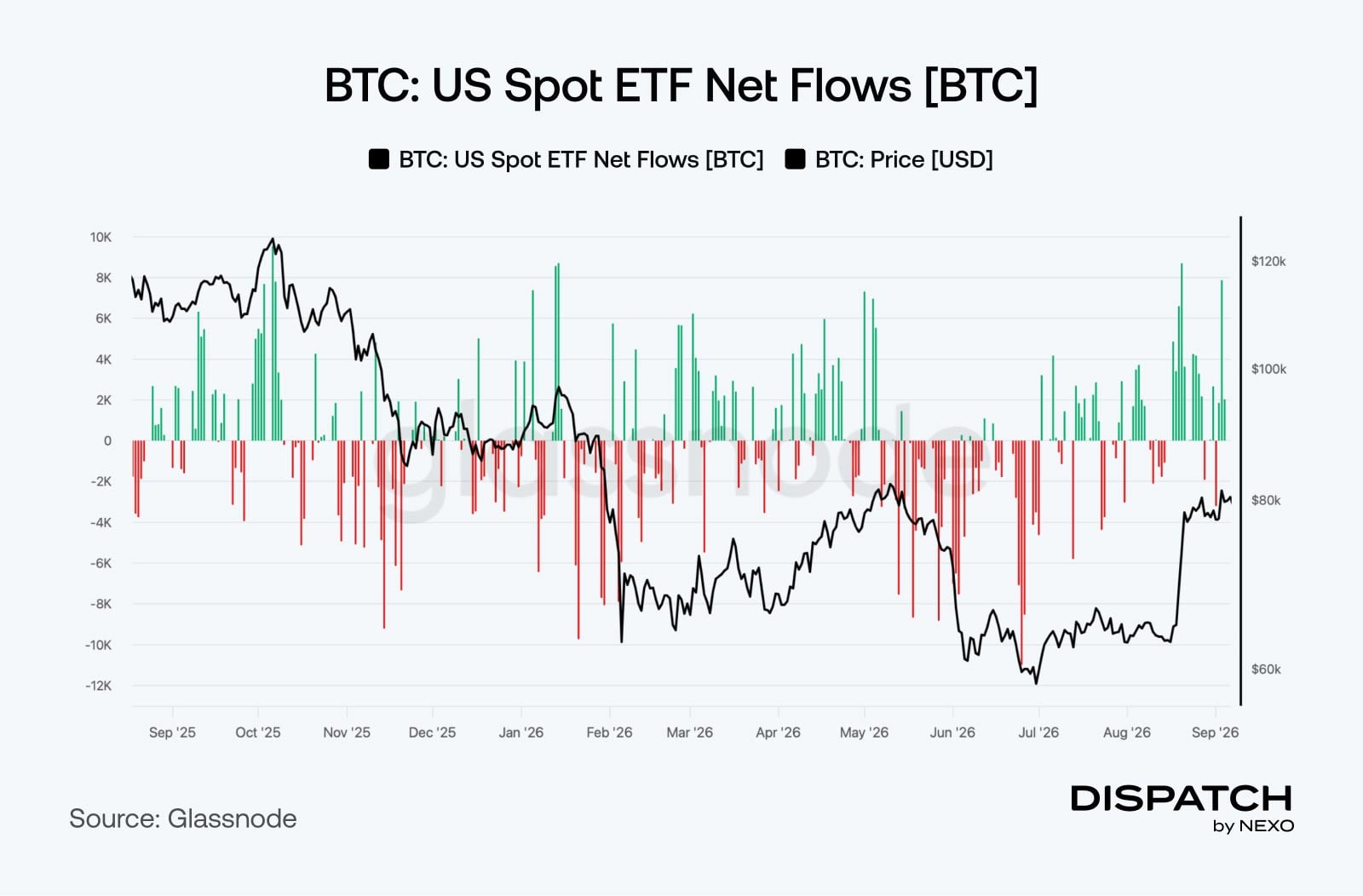
The signal: US spot Bitcoin ETFs took in roughly $3.8 billion over three weeks, their strongest stretch of 2026, including a single day of $731 million on September 3, the largest since January. Two qualifications: year-to-date flows remain around $1 billion negative after heavy first-half redemptions, and BlackRock's IBIT absorbed close to 70% of last week's total.
Bitcoin's 50-day moving average crossed above its 200-day this week, the same golden cross Ether produced recently. Only three of twelve prior instances held for a full year. Meanwhile $83,000 has held as resistance, and holders moved into net selling for the first time since early June.
Washington decides on September 16: Thursday's inflation data determines whether a rate increase stays live; hike odds have held near 58% since Warsh's Jackson Hole address. Tuesday, September 15, at 2:15pm ET, the Senate votes on cloture on the motion to proceed to the CLARITY Act – Republicans hold 53 seats, so at least seven Democratic or independent votes are needed for 60, and Polymarket puts 2026 enactment near 18%. Wednesday, September 16, at 2:00pm ET, the Fed announces, with a fresh dot plot.
September 16 is the clearer test. A hard asset less tethered to yields than gold should, in theory, handle a rate increase differently than a high-beta tech trade would — Wednesday's reaction should offer an early read on whether that's holding up.
TradFi trends
G20 sees crypto rules as a path to growth
Global regulators don't usually rush to bless a new asset class. This time, they at least agreed to try.
Finance ministers and central bank governors from the G20 pledged to build clearer rules for digital assets, calling the innovation "broad-based economic growth" potential worth supporting rather than blocking. The statement, issued after a two-day meeting in Asheville, North Carolina, commits members to regulatory frameworks that preserve financial stability while establishing "clear pathways" for digital asset innovation. Officials also flagged upcoming Financial Stability Board findings on the cross-border risks of global stablecoin arrangements, and reaffirmed a push to expand operating hours for large-value payment systems. Several G20 members – including the US, EU, and Japan – already have frameworks in place; this is a commitment for the rest of the group to catch up, not a new policy itself.
Macroeconomic roundup
The macro data stack before the Fed
Last week's payrolls report blew past forecasts – 162,000 against expectations near 53,000, pointing to an economy strong enough for the Fed to keep holding the line on inflation, which is why bitcoin fell from $81,300 to $78,700 within hours. Yet September hike odds sit at 58%, almost exactly where they stood before the data landed. This week's inflation prints, not last week's jobs number, are what actually decide the Fed's next move.
10-Year Note Auction (Sept 9): A direct test of demand for long-dated government debt. Weak demand feeds the fiscal-stress narrative in this issue's lead; strong demand eases it.
Producer Price Index & Jobless Claims (Sept 10): The last data before Friday's headline release.
Consumer Price Index (Sept 11): The last inflation print before the Fed meets September 16. Hot pushes hike odds toward two-thirds; soft holds the current pricing.
CME FedWatch puts September hike odds at 58%, barely moved since before last week's jobs report. Friday's CPI is what actually changes that, and helps decide whether bitcoin's rally alongside gold is a coincidence or a pattern.
The week's most interesting data story
Reversal of the ETF money
US spot bitcoin ETFs just posted their strongest stretch of the year: $986.9 million last week, a third straight week of inflows, building on a $3.52 billion August that was the category's best month since September 2025. The single busiest day, $730.9 million on September 3, was the largest since mid-January. Turnover is quieter, though — daily trading volume has settled near $3 billion, below the activity that accompanied earlier expansionary phases. Worth watching rather than worrying about: inflows this concentrated in a handful of headline-driven days have, at times, marked short-lived peaks rather than sustained trends.
The numbers
The week’s most interesting numbers
$218.4 million – Net inflows into US spot ether ETFs last week, a third straight positive week, part of the category's best August since 2025.
9% – Dogecoin's seven-day gain as of Tuesday, one of the strongest weekly moves among major crypto assets even as bitcoin cooled.
$81,700 – Bitcoin's intraday high last Thursday, reached after Fed Governor Waller signaled he's open to holding rates steady if inflation keeps cooling.
4.9% – Share of Ethereum's supply now held by Bitmine, after adding 28,086 ETH last week to reach 5,929,198 tokens worth $14.8 billion.
Hot topic
What the community is discussing
Volatility – another role of Bitcoin HODLers.
ETH’s own drivers emerge.
Will this affect Bitcoin?
Dispatch is a weekly publication by Nexo, designed to help you navigate and take action in the evolving world of digital assets. To share your Dispatch suggestions and comments, email us at [email protected].