What is crypto lending, and how does it work?
Nov 28, 2025•9 min read
Updated: October 26, 2026
Crypto lending is a way to put your digital assets to work through a lending arrangement. It has two sides: you can lend your crypto and earn interest on it, or you can borrow against your crypto, using it as collateral to access cash or stablecoins without selling it.
Both work like their traditional finance equivalents, a savings account and a secured loan, but with crypto as the asset. Here's how each side works, the main types of platforms, and the risks to understand before you start.
The two sides of crypto lending
Lending (earning): You add crypto to a platform, and it pays you interest over time. The platform puts those assets to work, for example, by lending them to borrowers who pledge collateral. Rates vary by asset, platform, and term.
Borrowing: You pledge crypto as collateral, and the platform gives you access to cash or stablecoins up to a limit based on its value. You keep your crypto and pay interest only on what you borrow.
Why do people care about crypto lending in 2026?
Crypto lending appeals to people who believe in their digital assets long term but also want financial flexibility.
Selling Bitcoin every time you need cash breaks your strategy. It ends your exposure to future price growth, may trigger taxable events depending on where you live, and disrupts the long-term plan you’ve built.
Crypto lending offers a different approach: unlock liquidity without selling what you own.
It mirrors a strategy wealthy investors have always used — leveraging the value of their assets rather than liquidating them.
How does borrowing work?
Borrowing against crypto follows a clear flow:
- You add digital assets such as Bitcoin as security.
- The platform evaluates their value and offers you access to a smaller amount of credit. For example: add $100,000 in Bitcoin → access $50,000 in credit.
- Your “loan-to-value” (LTV) ratio shows how much you’ve borrowed relative to the value of the crypto you added. In that case, your LTV is 50%.
If the market stays stable or rises, your position becomes safer. If the market falls, your LTV goes up, meaning you’re using a larger portion of your security to support the same amount of credit.
Most platforms notify you in advance if your LTV approaches a limit. At that point, you can either add more crypto to increase your collateral or repay part of your outstanding balance.
If you don’t act and the market continues falling, the platform may automatically use a small portion of your crypto to repay part of the credit. This keeps the arrangement financially balanced.
For a step-by-step example of how LTV changes when Bitcoin rises or falls, and how to stay out of margin call territory, see our guide to how Bitcoin-backed loans work.
How do repayment and interest actually work?
If you’re thinking about borrowing against your crypto, two questions usually come up right away:
“Do I have to pay this back on a fixed schedule?” and “How does the interest get charged?”
Here’s the simplest way to think about it.
1. Repayment is usually flexible
With crypto-backed credit lines, you’re not locked into a traditional monthly payment schedule. Platforms like Nexo let you repay:
- Whenever you want
- In any amount
- At your own pace
There’s no “missed payment” in the traditional sense because there’s no set due date. What matters is that your credit balance stays supported by enough collateral.
Think of it like borrowing against your own asset instead of taking a bank loan — you’re in control of the timing.
This is especially helpful if your income isn’t perfectly regular or if you’re using the credit line as part of a longer-term strategy.
2. Interest accrues only on what you actually borrow
Another common question:
“If I secure the credit line with my crypto, do I pay interest on the whole collateral?”
No. You only pay interest on the amount you actually withdraw, not the total value of the crypto you add.
Example:
- You add 1 BTC worth $100,000.
- You borrow $50,000.
You only pay interest on $50,000 — not on the full $100,000.
The interest accrues daily, making it easy to track. If you repay part of the balance, the interest owed naturally decreases.
3. You can repay in multiple ways
People also ask:
“Do I have to repay in the same currency I borrowed?”
Platforms like Nexo give you options:
- Repay in the currency you borrowed (like stablecoins)
- Repay using other crypto you hold
- Repay using funds from your bank account
That flexibility is part of why crypto lending has grown — it adapts to how people already manage their digital assets.
In both traditional and crypto lending, your asset isn’t sold when you borrow against it — it’s held as security while you access funds. The interest you pay is simply the cost of using that liquidity without giving up the asset itself.
And because crypto markets operate around the clock, you can adjust your collateral, repay early, or track your position in real time, giving you more visibility and flexibility over your borrowing than many people are used to.
For many long-term holders, that tradeoff is worth it. They keep their exposure to future price growth, stay invested, and still access funds when they need them.
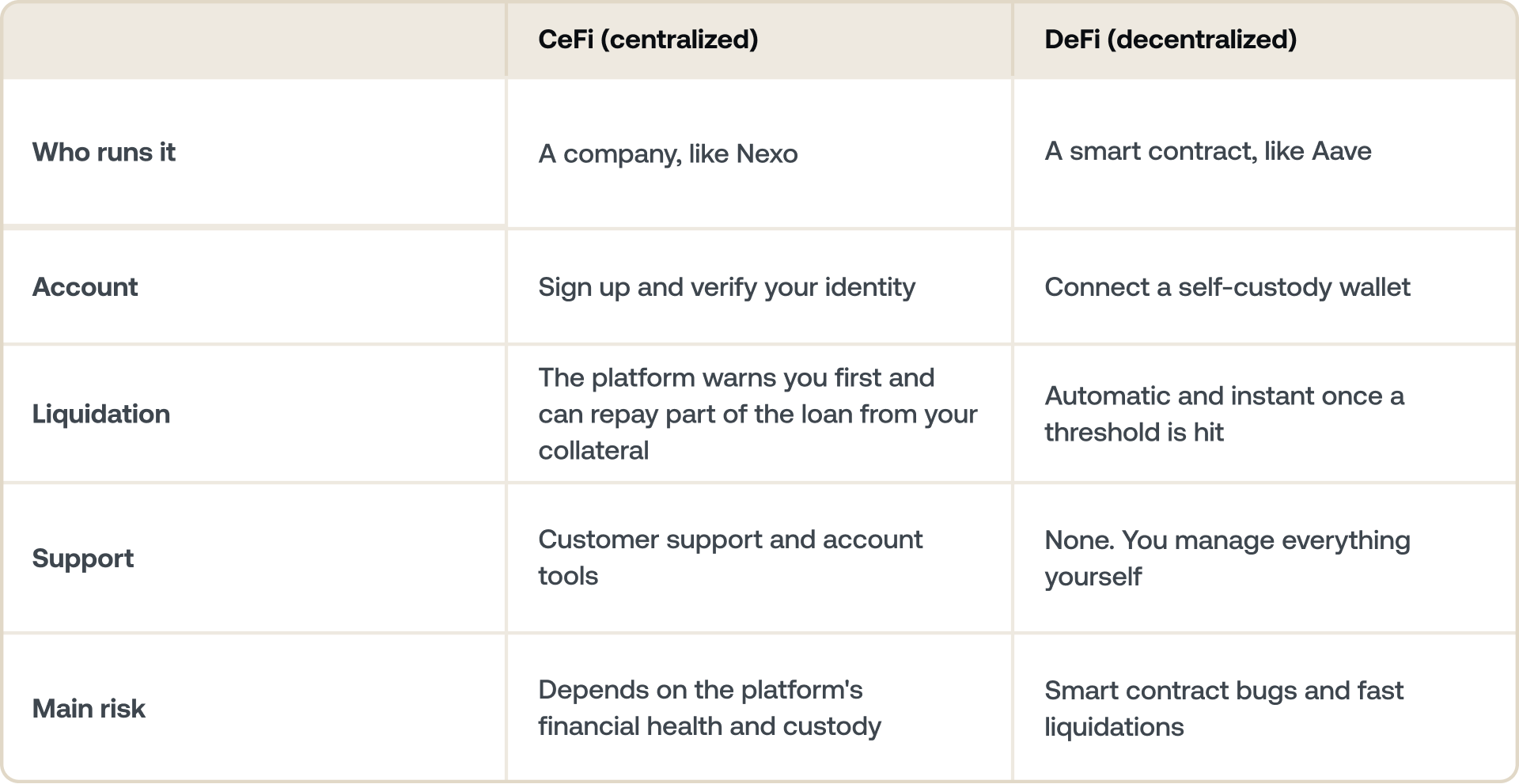
CeFi vs DeFi lending
Crypto lending happens on two kinds of platforms:
Why do people borrow instead of selling?
Borrowing against crypto is ultimately a wealth choice, not a speculative one. The most common reasons include:
1. Staying invested long-term
Selling Bitcoin means giving up future upside. Borrowing keeps you exposed to potential growth.
2. Access to liquidity
For big purchases, cash flow, or new investments — without selling core assets.
3. Flexible repayment
Many platforms, including Nexo, let you repay at your own pace. No fixed schedule unless you choose one.
4. Avoiding a taxable event
Selling crypto may create a taxable event in some jurisdictions. Borrowing allows long-term holders to access liquidity without immediately selling their assets, which can be useful for strategic planning.
Why crypto lending feels more mature in 2026?
Several shifts made crypto lending more structured and predictable:
- Clearer frameworks in major financial regions
- Stronger custody standards
- Better transparency around risk
- More tools for users to track and manage LTV
- A larger base of long-term holders
- Rising institutional interest in using crypto as productive collateral
Crypto lending is becoming part of modern wealth management.
A newer option: Zero-interest Credit
Standard crypto-backed loans charge interest from the moment you borrow. But a newer structure works differently—and it's worth understanding the trade-off.
With zero-interest credit, you borrow at 0% interest rate with no ongoing interest charges. In exchange, your loan comes with two predefined price boundaries on your collateral: a minimum repayment price and a maximum repayment price.
Here's what those mean in practice:
- Minimum Repayment Price — the floor below which your position cannot be liquidated mid-term. It protects you from the sudden margin calls that standard loans carry during sharp market drops.
- Maximum Repayment Price — the ceiling at which you can lock in gains. If your collateral rises above this level, you exit at that price rather than capturing unlimited upside.
Between the two, your credit settles at the market price on the Repayment Date. You can repay in stablecoins and keep your collateral, or renew for another term. There are no margin calls or liquidations while the credit is active. Terms run from 5 days to 12 months, with BTC, ETH, SOL, or XRP as collateral.
So the tradeoff is straightforward: you give up some price upside in exchange for zero interest costs and predictable, liquidation-free terms.
When it makes sense:
- You want liquidity now, but expect your crypto to stay within a defined price range by repayment.
- You're managing the timing of a large purchase or taxable event and want a clear repayment structure from day one.
- You'd rather have certainty over costs than chase maximum upside.
When a standard credit line may suit you better:
- You want full exposure to price growth with no ceiling.
- You prefer a flexible, open-ended borrowing arrangement with no fixed term.
- Your priority is the lowest possible rate at low LTV rather than a fixed-term structure.
Neither approach is inherently better. They serve different goals — one prioritizes cost certainty, the other prioritizes flexibility and uncapped upside.
Nexo offers both a standard crypto credit line and a structured Zero-interest Credit — each suited to different borrowing goals. Compare them and see which fits your situation.
Where Nexo fits.
Nexo, ranked the #3 CeFi lender by total loan volume in Galaxy Research's Q1 2026 report, offers a crypto-backed credit line that lets you use your digital assets as collateral to access funds. Instead of selling your Bitcoin, Ethereum, or other assets, you add them to your account, and Nexo instantly calculates how much credit you can unlock based on their current value.
One of the platform’s strengths is that you can borrow against your entire crypto portfolio.
You can combine BTC, ETH, and more than 90 supported assets under a single Credit Line, allowing you to access liquidity based on the collective value of your holdings — not just one asset. This helps users make the most of diversified portfolios, rather than relying on a single asset as security.
Approval is automatic because your crypto serves as the security. There are no credit checks, and no fixed repayment schedule — you repay whenever it works for you, in part or in full, as long as your credit line remains supported by enough collateral.
Interest rates start from 1.9% annually, depending on your Loyalty Tier and the loan-to-value (LTV) ratio you choose to maintain.
Nexo also provides tools to track your LTV in real time, set alerts, and see how market movements affect your position.
If prices shift, you can add more collateral, repay part of your balance, or let the system automatically settle a portion using the crypto you’ve added.
It’s a flexible, structured way to access liquidity while staying invested — designed for people who want to manage their digital assets with the same clarity and control they expect from traditional finance.
The takeaway
Crypto lending goes beyond a fancy feature. It’s a mindset.
It’s about using what you own strategically, whether you want liquidity, daily rewards, or simply a way to make your long-term holdings work for you.
It blends traditional finance logic with the flexibility of digital assets: a system built around opportunity, responsibility, and long-term thinking.
In 2025, that’s what modern crypto wealth management looks like.
Frequently asked questions
1. Is crypto lending safe?
It carries real risks: price drops can trigger margin calls or automatic repayment. Borrowing at a low LTV and choosing an established platform with clear custody practices reduces those risks, but doesn't remove them.
2. What happens if you don't pay back a crypto loan?
On most crypto credit lines, there's no fixed due date, so you don't "miss" a payment. Interest keeps accruing, though, which raises your LTV over time. If your LTV reaches the platform's limit, part of your collateral is used to repay the loan.
3. What's the difference between crypto lending and a crypto loan?
"Crypto lending" is the whole market, both lending to earn and borrowing. A crypto loan is the borrowing side: you pledge crypto as collateral and receive cash or stablecoins.
4. Is crypto lending worth it?
It can be if you hold crypto long term and want to access cash without selling, or want your holdings to earn interest. It's a poor fit if you'd struggle to add collateral during a sharp drop or need guaranteed returns.
These materials are accessible globally, and the availability of this information does not constitute access to the services described, which services may not be available in certain jurisdictions. These materials are for general information purposes only and not intended as financial, legal, tax, or investment advice, offer, solicitation, recommendation, or endorsement to use any of the Nexo Services and are not personalized, or in any way tailored to reflect particular investment objectives, financial situation, or needs. Digital assets are subject to a high degree of risk, including but not limited to volatile market price dynamics, regulatory changes, and technological advancements. The past performance of digital assets is not a reliable indicator of future results. Digital assets are not money or legal tender, are not backed by the government or by a central bank, and most do not have any underlying assets, revenue stream, or other source of value. Independent judgment based on personal circumstances should be exercised, and consultation with a qualified professional is recommended before making any decision.