What to do in each phase of the Bitcoin cycle
May 26•9 min read

The short version
The Bitcoin cycle moves through four phases: accumulation, markup (bull run), distribution, and markdown (bear market). Each phase calls for a different approach — from buying steadily when prices are low, to earning on your holdings when the market is quiet, to borrowing against your crypto instead of selling at the peak. Knowing which phase you're in doesn't guarantee perfect timing. It does help you make more deliberate decisions.
You've probably read about the Bitcoin cycle. The halving, the four-year pattern, the bull and bear phases. It makes sense in theory.
But theory doesn't tell you what to actually do. When to buy more. When to hold steady. What to do with your holdings when the market turns.
That's what this guide covers — one practical decision for each phase of the cycle. Not predictions, because nobody has those. Just a clearer framework for acting with intention rather than reaction.
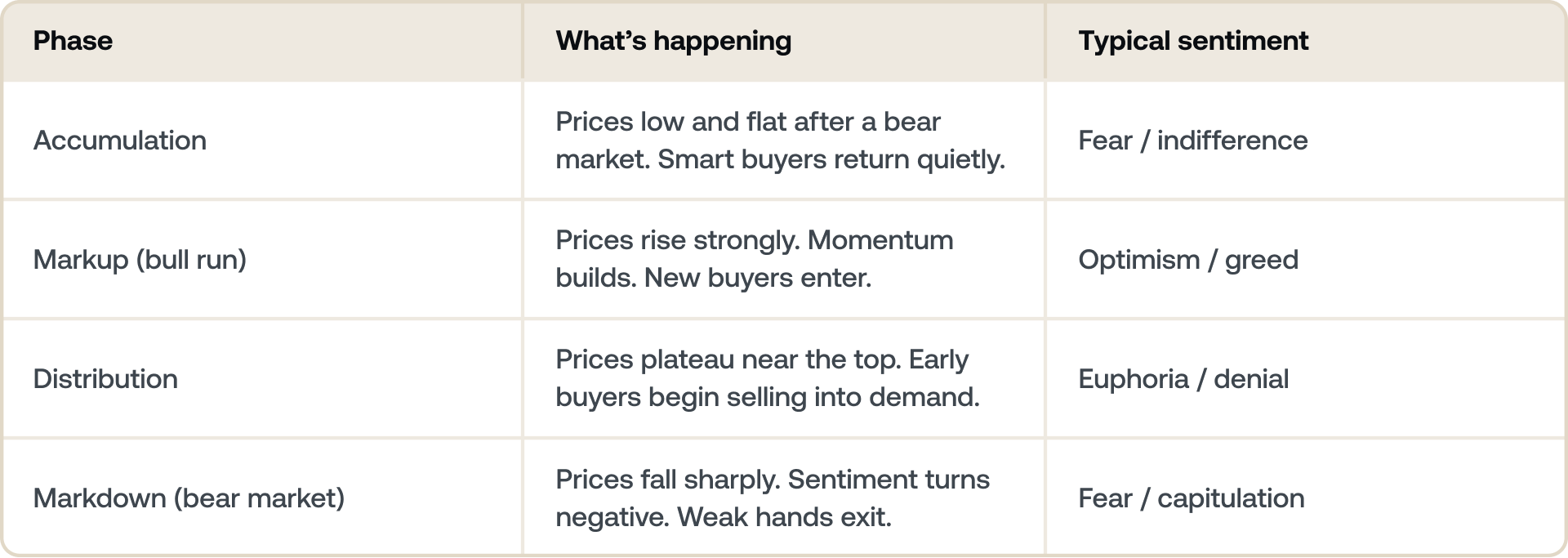
The four phases at a glance

Each phase feeds into the next. The bear market creates the conditions for accumulation. Accumulation sets the foundation for the markup. And so on.
Phase 1: Accumulation — the quiet phase most people miss
Accumulation follows the bottom of a bear market. Prices have stopped falling and are trading in a flat, often boring range. Most retail investors have left. The news cycle is quiet or negative. It doesn't feel like anything is happening.
That's exactly why it matters.
Historically, this is the phase where long-term holders and institutional buyers build positions — not because they've called the bottom perfectly, but because prices are at or near cycle lows and the risk-reward balance has shifted.
The 2019–2020 period is a well-documented example. Bitcoin spent months consolidating well below its 2017 peak while most of the market ignored it. That quiet phase preceded the 2020–2021 bull run.
What to do during accumulation
The key is consistency, not precision. Nobody times the exact bottom. The goal is to build exposure gradually while prices are low.
- Dollar-cost averaging (DCA) — buying a fixed amount at regular intervals — removes the pressure of timing. You buy some at the current price, and if it drops further, your next purchase averages your cost down.
- Prioritize assets you'd hold through a full cycle. Accumulation isn't the time for speculative bets on unknown tokens — it's the time to build positions in assets you understand.
- Earning interest on existing holdings keeps your crypto working even when the market isn't moving. If you're holding Bitcoin or stablecoins through this phase, they can generate returns while you wait.
Nexo's Flexible Savings let you earn daily interest on Bitcoin, Ethereum, USDC, and other assets — with no lock-up period. It's one way to keep holdings productive during flat or slow markets.
What to avoid: selling out of boredom or frustration. The accumulation phase looks unimpressive in real time. That's the point.
Phase 2: Markup (bull run) — when momentum builds
The markup phase begins when prices break out of the accumulation range and start climbing with conviction. Volume increases. Media coverage picks up. New participants enter the market for the first time.
This is the phase most people associate with crypto — the headlines, the all-time highs, the rapid price gains. It typically starts quietly and becomes loud as it matures.
Bitcoin usually leads the markup. As it rises, capital tends to rotate into Ethereum and then into smaller altcoins later in the cycle — a pattern often called altcoin season.
What to do during the markup
If you accumulated during the previous phase, this is where that patience starts to pay off. The decisions here are less about buying aggressively and more about managing what you've built.
- Avoid selling too early. The markup phase has historically lasted 12–18 months. Exiting at the first signs of a rally often means missing the majority of the move.
- Rebalance gradually, not all at once. If one asset in your portfolio grows much faster than others, trimming it slightly and redistributing keeps your risk balanced without a full exit.
- Consider borrowing against holdings rather than selling. If you need liquidity — for an expense, an opportunity, or just cash flow — a crypto-backed credit line lets you access funds without selling your Bitcoin or Ethereum. Your assets stay in place and can continue to benefit if prices keep rising.
Nexo's Credit Line lets you borrow against Bitcoin, Ethereum, XRP, Solana, and other assets, with rates from . You keep your crypto exposure while unlocking liquidity.
What to avoid: adding maximum leverage or chasing recent performers late in the rally. The markup phase eventually transitions into distribution — and that transition is rarely announced clearly.
Phase 3: Distribution — the most deceptive phase
Distribution is the hardest phase to identify in real time. Prices are still high — sometimes making new all-time highs — but the underlying market structure is changing. Early buyers and large holders start selling into the demand created by late arrivals.
Sentiment is often at its most euphoric during this phase. Headlines are bullish. New investors are entering in large numbers. It feels like the market can only go up. That's precisely when experienced participants are distributing.
One technical signal worth watching: increased volatility at high price levels without meaningful new highs. When the market is swinging sharply but not making progress upward, it often indicates that buyers and sellers are at equilibrium — a classic distribution pattern.
What to do during distribution
The primary goal here is protecting what you've built, not increasing the final percentage of gains.
- Take some profits in stages, not all at once. Selling everything at what you think is the top is extremely difficult to execute correctly. Selling a portion at regular intervals as prices stay elevated is more realistic.
- Reduce leverage if you're using it. The distribution phase often precedes sharp drawdowns. High leverage going into a markdown phase can turn a manageable loss into a significant one.
- Move a portion into stablecoins. This doesn't mean exiting crypto entirely — it means converting some gains into a stable store of value you can redeploy during the next accumulation phase.
What to avoid: assuming the bull market will continue indefinitely because sentiment is high. Distribution is characterized by high confidence and deteriorating fundamentals — a combination that consistently catches late buyers off-guard.
Phase 4: Markdown (bear market) — where patient holders are built
The markdown phase is the bear market: a sustained decline that often gives back 70–85% of the gains from the markup phase. It's psychologically the hardest part of the cycle. Prices fall further than most expect, and the declines can be slow and grinding rather than fast and clean.
Historically, Bitcoin has reached new all-time highs in subsequent cycles even after these deep corrections. But that historical pattern is not a guarantee — it's context.
The markdown phase is also where the next cycle's foundation gets built. As prices fall and sentiment deteriorates, long-term buyers begin quietly accumulating again. That's how the cycle resets.
What to do during the markdown
The most important thing during a bear market is staying in a position to participate in the next cycle. That means managing risk, not panicking, and using the phase constructively.
- Don't sell into maximum fear. The markdown phase ends when selling pressure exhausts itself — usually when the last group of holders capitulates. Selling at or near the bottom locks in losses at the worst possible time.
- Earn interest on holdings you're not planning to sell. If you're holding Bitcoin or stablecoins through the bear market, savings products keep those assets productive even while prices are down.
- Use the bear market to buy gradually. This is accumulation in practice — not a single large purchase at what you think is the bottom, but a steady build over months as prices stabilize.
Nexo's Fixed-term Savings offer higher interest rates in exchange for committing your crypto for a set period (1, 3, or 12 months). For holders who plan to hold through a bear market anyway, Fixed-term Savings turns idle assets into productive ones.
What to avoid: over-trading in an attempt to catch every dip and recovery. Bear markets have strong relief rallies that often look like the start of a new bull phase. Most are not.
What the cycle doesn't tell you
The four-phase model is a framework, not a clock. Phases stretch and compress. Transitions are messy in real time and only obvious in hindsight. The 2022 bear market lasted longer than most cycle models predicted. The 2020–2021 markup moved faster than historical averages.
Several factors can alter the cycle's behavior:
- Macroeconomic conditions — interest rates, global liquidity, and inflation affect crypto alongside every other asset class.
- Institutional participation — as more large players hold Bitcoin, the sharp retail-driven swings of earlier cycles may moderate.
- Regulatory developments — policy shifts can accelerate or dampen any phase.
The cycle is a useful lens. It helps you understand why the market is behaving the way it is and gives you a framework for decisions. It doesn't remove risk or guarantee outcomes. Every decision should be made with your own financial situation and risk tolerance in mind.
Go deeper
- New to the Bitcoin cycle? Start with What is the Bitcoin cycle for a plain-language overview of how it works and why it exists.
- For a closer look at the halving and the "is it still relevant?" debate, read Bitcoin 4-year cycle explained.
- If you're thinking about portfolio positioning across cycles, how to diversify a crypto portfolio covers the broader strategy.
Frequently asked questions
1. What are the four phases of the Bitcoin cycle?
The four phases are accumulation, markup (bull run), distribution, and markdown (bear market). Each follows the previous: the bear market creates the conditions for accumulation, accumulation sets the foundation for the markup, and so on.
2. What is the accumulation phase in crypto?
The accumulation phase happens after a bear market bottom. Prices are low and flat, sentiment is poor, and most retail investors have left the market. Long-term buyers and institutions tend to build positions during this phase, which is why it often precedes strong bull runs.
3. What should I do during a crypto bear market?
Avoid panic selling, keep existing holdings working through savings products, and consider buying gradually as prices stabilize. The bear market is where the next cycle's foundation is built — selling into maximum fear tends to lock in losses near the bottom.
4. When should I buy Bitcoin in the cycle?
Accumulation-phase buying — buying gradually at low prices using strategies like dollar-cost averaging — has historically offered the best entry points. The difficulty is that accumulation feels uneventful in real time. There's no announcement that it's happening.
5. What is the distribution phase in crypto?
Distribution is the phase near the cycle's top where early buyers begin selling into the demand created by late arrivals. Prices can still be rising or making new highs, but the underlying momentum is weakening. It's the hardest phase to identify in real time.
6. How long does each Bitcoin cycle phase last?
Phase lengths vary significantly between cycles. Historically, the markup phase has lasted 12–18 months, the distribution phase can be weeks to months, and the markdown phase has ranged from 12 to 24 months. The accumulation phase before a halving typically spans 12–18 months. These are averages, not fixed timelines.
7. Can I earn on my crypto during a bear market?
Yes. Savings products let you earn interest on holdings like Bitcoin, Ethereum, and stablecoins regardless of market conditions. For holders who plan to hold through a downturn anyway, earning on those assets keeps them productive rather than idle.
These materials are accessible globally, and the availability of this information does not constitute access to the services described, which services may not be available in certain jurisdictions. These materials are for general information purposes only and not intended as financial, legal, tax, or investment advice, offer, solicitation, recommendation, or endorsement to use any of the Nexo Services and are not personalized, or in any way tailored to reflect particular investment objectives, financial situation or needs. Digital assets are subject to a high degree of risk, including but not limited to volatile market price dynamics, regulatory changes, and technological advancements. The past performance of digital assets is not a reliable indicator of future results. Digital assets are not money or legal tender, are not backed by the government or by a central bank, and most do not have any underlying assets, revenue stream, or another source of value. Independent judgment based on personal circumstances should be exercised, and consultation with a qualified professional is recommended before making any decision.