Rising yields: How Bitcoin holds up
Oct 06•8 min read

In this patch of your weekly Dispatch:
- US Bonds vs BTC
- ETH’s 70% quarter run
- Nvidia’s $5.7 trillion market cap
Market cast
BTC: Quiet near highs and waiting for direction
On the weekly chart, Bitcoin’s price continues to hover near the upper Bollinger Band, a volatility-based indicator, and it is too early to say whether momentum has faded. The RSI, a momentum oscillator, is elevated but not yet in overbought territory, while the Stochastic, another momentum oscillator, has moved above the 80 threshold. The MACD, a trend and momentum indicator, remains deep in positive territory.
On the daily chart, price action looks range-bound. Both the RSI and the Stochastic are at high levels but neutral, while the MACD histogram sits just below the zero line.
Key levels to watch: on the downside, immediate support sits around $85,000, with the next level near $83,000. To the upside, resistance comes in around $87,000, followed by the round $90,000 level, with the weekly upper Bollinger Band also acting as dynamic resistance along the way.
The big idea
Bitcoin and the bond market dynamics
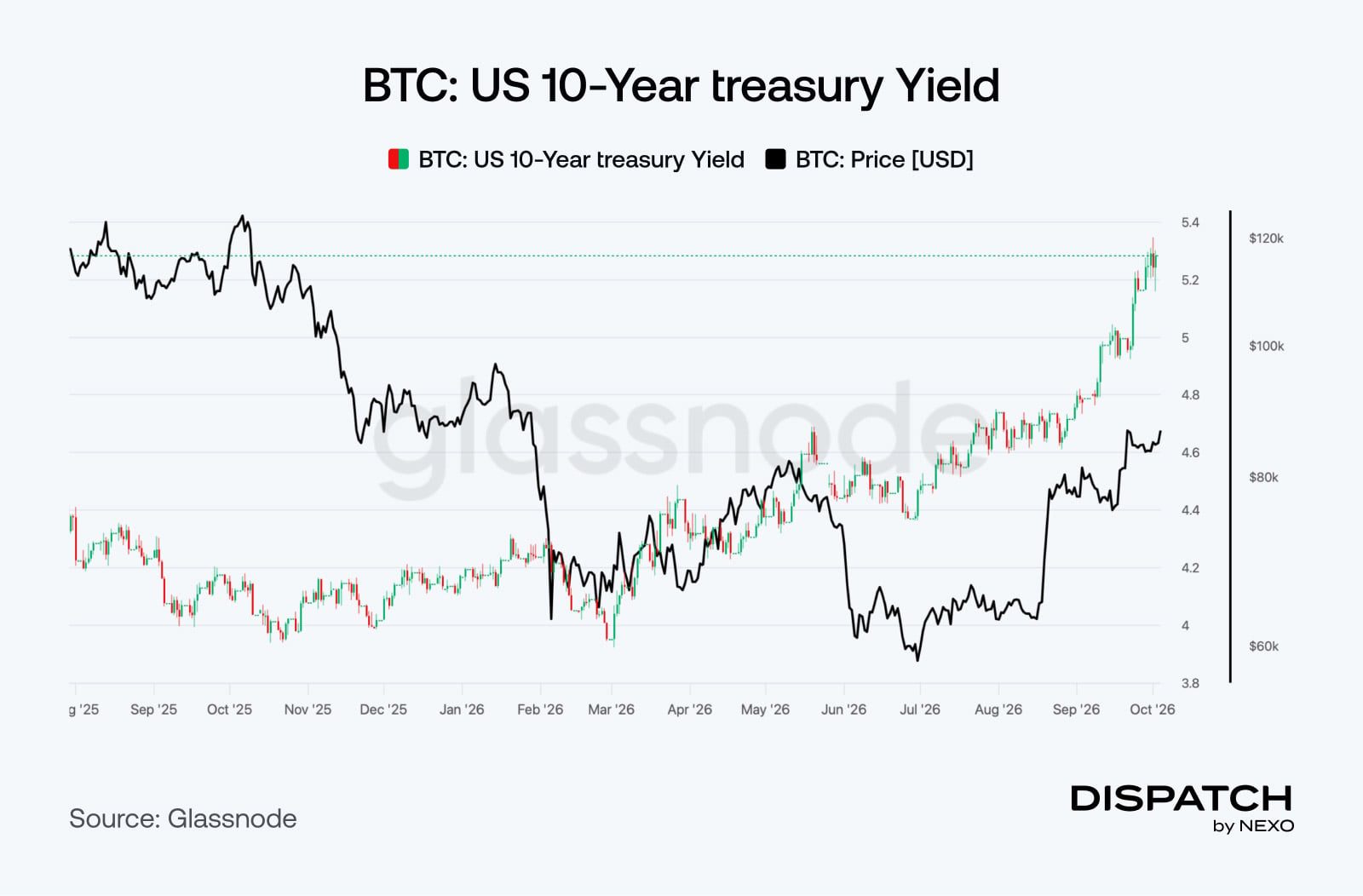
For all the tailwinds in the macro backdrop, an unusual dynamic is playing out in the U.S. bond market, one of the world's largest. A weak September jobs report has cut the odds of a Fed rate hike in October to around 20%, yet Treasury yields have not followed. The 10-year yield, the rate the U.S. government pays to borrow for a decade, rose to 5.28% on October 2, the day of the report, near the 5.34% high it touched a day earlier, its highest level since 2002. For Bitcoin, what appears to matter is less how high yields go than why they are rising. With inflation and a growing supply of bonds, rather than Fed rate hikes, driving the move, it has so far coincided with gains, not losses. Higher yields normally weigh on Bitcoin, because investors can earn more from government bonds. Instead, Bitcoin rose about 43% over the quarter, while the 10-year yield climbed from 4.47% to 5.29%.
The move is global: the German 10-year yield topped 3.6%, and the UK 30-year gilt yield crossed 6% for the first time since 1998. Behind it are three forces. Inflation: oil near $100 amid the Iran conflict adds to price pressure, and core PCE is still 3.0%. Inflation erodes the fixed payments bondholders receive, so they demand a higher yield. Rates: the Fed raised its target 25 basis points on September 16, to 3.75%-4.00%. Longer-dated yields build on the policy rate plus where investors expect it to go. Supply: the Congressional Budget Office sees debt held by the public rising from 101% of GDP to 120% by 2036. More bonds than buyers readily absorb push prices down and yields up.
Debt is part of this, not all of it. By Bianco Research's measure, total borrowing relative to GDP is near its level of 20 years ago, and combined government and corporate interest costs, at 3.8% of GDP, are only slightly above the 3.5% long-run average, so growth and persistent inflation matter as much as deficits. That yields held firm as hike odds fell points to inflation, growth and bond supply rather than near-term Fed policy.
That distinction matters for Bitcoin, because the last major rise in yields, in 2022, was a Fed story. The Fed raised rates aggressively, with several 50- and 75-basis-point hikes, the 10-year yield more than doubled, and Bitcoin fell 64% amid crypto blowups. This time the response has been different. Based on Glassnode data, the 10-year yield rose 49 basis points from the September 8 close to October 2, while Bitcoin gained 7.7%. Bitcoin still reacts to sharp moves, falling 1.3% on average on the four days since July 1 when the yield jumped 8 basis points or more, but the dips have not changed its direction. It closed October 4 near $86,500, capping its best quarter since late 2024.
Scarcity helps explain the resilience. Bitcoin's supply is fixed at 21 million coins, so no government or central bank can expand it. When yields rise on inflation and deficit financing rather than strong growth or Fed tightening, a fixed-supply asset outside any sovereign balance sheet answers a different question from a Treasury bond. August showed it: deficit and dollar concerns, sharpened by Treasury's wider buybacks, pushed the dollar index to three-month lows and Bitcoin up 21% in three sessions, the debasement trade, a bet on hard assets as currencies weaken. Gold has since slipped to near $4,150 from above $4,600, while Bitcoin trades above its late-August level.
The evidence so far is clear: Bitcoin is not simply moving opposite to Treasury yields. It has risen as yields climbed, and the reasons behind the climb, inflation and a growing supply of bonds rather than Fed rate hikes, are the conditions in which its fixed supply gives it a case bonds cannot make. The risk is a return of the 2022 pattern if the Fed raises rates again. With the Fed's two goals, stable prices and a strong job market, pulling in opposite directions, two events will show which way this is heading. This week's 10-year auction on Wednesday and 30-year auction on Thursday will show whether investors will buy government debt at the highest yields in decades. Next week's inflation report, the September CPI on October 14, is probably the best marker for the Fed: a hot reading would raise the odds of another rate hike and revive the pressure of 2022, and a soft one would ease it. One quarter is evidence, not proof, but for now the reason yields are rising has not worked against Bitcoin.
TradFi trends
Nvidia Hits a Record $5.7 Trillion
Nvidia shares reached a record $237.88 on Friday, their first high in more than four months, lifting the chipmaker's market value to roughly $5.7 trillion, the largest of any company and nearly double the roughly $3 trillion crypto market. The rally followed a $150 billion increase to Nvidia's buyback authorization on September 28, bringing the total to $235 billion, and a weak jobs report that cooled bets on a Fed rate hike and lifted the Nasdaq. Underneath sits demand: revenue of $96.2 billion last quarter, up 106% from a year earlier, with $108 billion guided for this one.
Ethereum
ETH’s 70% rally and what came with it
While Bitcoin posted its best quarter since late 2024, up about 43%, Ether surged about 70%, as U.S. Ethereum ETFs took in roughly $3 billion. The flip side of the rally may be thinner liquidity: Ether's market depth, the volume of orders near the current price, fell to 35%-45% of Bitcoin's from at least 60% a year earlier, according to CoinGecko. Ether remains liquid at close range, though, with most exchanges holding over $1 million in orders on each side. Staking exits also rose temporarily on one operator's precautionary withdrawals, and the queue has begun to ease. On the development side, the Glamsterdam upgrade begins testing on the Sepolia testnet on October 6.
The week's most interesting data story
The chart that shows the limits of policy
If the Big idea had too many moving parts, one chart makes the point simply: neither Treasury's buybacks nor the Fed's hike has stopped the climb in yields. After the U.S. Treasury announced larger bond buybacks on August 19, the 10-year yield dipped to 4.65% and was back above its starting level by August 21. It has since risen about 63 basis points, through the first enlarged buyback on September 10 and the Fed's hike on September 16. Treasury Secretary Scott Bessent has said he cannot set the equilibrium price; the buybacks aim to steady trading, not cap yields. That is no sign of a debt crisis, but it shows the limits of official control over long-term rates, which is part of why investors look at assets outside the system.
The numbers
The week’s most interesting numbers
$113,000 – Citi's new 12-month Bitcoin target, raised from $82,000, citing resumed ETF inflows and stronger crypto activity.
848,000 BTC – Bitcoin held by Strategy, its highest total ever, after adding 334 BTC last week – more than 4% of Bitcoin's 21 million supply cap.
102.5 – The U.S. Dollar Index on Monday, its highest in nearly 18 months, while Bitcoin held around $86,000.
Hot topic
What the community is discussing
Bond dynamics in Europe
Bitcoin’s start in Uptober?
Solana continues to rival Ethereum for on-chain capital settlement.
Dispatch is a weekly publication by Nexo, designed to help you navigate and take action in the evolving world of digital assets. To share your Dispatch suggestions and comments, email us at [email protected].
This content is for informational purposes only and does not constitute investment, legal, or tax advice. Crypto assets are highly volatile and their value can go up or down significantly, including to zero. Past performance and historical correlations are not indicative of future results. Nexo has a commercial interest in the adoption of digital assets.
The availability and use of any products or services made available through Nexo US LC (“Nexo US”) are subject to the applicable terms and conditions on the Nexo US platform. This message is for informational purposes only and does not constitute financial, investment, legal, or tax advice. Any decision you make based on this information is solely your responsibility. Nexo US provides the user interface and routes client instructions to third-party service providers. Investment advisory services for eligible digital asset strategies are provided by Gravitalix Financial, LLC (“Gravitalix”), an investment adviser registered with the U.S. Securities and Exchange Commission. Registration with the SEC does not imply a certain level of skill or training. Please review Gravitalix’s Form ADV and related disclosures carefully before investing. Digital assets are not money or legal tender, are not backed by any government or central bank, and are not insured or guaranteed by any governmental or private insurance scheme (including FDIC or SIPC). Any rates, yields, or rewards displayed in the Nexo US app or related materials are subject to change, may be reduced or discontinued at any time, are not guaranteed, and may not be available in all jurisdictions or for all clients. Past performance is not indicative of future results.
Digital Asset services are provided by Bakkt Financial Solutions I, LLC (NMLS ID 1890144) through a software licensing agreement between Bakkt Financial Solutions I, LLC (“Bakkt”) and Nexo US LLC. Bakkt is not a registered broker-dealer and is not a member of SIPC or FINRA. Digital assets are not FDIC- or SIPC- insured. Bakkt Financial Solutions I, LLC is licensed to engage in virtual currency business activity and money transmission by the New York State Department of Financial Services. Digital asset borrowing requires sufficient collateral. Failure to maintain collateral value due to market volatility may result in the liquidation of your assets. Please ensure that you fully understand the risks involved before trading. See here for Bakkt Licenses and Bakkt Disclosures. If you no longer wish to receive marketing communication from us, including product updates, industry news and exclusive promotions, click here.